
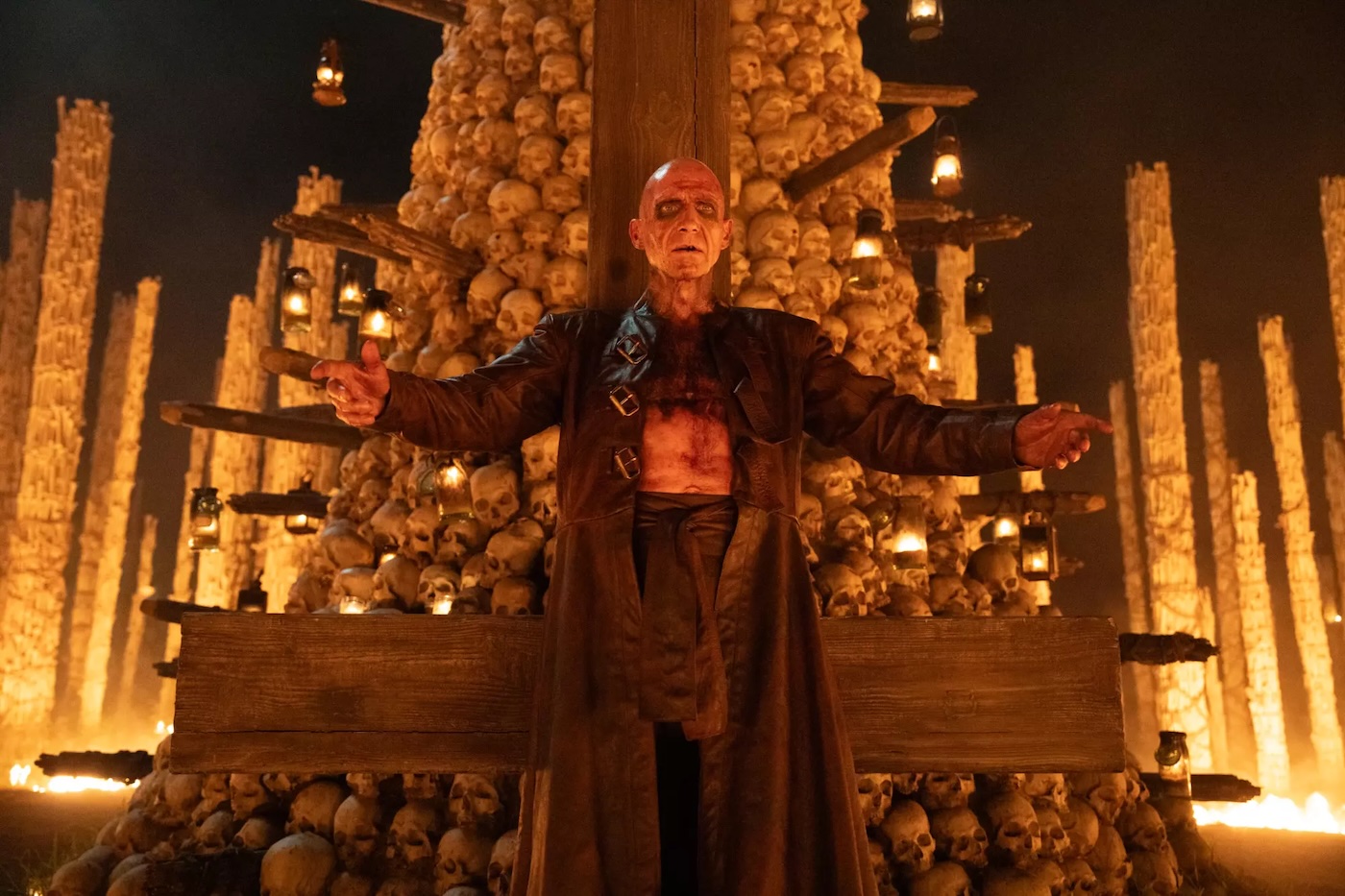
The horror generated by the infected takes a backseat to the evil that men do in Nia DaCosta’s “28 Years Later: The Bone Temple.” The “Candyman” director leaves her mark on the franchise by intensifying the violence, adding brilliant needle drops, and bringing her frequent collaborator, cinematographer Sean Bobbitt (a Corpus Christi native), on board, moving away from the lo-fi aesthetic for a more traditional look. Picking up where last year’s “28 Years Later” left off, the story’s focus shifts to 12-year-old Spike (Alfie Williams), who has fallen into the hands of Satanists led by the charismatic Sir Lord Jimmy Crystal (Jack O’Connell). Meanwhile, Dr Ian Kelson (Ralph Fiennes) continues researching the rage virus, making progress while treating infected Alpha, Samson (Chi Lewis-Parry). As anticipation builds, the zenith arrives, leaving the perfect setup for the final installment.
I’ll spare you the backstory of the previous chapter, which ended with 12-year-old Spike surrounded by a horde of the infected, only to be rescued by tracksuit-wearing Sir Lord Jimmy Crystal and his blonde-wig-wearing cronies, the “Jimmies.” The devil-worshiping gang, who refer to Satan as “Old Nick,” except for Jimmy Crystal, who uses the term “Father,” are also called “Fingers,” with each member representing an appendage of Satan and the seven deadly sins. They don’t drink “milk-plus” like the droogs in “A Clockwork Orange,” but they do commit acts of “ultra-violence,” referring to killing someone as an act of “charity.”
Spike is reluctantly initiated into the gang as gallons of blood are spilled, hinting that DaCosta is determined to make the fourth film of the franchise the most brutal. Despite watching the “king of the infected” eat brains from a skull, nothing compares to the nauseating sound of someone being skinned alive while flesh hits the ground. As Jimmy Crystal would say, “How’s that?” It’s a Clive Barker moment where Pinhead’s appearance would have felt at home.
The practical effects by Sam Conway and his team are gruesome, and Flora Moody’s makeup effects, working closely with DaCosta, transform the film’s scariest villain, Alpha male Samson (played by 6-foot-8 actor Chi Lewis-Parry), into a more human version of the rage-filled infected baddie while maintaining his menacing presence.
Alex Garland’s story features a major turning point as the relationship between Kelson and Samson develops into a friendship. The good doctor becomes the Alpha’s pusherman, as Samson becomes addicted to Kelson’s morphine and xylazine-laced blowdarts. While under sedation, a mixture of antipsychotics is given to Samson, in the hope of reaching the human who once was, before infection. The poignant moment is underscored by Duran Duran’s “Ordinary World,” as DaCosta manages to turn what could have been fodder for MST3K into a deeply felt scene that brings hope to the table.
Duran Duran plays a prominent role in the film as Kelson reveals his love for the English pop band—“Girls on Film” and “Rio” are featured—and we hear needle drops of Radiohead’s “Everything in Its Right Place” and the familiar “‘In The House, In A Heartbeat’ by John Murphy, first heard in “28 Days Later,” which has become the unofficial franchise theme. The film’s most memorable moment incorporates Iron Maiden’s “The Number of the Beast,” transforming the menacing Jimmies into Schulz Satanists—devil worshipers who dance like the Peanuts gang.
Eventually, Jimmy Crystal and Dr Kelson cross paths, setting up a showdown between O’Connell and Fiennes, which is just as good as Michael B. Jordan’s confrontation with the English actor as the charismatic and menacing vampire Remmick in “Sinners.” Except here it’s mind over muscle in a battle of wits between good and evil.
Another standout performance comes from Erin Kellyman as Jimmy Ink, the smartest Finger, who begins to see through Sir Lord Jimmy Crystal’s BS. She takes Spike under her wing, protecting him from the self-proclaimed son of Old Nick. I would love to see a Jimmy Ink origin story, but I’ll settle for her return in the final chapter.
Hildur Guðnadóttir ties the film together with a suspenseful score that sounds like a ticking time bomb, blended with a tiger’s roar, as it builds to a crescendo. At other times, the somber chords evoke a sense of melancholy.
The bar for horror films this year has been set incredibly high by Nia DaCosta. She has revitalized Danny Boyle’s franchise, and in my opinion, this fourth installment is the best of the series. “28 Years Later: The Bone Temple” is this year’s “Sinners.” Can we have Jack O’Connell in at least one horror film each year?
(3 ½ stars)
Now showing in theaters
This <a target=”_blank” href=”https://fortworthreport.org/2026/01/19/28-years-later-the-bone-temple-review-nia-dacosta-revitalizes-the-franchise-with-the-best-of-the-series/”>article</a> first appeared on <a target=”_blank” href=”https://fortworthreport.org”>Fort Worth Report</a> and is republished here under a <a target=”_blank” href=”https://creativecommons.org/licenses/by-nd/4.0/”>Creative Commons Attribution-NoDerivatives 4.0 International License</a>.<img src=”https://i0.wp.com/fortworthreport.org/wp-content/uploads/2021/04/cropped-favicon.png?resize=150%2C150&quality=80&ssl=1″ style=”width:1em;height:1em;margin-left:10px;”>
<img id=”republication-tracker-tool-source” src=”https://fortworthreport.org/?republication-pixel=true&post=375117&ga4=2820184429″ style=”width:1px;height:1px;”><script> PARSELY = { autotrack: false, onload: function() { PARSELY.beacon.trackPageView({ url: “https://fortworthreport.org/2026/01/19/28-years-later-the-bone-temple-review-nia-dacosta-revitalizes-the-franchise-with-the-best-of-the-series/”, urlref: window.location.href }); } } </script> <script id=”parsely-cfg” src=”//cdn.parsely.com/keys/fortworthreport.org/p.js”></script>