
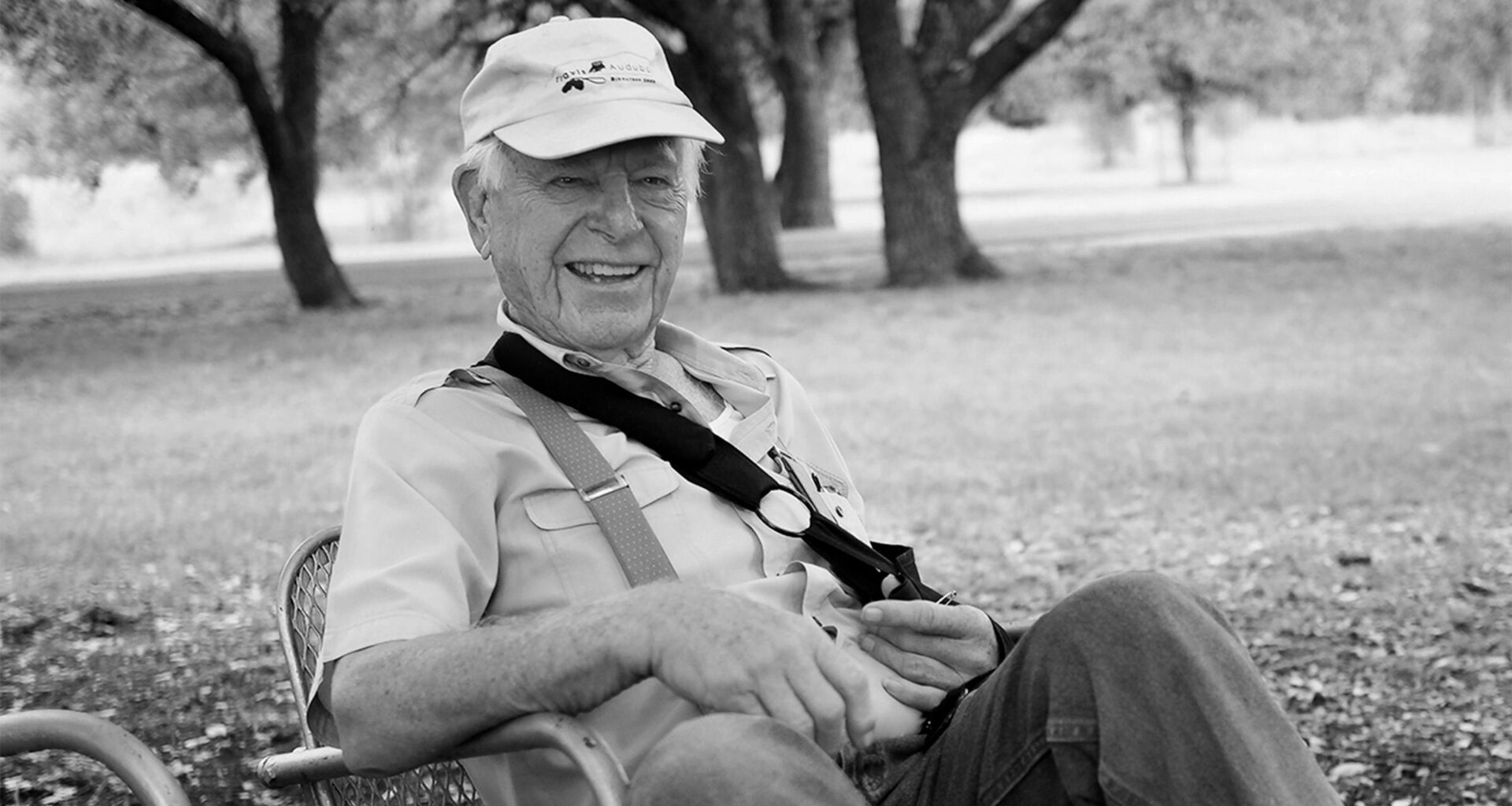
The next time you notice a Hill Country pasture mostly devoid of ashe juniper (also known as Texas cedar) and instead rippling with native grasses, remember J. David Bamberger.
Bamberger—who grew up poor in Ohio, worked as a door-to-door vacuum cleaner salesman, then made his fortune as an executive at Church’s Fried Chicken—died early Saturday. He was 97 years old.
Bamberger used the fortune he earned as a fried-chicken restaurateur to fund his life’s work: buying what he believed was the “sorriest” piece of property in Blanco County and nurturing it back to health. Springs began to flow, plants flourished, and wildlife returned. Today, Selah, Bamberger Ranch Preserve is a 5,500-acre oasis southwest of Johnson City, where students come for field trips, and members of the public can tour or take classes in land stewardship.
In 2002, he and his then-wife, Margaret, created a foundation to prevent any future development of the ranch, and he later built the Margaret Bamberger Research and Education Center on site to collect and disseminate information about species that inhabit the ranch.
Bamberger often said he wanted to be remembered not for the fried-chicken empire he built but for his work at Selah, which he named after the biblical word that’s interpreted as a pause. He worked to show others that by removing invasive species, replanting native grasses and trees, and managing livestock more carefully, even the most damaged lands could rebound. He also spent decades working to protect the Texas snowbell (an endangered flowering shrub endemic to the Edwards Plateau), and built his own bat cave (which he called a “chiroptorium”), where hundreds of thousands of bats now spend their summers, gobbling up mosquitoes and crop pests for miles around.
Bamberger was born in Massillon, Ohio, in 1928. He spent much of his childhood in a small rural shack that for years lacked electricity or running water, and his father died in an industrial accident when he was fourteen. His mother, Hester, instilled in him a respect for the natural world: when he was a child she taught him how to gather nuts and edible plants, and at one point she gave him a copy of Pleasant Valley, by Louis Bromfield. That book, which documented Bromfield’s experience experience buying and revitalizing farmland in Ohio, had asignificant impact on Bamberger.
“Mom just taught me to respect [Mother] nature, to work with her, to love her. She passed that love of the natural world on to me, and it grew in me,” he said in an interview in 2019. Bamberger had a knack for getting along with people, too, and said he learned more in the seventeen years he spent in the Kirby vacuum cleaner business than he did while attending Kent State University.
“The biggest thing I learned was how to handle rejection,” he once told me of that job. “When you’re selling door-to-door, you’ve got to knock on a lot of doors and talk to a lot of people, and you’re going to get turned down. It applies to your health, your economics, your family, everything.”
In 1947, Bamberger married his high school sweetheart, Donna, and a few years later the couple moved to San Antonio, where they raised their three children—David, Deena, and Douglas—over a marriage that lasted 45 years. It was in San Antonio that Bamberger met Bill Church Jr., whose father owned a few small chicken restaurants. Church Jr. stepped in to take over the family business a few years after his father died; Bamberger soon joined him, and they began opening more locations of Church’s Fried Chicken. (In 2019, the company rebranded as Church’s Texas Chicken.)
“In 1969, days after the Church’s company went public, Bamberger purchased his worn-out ranch in Blanco County. At the time, there wasn’t much water in the area: the land was overgrown with nonnative species, and it didn’t support much wildlife. Bamberger quit his job as executive vice president at Church’s in 1973, then returned in 1983 as a board member, but he left for good in the late 1980s to focus on his true love: that decrepit piece of land.
After he removed much of the nonnative species and planted native grasses, water began to flow, and wildlife began to return. “Now there are lakes you can swim in, creeks that run, and trees that weren’t here then,” Bamberger said in 2019. He and his second wife, Margaret, implemented an educational component to the ranch business in the 1990s, adding workshops for adults in land stewardship, water management, wildlife management, and native grasses, as well as summer camps for children. They also began offering public tours.
Bamberger was frugal, driving around in an old pickup truck and coasting in neutral whenever possible. He furnished buildings at the property with hand-me-down or given-away items. He taught landowners that they didn’t need millions to help conserve and protect their land. And he loved to tell a story, sometimes stretching it slightly—as became clear when we worked together on My Stories, All True, a book I wrote about his life. His bright blue eyes twinkled when he did.
He might describe the time he accidentally stood up Lady Bird Johnson for dinner, or how he trained the catfish in a pond at Selah to rise to the surface in front of an audience. He might tell about the time he traveled to Australia on Church’s business, during which his suit got stuck at the cleaners, leaving him to conduct a TV interview in his boxers (shot, of course, from the waist up). He also shared personal experiences, like how he dealt with one of his son’s addiction problems, how his first marriage ended in divorce, and how he struggled when he returned to Church’s Chicken after a ten-year absence, and the loss of his second wife, Margaret, who died in 2009 of cancer. Bamberger said he enjoyed his high-rolling days as corporate executive, when he flew in a corporate jet and mingled with the likes of Ann Richards and Sam Walton, but grew tired of that lifestyle.
His heart was always in Selah, where he lived at the time of his death with his third wife, Joanna, whom he married in 2023. They spent much of their time at the ranch, walking the property, hunting for projectile points left by Native Americans, joking, discussing politics, and admiring the thriving landscape he nurtured for so many years.
“I’d like to think it’s not my days as a door-to-door man or my days in the fried-chicken business, but how someone can start out with nothing and—through living an enthusiastic and optimistic life—be able to initiate something and finish something,” he said, when asked what he wanted most to be remembered for. “I never inherited a penny. I want Bamberger Ranch Preserve, these 5,500 acres, to influence the life of other landowners and young people.”
That dream—to have an impact on future landowners, and on Texas at large—has already been realized. Andy Sansom met Bamberger in the early eighties, when Sansom, then director of the Nature Conservancy in Texas, was working to acquire Bracken Cave, home to the largest bat colony in the world. Their meeting fanned a friendship—and sparked Bamberger’s interest in bats.
“My relationship with him is a significant part of my realization that conservation in Texas must largely occur on private lands,” Sansom said in a 2023 interview. “We cannot buy enough land in Texas to protect the landscape. Only by the efforts of J. David Bamberger do we have a chance of protecting our watersheds, aquifer recharge areas, and wildlife habitats.” (Samson also noted that a little luck figured into Bamberger’s purchase of Selah and his ability to bring water back to it: In 1969, nobody realized that Bamberger’s ranch sat atop a perched aquifer—one that occurs above the regional water table, he said.)
Others who knew him reflected similar sentiments. Carter Smith, a former executive director of the Texas Parks and Wildlife Department, described Bamberger as “an artesian well of influence and inspiration” throughout the Hill Country, noting that people came from all over to listen and learn from him. That resulted in an impact far beyond Bamberger’s own fence line, Smith said.
“It’s hard to imagine a single private landowner who’s had more of an impact on stewardship across Texas,” Smith continued. “The reality is, if we’re going to accomplish conservation at any kind of scale, we’ve got to work cooperatively and collaboratively with private landowners. Bamberger helped break down a lot of barriers to that in the 1990s.”
Weldon “Rusty” Yates, chairman of the board of Selah, Bamberger Ranch Preserve, called Bamberger’s educational outreach to children, especially those who have no access to nature, his most important work. “I don’t know how you pay tribute to a man like J. David Bamberger,” Yates said. “Where do you start? Successful entrepreneur? Visionary land steward? Generous philanthropist? For me, he’s been a mentor and a friend, and we all know he’s an entertaining raconteur. I’ve got to describe him as a force for nature.”
And Margie Crisp, an artist, a writer, and the daughter of Bamberger’s second wife, Margaret, said Bamberger bridged the gap between professional biologists and traditional landowners. “I think one of his greatest contributions has been to give people the awareness that they have the tools in their hands for ecological restoration to the Hill Country,” Crisp said. “He simplified it to the catchphrase, ‘If you cut the cedars the springs will come,’ but the story was more complex. You had to spend time plowing and digging and planting native grasses. But because he was able to distill the message into that concept, it was relatable to a huge number of people.”
Bringing Church’s Texas Chicken to prominence might be the endeavor with which Bamberger is most associated. But his impact on Texas ecology and conservation remains a contribution to his state that won’t soon be forgotten.
When you buy a book using a link on this page, a portion of your purchase goes to independent bookstores and Texas Monthly receives a commission. Thank you for supporting our journalism.
Read Next