
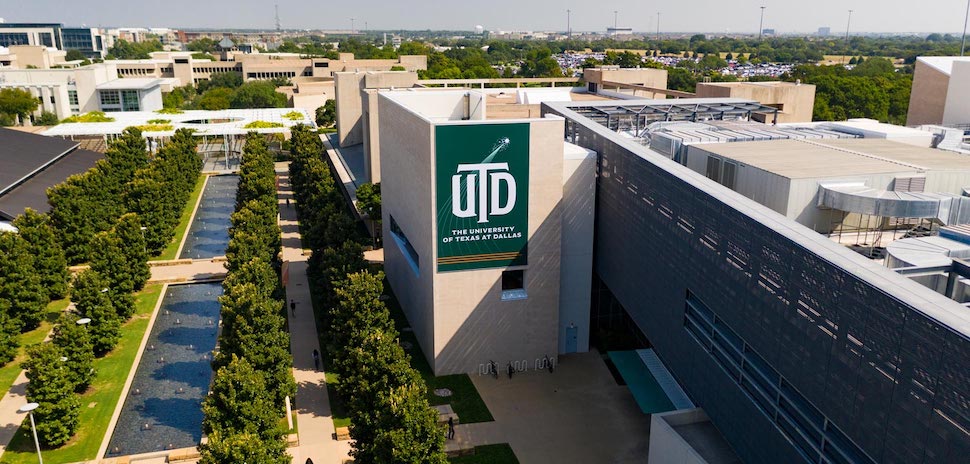
UT Dallas received $40 million in 2023 from the Harry W. Bass Jr. Foundation that will create new opportunities for students, faculty and the broader community. In recognition of the gift, the School of Arts, Humanities, and Technology, is now the Harry W. Bass Jr. School of Arts, Humanities, and Technology. [Photo: UTD]
Snagging its third federal grant in six months, Dallas-based Solidion Technology (Nasdaq: STI) has been awarded a grant from the U.S. Army’s STTR Program to develop an advanced fiber-based electronic battery system built on a coaxial carbon nanotube yarn architecture.
The advanced battery technology solutions provider said research on the project will be conducted jointly with the University of Texas at Dallas. The grant’s amount was not disclosed.
Solidion described its innovation as “a flexible, rechargeable lithium-ion battery in fiber form.” A coaxial carbon nanotube yarn serves as both the structural core and current collector of the anode, and is integrated with Solidion’s silicon as the high-capacity anode material, the company said.
“Advancements in advanced fiber-based electronic battery systems are a part of the larger commitment by the Department of War to innovate and collaborate with cutting edge U.S. companies such as Solidion,” CEO Jaymes Winters said in a statement.
Earlier grants for electrochemical manufacturing of graphite, nuclear reactor solution
In early December, Solidion received a grant to advance its R&D for the electrochemical manufacturing of high-performance graphite based on biomass-derived carbon. That grant was funded by ARPA-E, the Advanced Research Projects Agency, from its highly competitive OPEN program.
Three weeks ago, the company received a U.S. Department of Energy grant to scale up the synthesis of a carbon-nanosphere material, which will be used as an anti-corrosive additive in molten-salts-based heat transfer fluids for advanced molten salt nuclear reactors. Solidion had previously received a 2025 R&D 100 Award in partnership with Oak Ridge National Laboratory for innovation in electrochemical graphitization in molten salts (E-GRIMS).
Headquartered in Dallas with pilot production facilities in Dayton, Ohio, Solidion’s core business includes manufacturing of battery materials and components, as well as development and production of next-generation batteries for energy storage systems, including including UPS systems serving the AI data center market and electric vehicles for ground, aerospace, and sea transportation. Solidion said it holds a portfolio of over 525 patents, covering innovations including high-capacity, silane gas free and graphene-enabled silicon anodes, biomass-based graphite, advanced lithium-sulfur, and lithium-metal technologies.
Don’t miss what’s next. Subscribe to Dallas Innovates.
Track Dallas-Fort Worth’s business and innovation landscape with our curated news in your inbox Tuesday-Thursday.
R E A D N E X T

The federal ARPA-E award adds to the Dallas-based company’s momentum as it advances next-generation battery materials and builds out new power tech for AI data centers.

Combining cutting-edge research and real-world applications, the UT Dallas professor transforms public health with innovations in detection technology, including “a check engine light” for the human body. In collaboration with EnLiSense, the company she cofounded, Dr. Prasad combines chemistry with software and hardware to bring the technology to life as market-ready devices.

At the recent 76th Annual Technology & Engineering Emmy Awards in New York City, Topaz Labs got a big win in the category of AI Image/Video Enhancement for High Quality TV Catalog Restoration.

The Austin-based energy startup—co-founded and led by Zach Dell—offers fixed-rate energy plans with home battery backup. Its $1 billion Series C will fund national expansion and a new factory at a former newspaper press site.

Dallas is aging faster than ever, with seniors facing rising challenges of isolation, health, and care. Technology, when designed with empathy, can bridge these gaps – connecting families, empowering caregivers, and enabling prevention. By building tools with empathy, we can transform elder care from survival to peace of mind and joy.