
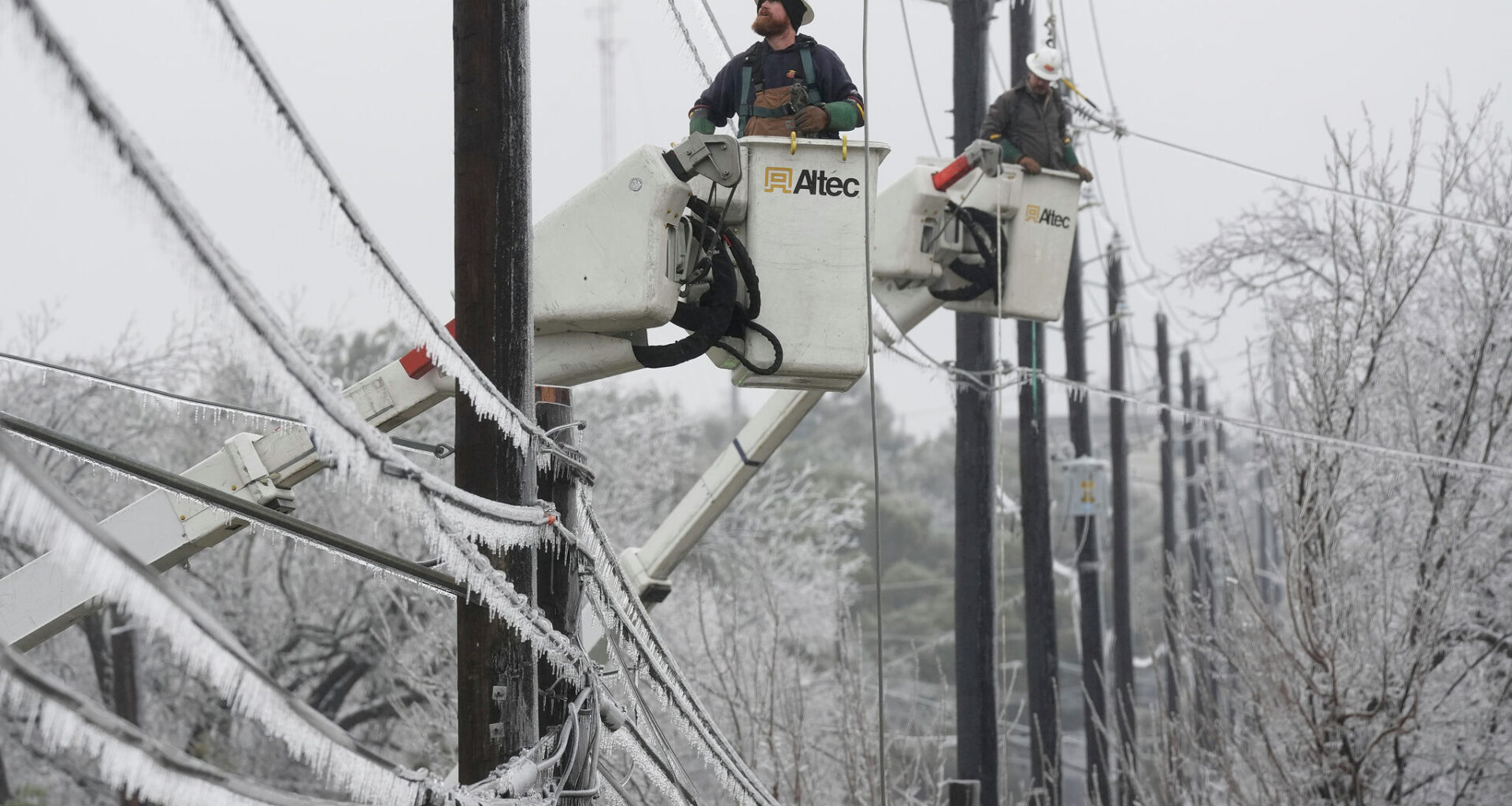
Austin Energy linemen work to restore power on ice-covered lines during a February 2023 ice storm. Ice and snow in this weekend’s forecast winter storm across Texas is more likely to cause power outages than supply, the statewide grid operator says.
Jay Janner/Austin American-Statesman file photo
With a powerful cold snap forecast to be clamping down on Texas this week, Texans still jumpy about deadly blackouts during a deadly deep freeze five years ago want to know if the power is staying on this time.

No worries, the statewide grid operator says.
Article continues below this ad
“Based on expected weather conditions, ERCOT anticipates there will be sufficient generation to meet demand,” a spokesperson for the Electric Reliability Council of Texas said. “ERCOT will continue to deploy all available resources to manage the grid reliably and coordinate closely with the Public Utility Commission, generation providers, and transmission utilities.”
Weather forecasts on Tuesday were predicting an arctic cold front would be dipping south into Texas by Friday evening with a widespread freeze expected to settle into San Antonio, Austin and Houston by Saturday night and Sunday morning.
READ MORE: 2021 winter storm exposed grid weakness; part of Texas’ solution is being built near S.A.
If there are outages, they’re more likely to be caused by ice or snow pulling down power lines. As of Tuesday evening, chances were increasing for freezing rain or sleet by Saturday across Central and South Texas.
Article continues below this ad
ERCOT’s forecast shows that as temperatures fall across the state Friday, energy demand will increase. But with supply expected to top 101,000 megawatts at that time, the forecast demand of 61,000 megawatts late Friday and early Saturday will not strain the grid.
Peak demand for this storm is expected about 8 a.m. Monday, when demand will jump to nearly 80,000 megawatts — near a record set last February. But the grid operator’s expected 95,811 megawatts of supply will be more than enough to handle it. In fact, ERCOT’s modeling shows supply often surpassing demand by as much as 20,000 megawatts through the weekend.
It takes about 1 megawatt to power 250 average Texas homes on a cold day.
In Austin, City Council members Tuesday asked Austin Energy for its outlook for the weekend. Interim General Manager Stuart Reilly said forecasts were calling for “a decent chance of winter precipitation” but that it was unlikely to be as bad as 2021 or during a devastating ice storm in 2023. That year, Austin suffered widespread local power outages as ice-laden trees fell on power lines, causing days-long outages.
Article continues below this ad
“We have additional crews on, on standby and on call, and we’ll be ready to respond if we need,” Reilly said.
The Electric Reliability Council of Texas and CPS Energy, whose crews are seen here during the state grid’s failure in Feburary 2021, both are confident in their abilities to keep the lights on during a cold snap settling into Texas later this week.
Kin Man Hui/Staff photographer
In San Antonio, CPS Energy has said it’s confident it has sufficient capacity to keep up. The city-owned utility said in a November winter preparedness update that new generation added to its portfolio in the past year pushed capacity beyond this winter’s expected demand. No CPS officials were available Tuesday to comment on preparations in case of ice or snow.
In ERCOT’s earlier Monthly Outlook for Resource Adequacy report for January, the grid operator said the risk of supply shortages are highest from 6 a.m. to 9 a.m., with the most risk around 8 a.m. Even then, it said, the probability of an energy emergency was just 1.4%.
Article continues below this ad
Morning and early evening hours have consistently strained the grid in recent winters. That’s because the state’s plentiful solar generation has yet to come online in the early morning hours, which is when residents are waking up and cranking their heat to warm their home. In the evening, solar and wind generation also are declining, leaving traditional generation and batteries to carry the load.
RELATED: Is CPS ready for winter energy demand? Here’s what we know.
In a December report, ERCOT said battery storage on the grid is increasingly key in reducing the risk of an energy emergency because their stored energy can be deployed during high-risk hours. The grid operator now has monthly energy storage capacity exceeding 17,600 megawatts.
The current wintertime record for peak demand was set nearly a year ago, when the grid served 80,500 megawatts during sub-freezing temperatures in mid-February. The previous record of 70,800 megawatts was set in January 2024. The demand records don’t include the February 2021 storm because ERCOT doesn’t know how high demand was before the grid crashed, leaving thousands of Texans in the dark for days and leading to nearly 250 deaths.
Article continues below this ad
The grid operator has been preparing for winter demand by hosting educational workshops and online informational sessions. On Dec. 2, it began evaluating the adequacy of generation resources and transmission facilities. Last summer, ERCOT said, it evaluated 4,079 energy resources and transmission service providers. The number of inspections done in preparation for this winter wasn’t available Tuesday.
Chaya Tong contributed to this report.