
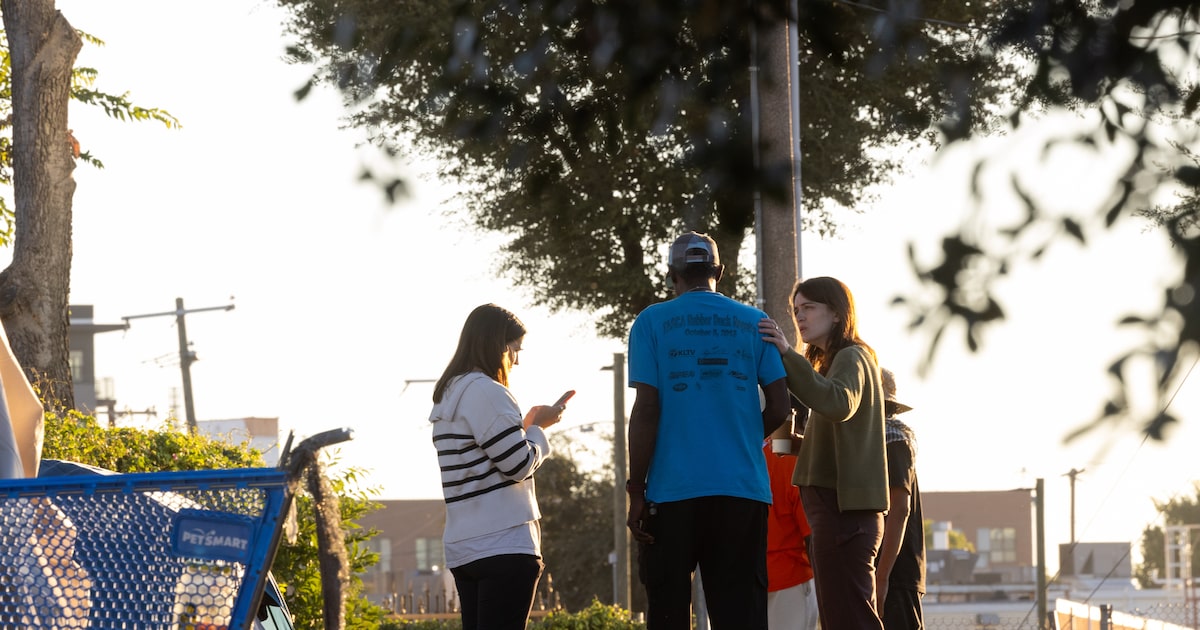
More than a year ago, a coalition of organizations began clearing homeless encampments in downtown Dallas and connecting people living there with mental health treatment and stable housing.
Now, the Street to Home Initiative is looking to launch a $28 million second phase aimed at helping 1,100 homeless people across Dallas County while preventing tents from returning to downtown streets, businesses and parks.
The county Commissioners Court this week unanimously approved $10 million for that effort, matching the $10 million pledged by the Dallas City Council last month. But with their support, county officials pressed Housing Forward – the region’s lead homeless response agency that manages the initiative – for proof this public investment will produce lasting results.
Since the initiative launched in July 2024, service providers have cleared 250 tent encampments in the loop from the public library and City Hall to the Lorenzo Hotel, Housing Forward CEO Sarah Kahn said.
Breaking News
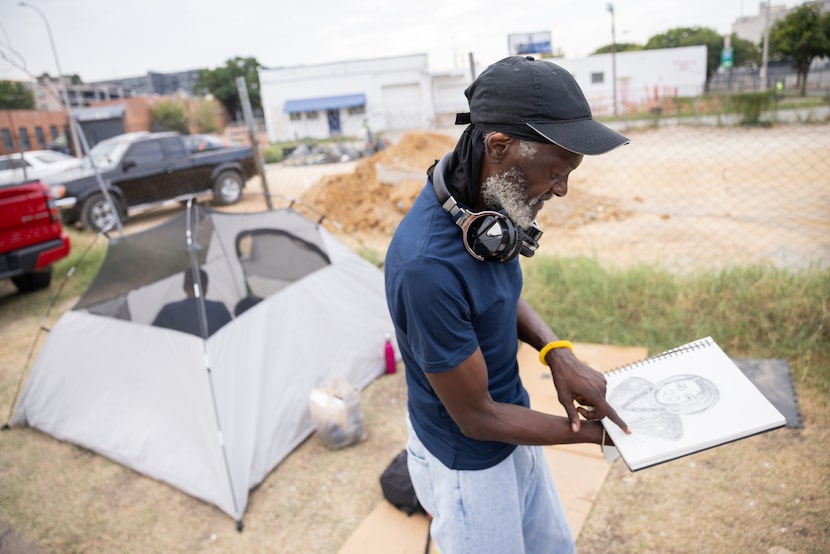
Booker Campbell looks at his sketches as he talks to Hannah Sims (not pictured), a trained social worker and project manager at Housing Forward, while staying on Marilla St. in Dallas on Tuesday, Aug. 20, 2024. Campbell is one of more than 100 people who’ve recently found a fresh start through the Street to Home operation to find permanent housing for people living outdoors in downtown’s public spaces.
Juan Figueroa / Staff Photographer
The work relied on a targeted ground approach. Behavioral health outreach teams met with homeless individuals and brought them to shelters, mental health treatment or institutional care – and eventually permanent housing.
“The result is that we are resolving street homelessness as opposed to moving it from block to block around the city and around the county,” Kahn said.
Unified push
Dozens of groups, from law enforcement to substance abuse treatment providers and civic organizations such as Downtown Dallas Inc., have collaborated over the past year, taking an aggressive approach toward street sleeping.
The city and county’s combined $20 million for phase two will be buttressed by $8 million in private donations, Kahn said.
The effort also will target high-risk encampments along the South Dallas transportation route for the FIFA World Cup, according to county officials, drawing hundreds of thousands of international soccer fans this summer.
The Street to Home Initiative has overlapped with the city of Dallas’ targeted homeless outreach, with city officials announcing last year that street sleeping will not be allowed.
In justifying the need for the county’s investment, county Commissioner Andrew Sommerman noted the burden homeless individuals are placing on the jail, Dallas Area Rapid Transit’s buses and trains, and the Parkland Hospital emergency department.
Last year, 6,004 homeless people brought to the jail accounted for 5,758 repeat bookings, according to data presented by Sommerman.
“Our jail is one of the most overrun homeless shelters that we have in Dallas County, although it is not done voluntarily,” he said.
Demands for results
Commissioners Elba Garcia and John Wiley Price questioned how repeat homeless bookings at the jail have persisted after such deep investments in homeless programs, including $2.5 million the county allocated to Housing Forward last year.
“The math ain’t mathing,” Price said. “I’m just having a real difficult time with this.”
Kahn said the need remains immense but connecting people with permanent housing is key. Of the 21,900 homeless individuals served by the network in the past five years, she said less than 10 percent have returned to the system after their year-long housing assistance expired.
This not only gives vulnerable people stability, she said, but also frees up shelters to accommodate more homeless clients in immediate need.
Garcia and Price pressed for the organizations to closely track data associated with the county’s $10 million investment, which alone is expected to get 450 people off the streets. But for how long?
“It’s extremely important that we help, but at the same time that we do it in a way that is accountable to Dallas County,” Garcia said.
Street to home
WHAT’S NEXT: The Street to Home Initiative is launching a $28 million second phase to house about 1,100 people countywide and prevent encampments from returning downtown.
WHO’S PAYING: The city and county each committed $10 million, with another $8 million coming from private donations.
TRACKING RESULTS: Dallas County commissioners approved the funding unanimously but demanded evidence the investment will pay off.
WHERE IT STANDS: Since 2024, outreach teams have cleared 250 downtown encampments and shifted focus to permanent housing to try to reduce strain on the county jail and hospitals.