
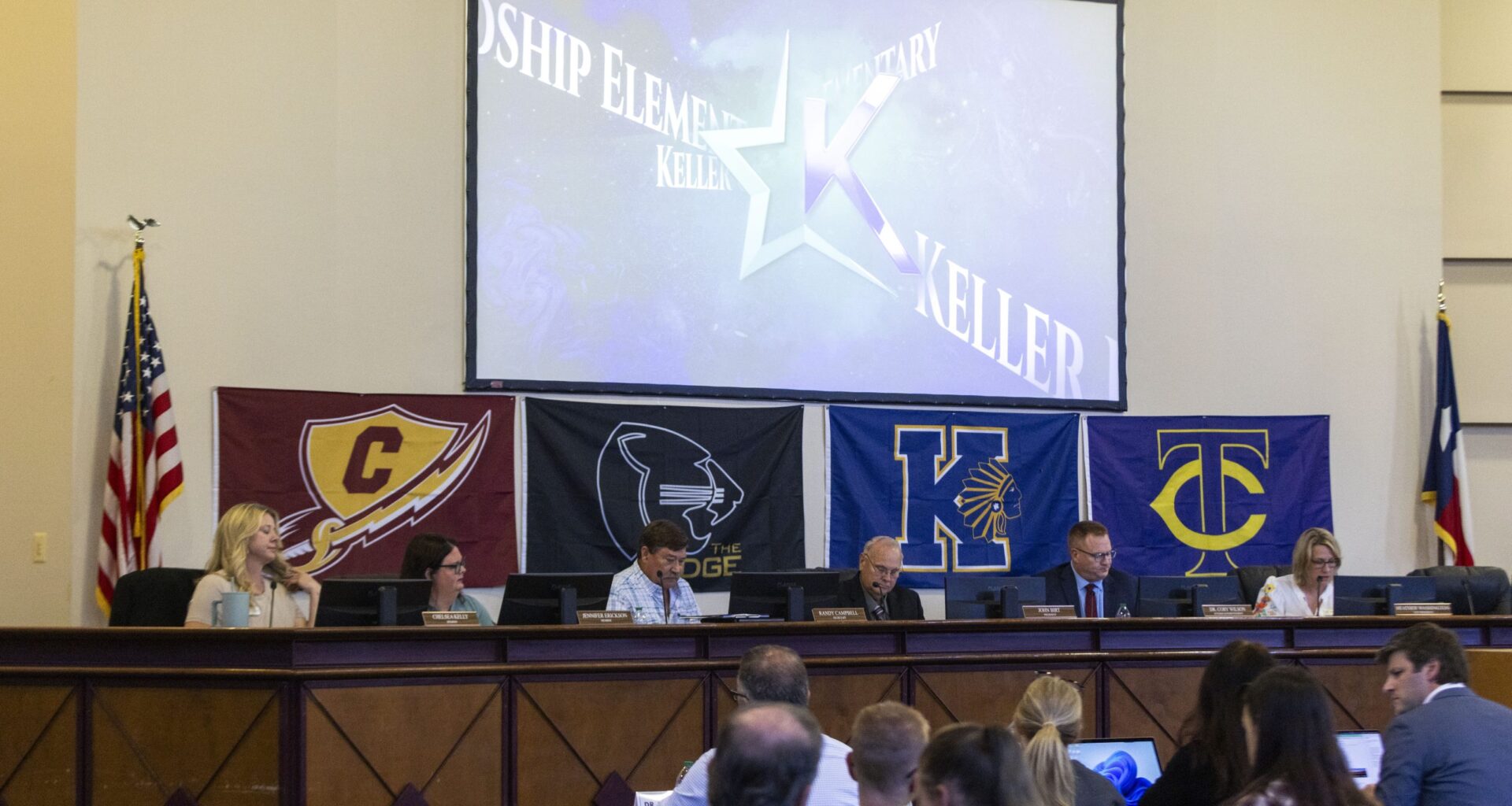
Keller ISD’s election system does not discriminate against Hispanic voters, a federal judge ruled as he dismissed a voting rights lawsuit against the district last week.
In a Jan. 15 decision, U.S. District Judge Reed O’Connor tossed the case and ordered the plaintiff’s legal team — the nonprofit arm of a firm that’s challenged election systems at school districts across North Texas — to explain why they shouldn’t be sanctioned for filing what he called a “baseless petition.”
Keller parent Claudio Vallejo sued the district last year arguing that its at-large voting system unlawfully dilutes Hispanic voter strength and prevents residents of color from electing candidates of their choice. Hispanic students make up nearly 25% of the district’s enrollment.
Vallejo’s attorneys from the Brewer Storefront, the nonprofit legal affiliate of Brewer, Attorneys & Counselors, sought to replace the district’s system where all voters select each trustee. The lawsuit sought a cumulative voting system, a method allowed under state law that gives voters multiple votes to distribute among candidates.
“We proposed cumulative voting as a lawful way to broaden participation and give community members a stronger voice in the political process,” said William A. Brewer III, a partner at Brewer Storefront. “The Voting Rights Act has served that goal for decades. It can continue to do so.”
O’Connor rejected that proposal, pointing to longstanding precedent that requires plaintiffs to show that communities of color are large and geographically concentrated enough to form a majority in a single-member district, a requirement Vallejo admitted he could not meet.
“His theory advocates exactly what the Supreme Court has decried as unlawful — the prohibited goal of mandating proportional representation,” O’Connor wrote.
The judge dismissed Vallejo’s constitutional claims under the 14th and 15th amendments, which alleged racial discrimination in how the district maintains its election system. O’Connor found no evidence of discriminatory intent or disparate impact.
He went further, calling the plaintiffs’ cumulative voting formula — which would allow a group with 12.5% of the voting-age population to elect a trustee — a “quintessentially race-conscious calculus” and “unlawful in context.”
O’Connor granted Keller ISD’s request for attorney’s fees and gave the Brewer Storefront’s legal team until Feb. 5 to justify why they shouldn’t face additional court sanctions.
“We respect Judge O’Connor and the court; however, we strongly disagree with the decision,” Brewer said. “Keller ISD serves a diverse community, yet its all-white school board oversees outcomes that disproportionately disadvantage students of color.”
Vallejo plans to appeal, Brewer said, “in pursuit of an outcome that is beneficial to the district, its students and its schools.”
The Brewer Storefront has previously challenged school board election systems in several North Texas districts — including Grand Prairie, Lewisville, Richardson and Eagle Mountain-Saginaw — arguing they dilute minority voting power. In Grand Prairie, the firm helped secure a 2014 settlement that shifted the district to a hybrid model with five single-member districts. Most recently, it prompted changes in Lewisville ISD, which is transitioning to a similar structure.
In Carrollton-Farmers Branch ISD, the Storefront won a 2015 lawsuit that led to the adoption of cumulative voting. The board now includes two Hispanic trustees.
If O’Connor proceeds with sanctions, those penalties could range from fines to formal reprimands.
Keller ISD’s attorneys maintain the lawsuit lacks a legal foundation and should be dismissed, according to court filings.
“Keller ISD was notified last week that the lawsuit filed against the district regarding our at-large election system was dismissed by the court,” district spokesperson Bryce Nieman said. “Our focus remains on serving all students within our community and ensuring that we continue to provide them with exceptional educational opportunities.”
The Keller case was first filed in February amid broader tensions within the district.
Last year, trustees proposed — then scrapped — a controversial plan to split Keller ISD in two. That move triggered lawsuits, public protests, the superintendent’s resignation and legislation from state lawmakers. It was cited in Vallejo’s original complaint as evidence of systemic disenfranchisement of Hispanic families west of Denton Highway.
Matthew Sgroi is an education reporter for the Fort Worth Report. Contact him at matthew.sgroi@fortworthreport.org or @matthewsgroi1.
At the Fort Worth Report, news decisions are made independently of our board members and financial supporters. Read more about our editorial independence policy here.
This <a target=”_blank” href=”https://fortworthreport.org/2026/01/21/federal-judge-dismisses-voting-rights-lawsuit-against-keller-isd/”>article</a> first appeared on <a target=”_blank” href=”https://fortworthreport.org”>Fort Worth Report</a> and is republished here under a <a target=”_blank” href=”https://creativecommons.org/licenses/by-nd/4.0/”>Creative Commons Attribution-NoDerivatives 4.0 International License</a>.<img src=”https://i0.wp.com/fortworthreport.org/wp-content/uploads/2021/04/cropped-favicon.png?resize=150%2C150&quality=80&ssl=1″ style=”width:1em;height:1em;margin-left:10px;”>
<img id=”republication-tracker-tool-source” src=”https://fortworthreport.org/?republication-pixel=true&post=377320&ga4=2820184429″ style=”width:1px;height:1px;”><script> PARSELY = { autotrack: false, onload: function() { PARSELY.beacon.trackPageView({ url: “https://fortworthreport.org/2026/01/21/federal-judge-dismisses-voting-rights-lawsuit-against-keller-isd/”, urlref: window.location.href }); } } </script> <script id=”parsely-cfg” src=”//cdn.parsely.com/keys/fortworthreport.org/p.js”></script>