
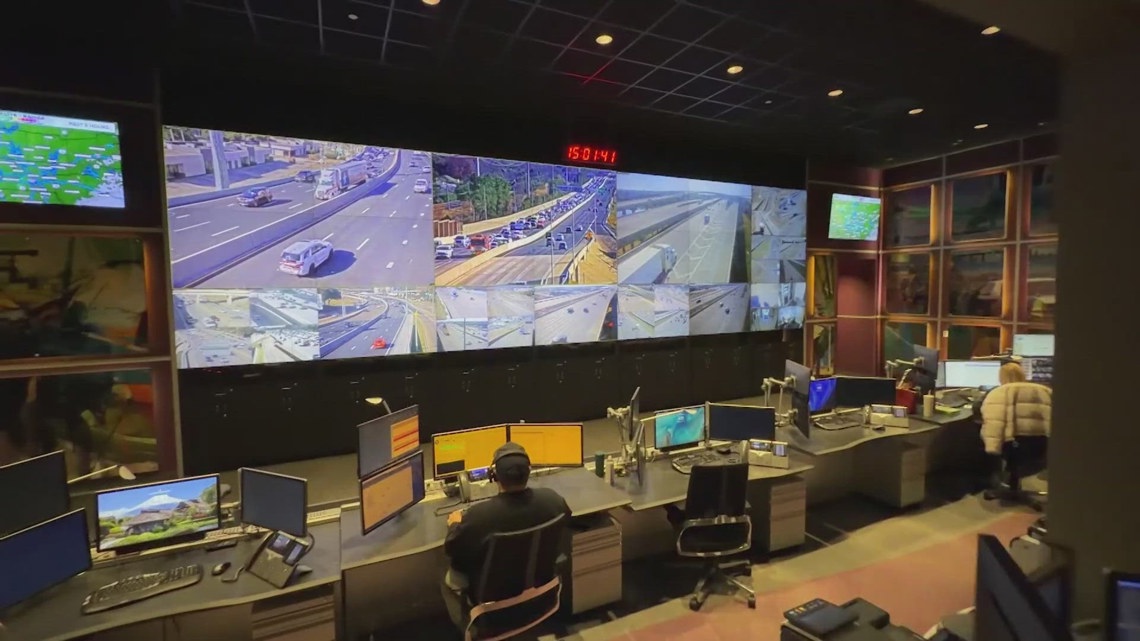
As North Texas braces for a winter storm, NTTA’s Safety Operations Center is on high alert, ready to manage icy roads, with the help of cameras and sensors.
PLANO, Texas — As North Texas braces for winter weather, few are watching the roads more closely than those inside the North Texas Tollway Authority’s Safety Operations Center in Plano.
“With the event coming, we are all hands on deck,” said Eric Hemphill, Director of Traffic and Incident Management at NTTA.
The control room features 21 seventy-two-inch TVs, each fully customizable. If it moves on an NTTA road, you can bet dispatchers have eyes on it. The large room uses specialized technology such as cameras, thermal imaging, and sensors.
“We’re ready for it, we’re staffed up for it, but it’s going to be a slog — it’s hard, hard work,” said NTTA spokesperson Michael Rey.
There are 2,000 cameras monitoring toll roads, and during events like this weekend’s storm, every one matters. When a truck and a car recently stalled after a crash, it was those cameras that alerted dispatchers. The dispatchers then dispatch DPS troopers, safety service patrol, incident management, and safety recovery vehicles.
“That team will be out there on the road for the snow and ice event. We staff up, we put a couple in a truck,” said Hemphill.
But not everyone watching this storm has high-tech equipment. James Mayo, a local resident, is watching out for someone closer to home — his grandmother.
“Grandma calls me and tells me my house is not ready for the storm, when can you come?” he said. The two picked up faucet covers and bags of de-icer at a Lowe’s in Plano. “Last time we had a storm, her driveway didn’t melt for five days,” he added.
Beyond cameras, NTTA relies on road sensors buried under the pavement and along bridge decks that measure more than just temperature.
“They tell us what the temperature of the roadway is, what the temperature of the outside is, whether the road is wet or dry, and some of our sensors tell us if we’ve put chemicals out — what the new freezing point of water will be,” explained Hemphill.
NTTA covers more than 1,200 lane miles across six counties, where preparation and timing are everything.
“For each minute something is on the roadway, it takes four minutes of recovery,” Rey said.
And in icy conditions, recovery will take even longer. Whether it’s the roads or our loved ones — we’re all on watch this weekend.