
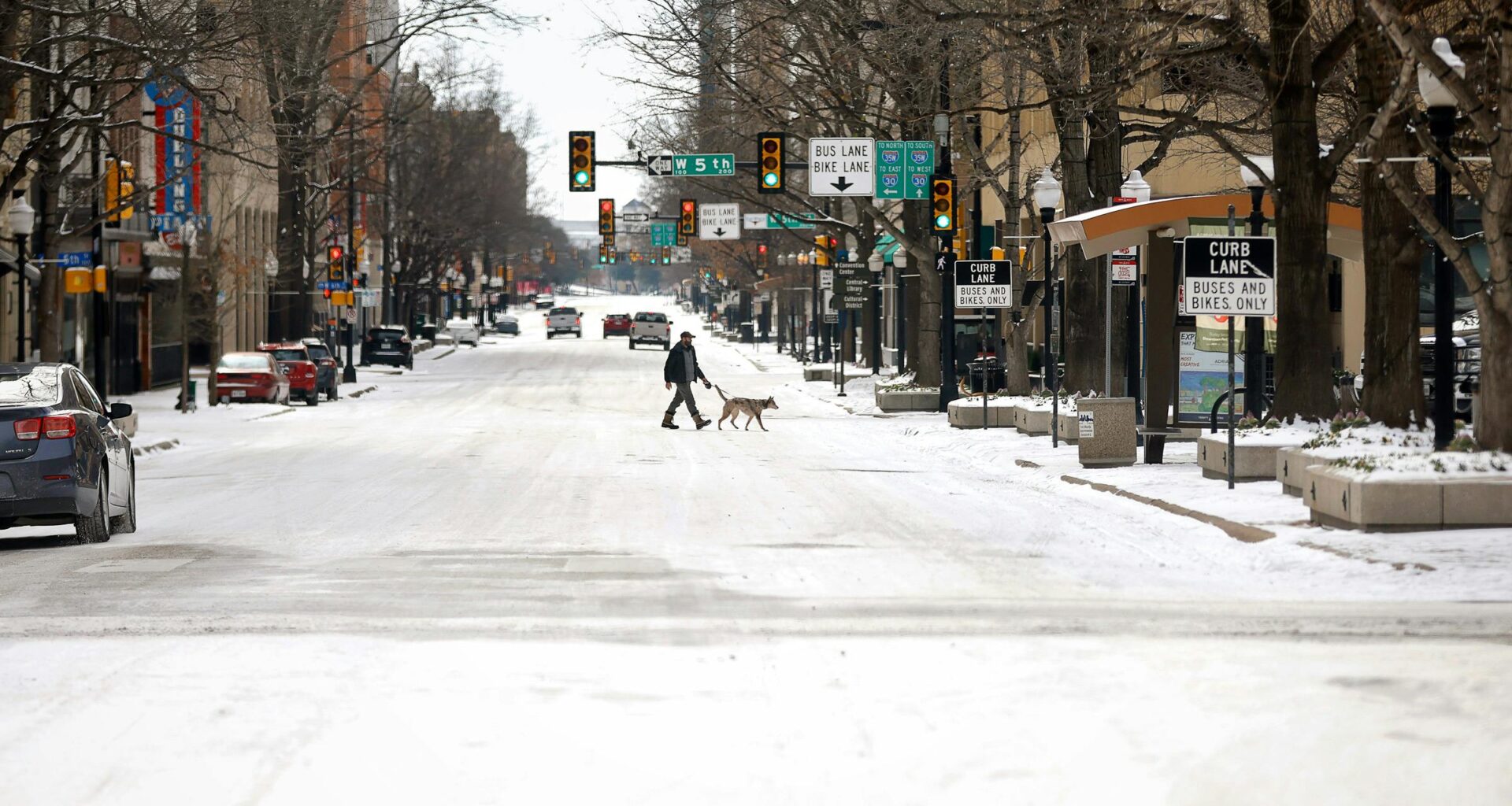
On Friday, as Texans head to sleep, a major winter storm will make its unwelcome arrival. By morning, roads across much of the state will be icy, and as much as five inches of snow and ice could accumulate in North Texas. After a severe winter storm triggered the failure of the electric grid in 2021, many who live here are reasonably concerned about how to prepare for potential disasters.
Forecasts project that temperatures across the state will dip into the twenties and teens, and wintry conditions are expected to last at least through Sunday. Governor Greg Abbott, who activated an emergency response on Tuesday, January 20, said the state is expecting hazardous road conditions and damage to local infrastructure.
In advance of Friday night, Texans should gather a supply of food and water to last a few days, keep their devices charged, and cover outdoor spigots and drip faucets to prevent pressure from building up in partially frozen pipes. For more advice and insight on what to expect, Texas Monthly spoke with Matt Lanza, the managing editor of Space City Weather, a trusted source for Gulf Coast weather news known for its “hype-free” approach to forecasting. The interview has been edited for length and clarity.
TM: How does this storm compare with the winter storm of 2021?
ML: This weekend’s storm is definitely different, particularly in how cold it will be. Uri, in 2021, was exceptionally cold. It’s a very rare type of cold that we get here in Texas. This weekend’s storm, on the other hand, is a once-every-one-to-two-winters type of cold. In general, you’re talking in the twenties in South Texas, teens in Dallas, and single digits to near zero in the Panhandle—which is cold for sure, but they’re not the extremes that they were in February 2021.
During Uri we had temperatures that were around forty to fifty degrees below normal, but this weekend is more like thirty degrees below normal. It’s still damn cold, but it makes a big difference in terms of the actual, tangible impact. It’s what separates, you know, a historic event, like Uri, from a notable event, like this.
From the precipitation perspective, it’s also different. This may have more impacts in northeast Texas than Uri did. This would mainly concern travel. It’s going to be very difficult to drive in some parts on Saturday and Sunday. There may be ice, sleet, or snow as well.
TM: You mentioned northeast Texas will be hit the hardest. How should those Texans prepare?
ML: Dallas looks to be the epicenter of precipitation, probably a combination of ice, snow, or sleet. It’s that wintry mix, potpourri-type thing. Places further north like Lufkin, Texarkana, Tyler, and Longview will be in the bulls-eye of a nasty combination of ice and sleet.
I think what we’ve seen time and time again with the weather in Texas, whether it’s a hurricane, a flood, severe weather, or winter weather, is you always have to think about the worst-case scenario. There’s just an inherently high amount of uncertainty in terms of how far south the ice is going to make it, or where it is going to change from sleet or snow.
So I think for everybody in Texas, but particularly the northeast part down through Central Texas and Abilene out toward [the] Hill Country: Just be ready to potentially be disrupted for a day or two, in terms of your travel plans. It just may be too treacherous to get out. Even if it’s only a tenth to a quarter inch of ice, that’s a lot on roads when you don’t have the equipment to melt the ice, like is the case here in Texas. I really think anyone north of I-10 should be ready to hang out at home for two days. It may not be that way for everyone, but you should plan for it.
TM: Are there projected high winds that people should watch out for?
ML: The winds don’t look particularly strong, but when you factor the potential for ice, even winds of just fifteen to twenty miles an hour can be a recipe for bringing down tree limbs. That’s when you can really get some damage, and that’s definitely a concern across eastern and northern Texas. That’ll also add to the wind chill as well.
TM: Do you expect the weather to continue into Monday, potentially affecting office and school schedules?
ML: It does look like the coldest weather will probably be this weekend, and the precipitation will be mainly confined to Saturday and Sunday. As we go into Sunday afternoon and evening, everything moves east and out of the state. For the most part, at least the first half of next week looks pretty dry, without any real issues. We’ll have some time to, number one, dry out, and number two, thaw out. Temperatures should get back up above freezing as early as Monday afternoon in a good chunk of the state but definitely on Tuesday. Right now, Saturday looks like a dicey day. Sunday looks like a very dicey day, the worst day statewide. Then some improvement on Monday and significant improvement on Tuesday.
I definitely think that there will be some school closures in North Texas, and that may be a large number. I mean, tell people to do their homework, but it might be a three-day weekend.
TM: Are you concerned about the power grid failing like it did in 2021?
ML: That’s one thing I’m not losing sleep over this time.
TM: You called this storm an “every-one-to-two-winters” type of storm. Do you see these winter storms becoming more frequent?
ML: I’ve talked to some people in the field that have looked at this, and it’s definitely a mixed viewpoint. Some people think that climate change will make these more frequent or more intense. Others think it won’t, just because it’s just generally warmer. Though I gotta say, it really feels like every winter now we have at least one of these. That could be the law of averages, so I think it’s important to not read into it too much, but at the same time, it’s a good reminder that you really have got to be prepared for winter weather in Texas. Not just in the “Oh, you know, we get cold once a year, it’s no big deal” way. This is “You may be stuck at home for a day or two” type cold. When we think about hurricane season, we always plan and think about what we’re going to do. So in the winter, it’s become the same thing.
TM: Is there anything Texans should know or keep an eye on heading into this weekend?
ML: Be wary of your phone’s weather app. It’s not necessarily bad, but when you get into situations like this, where you’ve got kind of that mixed staggered precipitation, it’s not going to perform as well. The forecast is too complex, and a few miles can make a big difference in terms of what you actually see. Stay informed with local weather broadcasts and trusted sources across the state.
Read Next