

Only about half of Texas students enter kindergarten ready to succeed, according to recently released Texas Education Agency data. The measure is tied to reading on grade level by third grade, which researchers say predicts long-term academic and economic success.
The new data comes as Texas launches a task force on early childhood education and care that was created by the Texas Legislature last year to streamline parents’ access to resources.
Kindergarten readiness is defined as students who meet standards in specific literacy assessments and do not require additional support. Texas public schools determine if students are kindergarten ready by conducting annual reading screeners at the beginning of the school year.
Kindergarten-ready children are more likely to graduate from high school, attend college, and earn more from stable jobs, according to a study in the Journal of Public Economics. Education advocates say ensuring children start school ready also enables parents to participate in the workforce.
The Education Lab
Related
However, data from Texas Academic Performance Reports show only 51% of Texas students were kindergarten ready last year, down from 59% in 2017. Asian students and children who need support to develop English proficiency because it’s not their home language both experienced slight increases in kindergarten readiness since 2017, data shows.
Kindergarten readiness declined among Hispanic, Black and white students, as well as low-income students and children in special education.
The figures are accessible through the Commit Partnership’s Comprehensive Summary Dashboard (Commit supports the Future of North Texas initiative at The Dallas Morning News).
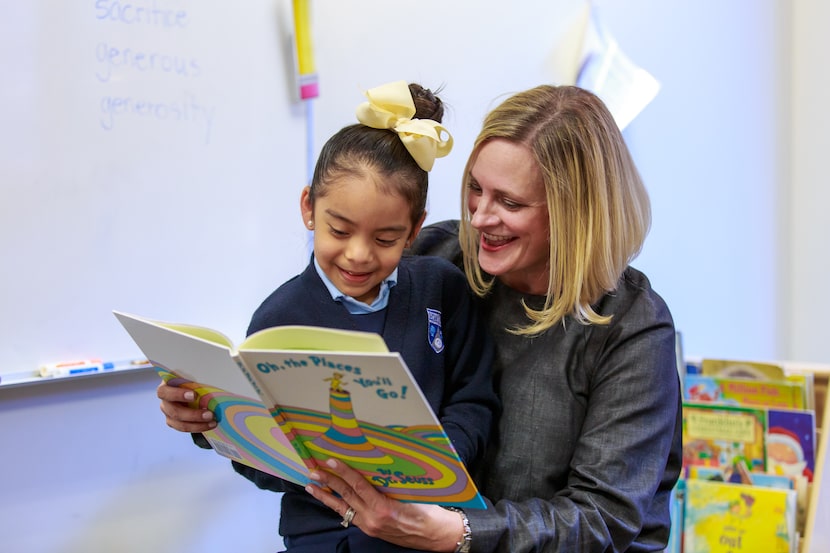
Jennifer Sampson, the McDermott-Templeton president and CEO of United Way of Metropolitan Dallas, reads to local students during United Way Reading Day, an annual event that encourages early literacy and kindergarten readiness.
Courtesy United Way of Metropolitan Dallas
The data, released late last month, is the first statewide look at kindergarten readiness for the 2024-25 school year and is helping shape the work of a new Governor’s Task Force on the Governance of Early Childhood Education and Care.
Speaking from John A. Sippel Elementary School in Schertz, Gov. Greg Abbott on Tuesday said the panel will involve the Texas Health and Human Services Commission, Texas Education Agency, and the Texas Workforce Commission.
“Early childhood education and care is a pressing need for parents across the state,” Abbott said.
“We want to make it easier for providers to operate. That, in fact, will in turn lower the costs for parents. We also want to make it easier for parents to access programs.”
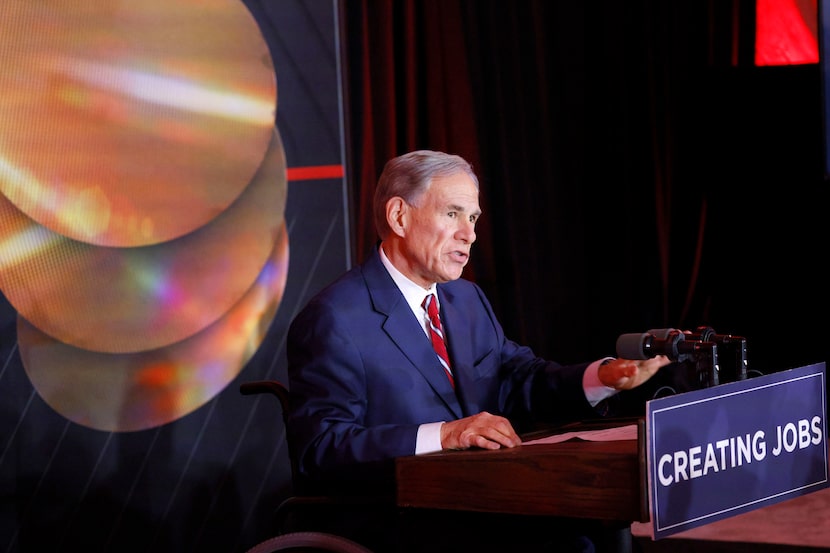
Texas Gov. Greg Abbott speaks during a ribbon cutting ceremony for the grand opening of Texas Instruments’ new semiconductor wafer plant. Wednesday, Dec. 17, 2025, in Sherman.
Chitose Suzuki / Staff Photographer
The task force is required to identify what works, what doesn’t, and what needs improvement in early childhood education programs. Its budget and policy recommendations must be shared with the Texas Legislature by Dec. 1.
Those recommendations will become the basis of even more laws that can be passed during next year’s legislative session, Abbott said.
Lawmakers passed legislation last year to create the panel to examine how agencies can better align early education and care programs, reduce inefficiencies, and ensure public investments create measurable outcomes for Texans.
That matters, as families and education providers face difficulties navigating across the multiple agencies administering Texas’ early childhood programs. Each program often has different eligibility rules, funding streams, and accountability structures.
State Rep. Alan Schoolcraft, R-McQueeney, who authored the legislation, lauded lawmakers for investing $8.5 billion into Texas public schools last year. A portion of those funds will bolster early childhood education, he said.
“If we don’t start them well, they will never catch up,” he said. “By making the early investments in a child’s life, it helps ensure they’ll be successful for the rest of their life.”
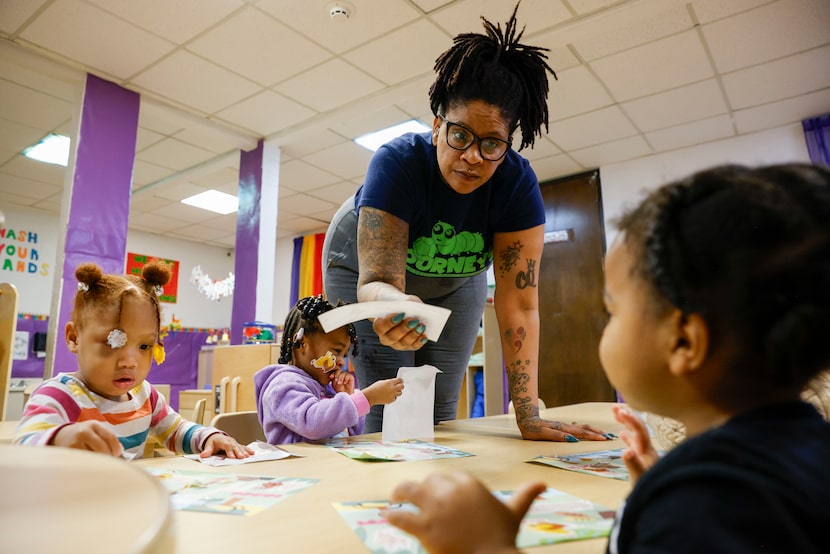
Carla Wright (center), toddler program teacher, helps 2-year-old Auri Johnson (right) with a sticker worksheet at Journeys Child Development Center in Grand Prairie, Texas, on Tuesday, Jan. 28, 2025.
Liz Rymarev / Staff Photographer
Lawmakers last year approved over $100 million to support child care scholarships for working families. However, about 100,000 Texas children are still on the state’s waiting list for a scholarship, according to Texans Care for Children, a child care advocacy group.
Meanwhile, Texas child care educators are paid about $12 an hour with little to no benefits, meaning programs struggle to recruit and retain staff, according to the Prenatal-to-3 Policy Impact Center at Vanderbilt University in Tennessee.
These factors, among others, have left 88% of Texas’ working families with low incomes in a child care desert, where demand is three times greater than the availability of high-quality child care seats, according to Children at Risk.
David Feigen, director of early learning policy at Texans Care for Children, said in a statement after Abbott’s news conference that the task force is an opportunity for Texas to address its child care crisis, especially for kids with disabilities.
State Sen. Donna Campbell, R-New Braunfels, who sponsored the legislation, stressed during the news conference that the task force is not designed to create “any bigger government,” new programs or “any automatic funding.”
It’s about learning how Texas can improve kindergarten readiness, child care capacity, and spending, she said.
“It is said that the best time to plant a tree is 20 years ago, but the second best time to plant a tree is now,” Campbell said. “And that’s what we’re doing.”
This reporting is part of the Future of North Texas, a community-funded journalism initiative supported by the Commit Partnership, Communities Foundation of Texas, The Dallas Foundation, the Dallas Mavericks, the Dallas Regional Chamber, Deedie Rose, Lisa and Charles Siegel, the McCune-Losinger Family Fund, The Meadows Foundation, the Perot Foundation, the United Way of Metropolitan Dallas and the University of Texas at Dallas. The News retains full editorial control of this coverage.