
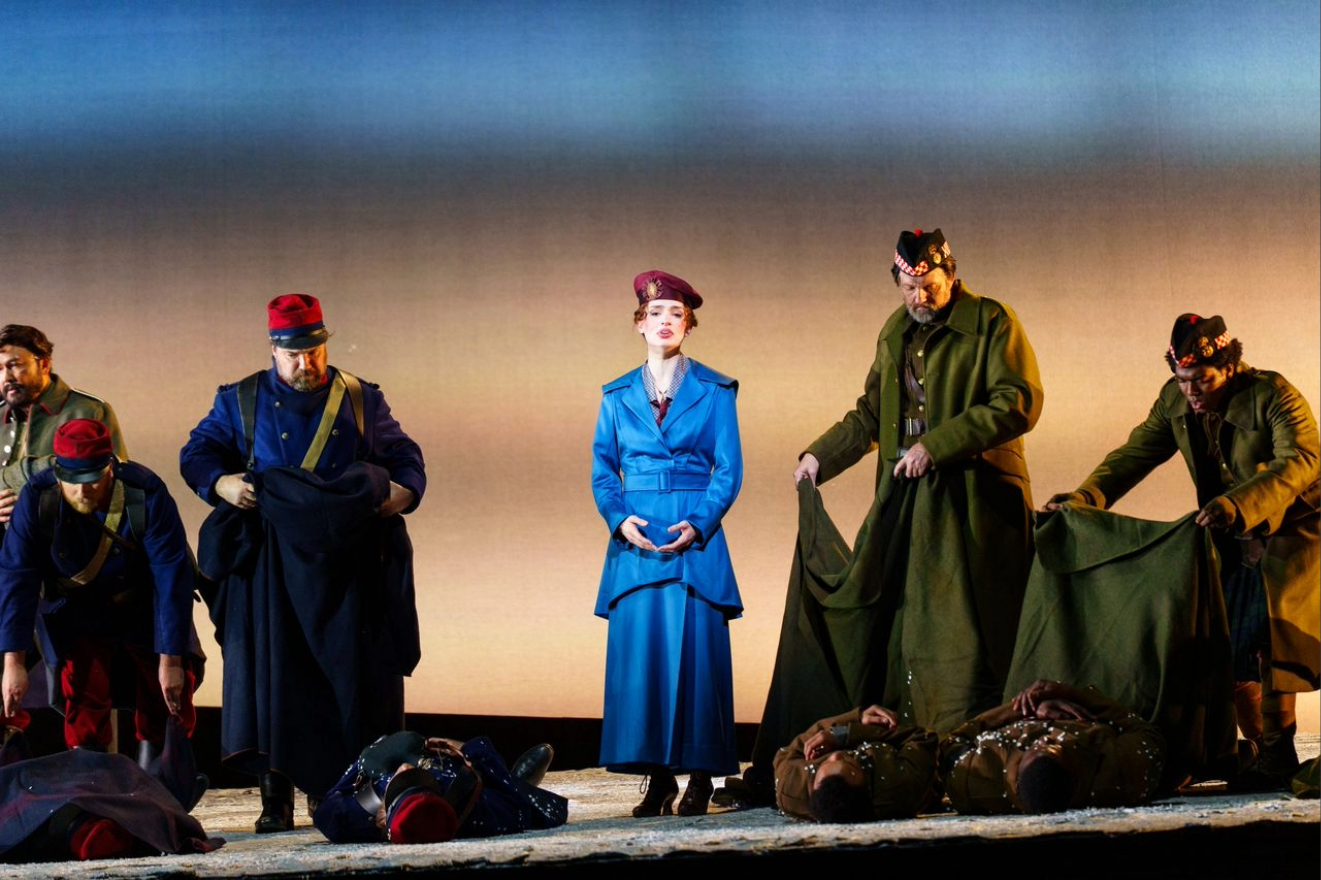
It’s a famous story. One Christmas Eve early in the first World War, forces on either side of the Western Front decided to declare a truce, put down their weapons, exchange gifts and sing carols.
According to a few photographs, soldiers’ letters back to their families and their own journals this wasn’t some script written for a Hallmark TV movie but really happened – although there have likely been some embellishments over the years.
German, French and British troops met in the no-man’s land, a 400-mile line through France and Belgium, retrieved their dead and got along. It never happened again.
A movie was made of this in 2005, in turn inspiring the 2011 opera by composer Kevin Puts and librettist Mark Campcell which went on to win the Pulitzer Prize for Music. Now Houston Grand Opera will bring Silent Night to the stage starting this Friday, January 23 in a Houston premiere.
The story doesn’t begin with the night of the ceasefire, but with the back stories of the main characters showing us something of their lives before they go off to war.
Tenor Miles Mykkanen will make his HGO debut as Nikolaus Sprink, with Butler Studio tenor Michael McDermott performing the role on Feb. 4. The opera’s cast also includes soprano Sylvia D’Eramo in her company debut as Anna Sørensen; bass-baritone Ryan McKinny, baritone Iurii Samoilov, and baritone Thomas Glass as the story’s three lieutenants; and tenor Jack Swanson as the soldier Jonathan Dale. James Robinson directs.
Japanese-American conductor Kensho Watanabe, who will be making his company debut with HGO, has worked with composer Puts, most recently when he made his Metropolitan Opera debut conducting Puts’ latest opera The Hours. He expresses a lot of admiration for Puts including his Pulitzer Prize-winning work.
“I love the way Kevin writes for the voice and also particularly how he writes for chorus. There’s many, many scenes that involve chorus and two very important chorus numbers that occur in both acts are especially notable.
“He has a lot of experience writing for orchestra and I also come from a symphonic background, I was a violinist before. So, there’s a lot of stuff for the orchestra to really play and take part in the narrative of the opera and the drama of all of it so it keeps the conductor and the orchestra very, very involved which I enjoy.”
Watanabe believes the opera has remained so popular because most people have an idea of what went on in World War I. “They have an understanding of the brutal trench warfare that occurred. And this momentary truce that occurred on Christmas Eve.
“I also find it very interesting that Kevin’s music spans various styles. While the opera begins with the two lead characters [German tenor Nikolaus Sprink and his lover Norwegian soprano Anna Sørense] they’re supposed to be professional opera singers working in Germany so when the war starts the first scene actually depicts them singing a Mozart like opera. “
Note this is Mozart like, not Mozart. Puts incorporated several different styles of music in his composition including Those styles include “war anthems, folk songs, hymns and German Lieder,” as described by HGO.
It is also an opera sung in four different languages over its 2-1/2 hours, Watanabe says. Besides the German, British/Scots and French soldiers, there’s the operatic scene in Italian, he says. “It feels in a way because each character is singing in in their native language, that there’s something that makes the characters a little bit more real and believable.
The opera is also what happens afterwards. “The consequences these soldiers face from their superiors who were emotionally, psychologically and physically removed from the brutality of war. And yet they were the ones who were coercing their subordinates to continue to kill each other.
“I think each character is trying to find their own agency in a situation where everyone seems very helpless. No one is able to make decisions for themselves. I think each officer, each soldier is trying to find some way to control the situation or make the best of it.”
Watanabe’s background includes playing the violin in orchestras. “What really took me to conducting was really my love of chamber music. I really enjoyed playing in quartets. More specifically being a second violinis tor a violis.” He liked what he called the internal communication that happens among the musicians.
He fell into conducting during his college years. He found the same energy he’d experienced in chamber music but “in some ways magnified across many more musicians.”
A college biology major, Watanabe was going to be a doctor but decided that music had more of an appeal for him. Asked his parents’ initial reaction, he says: “If they were hooked up to a lie detector, they would admit perhaps that for the first maybe 48 to 72 hours they were disappointed.” As he sees it, though, they were the ones that encouraged him to undertake extracurricular activities.
His Bachelor of Science degree from Yale where he studied molecular, cellular and developmental biology was far from a wasted exercise, though. He likes learning from people with all different disciplines. And he still applies that logical, scientific thinking to music. He holds a Master of Music degree from Yale as well.
As for the Peace in the Trenches opera, he believes “Regardless of the time period I think that if there is a take home of this opera for me it’s important that we make the effort to try to understand someone that seemingly is in opposition to what we think or believe.
“There are many scenes where the French, Scottish or German officers that are directly involved in the fighting have these mini summits in no man’s land to discuss whether they’re going to have the truce or if they’re going to extend the truce so there’ll be time to bury the dead soldiers that are just lying in no man’s land for days.
“The opera does a really great job in depicting the tension between these three. Even the French and Scottish who are seemingly working together, who are trying to work together, have many cultural differences and many differences of thought, not alone the difference in language.
“Yet there is some power in trying to find a commonality. I’m not trying to sugarcoat it. I think however that if something can be said about this opera: It is important even if it feels futile to try to make an effort to try to understand the other.”
One more aspect that Watanabe brought up to recommend the opera.
“If anyone’s a bagpipe enthusiast I think this might be a very rare opportunity to hear bag pipes.”
Performances are scheduled for January 23 through February at 7:30 p.m. Saturday and Wednesday and 2 p.m. Sundays at Wortham Theater Center, 501 Texas. For more information, call 713-228-6737 or visit houstongrandopera.org. $25-$295.50.
This article appears in Private: Jan 1 – Dec 31, 2026.
Related