
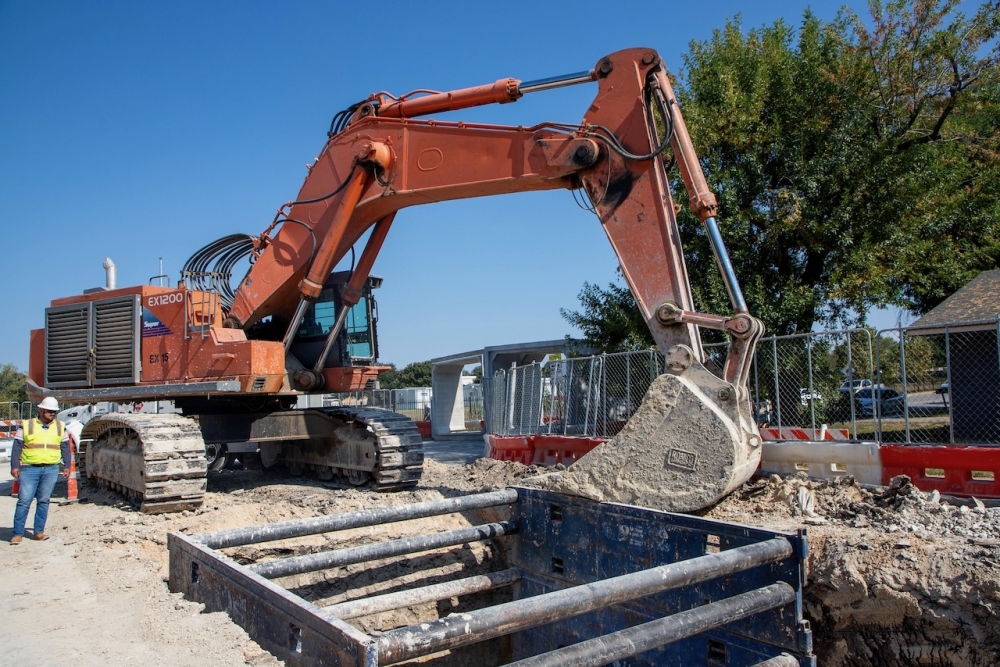
A $700 million bond package to fund mobility, watershed protection, parks and public facility projects has been recommended by city staff after months of review.
The outline may not represent Austin’s final 2026 bond—if an election is even called this year, a decision city officials are now considering—as a public task force will also weigh in with its own project proposals this spring.
The overview
City Council voted to begin developing a new bond with climate-centered elements back in 2024. That work has been handled by both city departments and the resident-led 2026 Bond Election Advisory Task Force.
Austin hasn’t called a comprehensive bond election since 2018, although stand-alone packages were approved for transportation in 2020 and affordable housing in 2022.
Given Austin’s current debt capacity, staff recommend capping a potential 2026 bond at $700 million. Council members are also weighing whether to push an election to another year, or reduce this year’s measure and plan for a larger bond in the near future.
City departments previously forwarded lists of all project they’d like to get funded as part of the ongoing bond development process. Their requests from last summer added up to nearly $4 billion, a total that was meant to be refined to a lower amount. That process has now been completed with the $700 million recommendation released Jan. 21.
“The 2026 Bond program is being developed with a clear objective: to address Austin’s most pressing infrastructure needs that will deliver the greatest benefit to the community through a predictable six-year bond cycle. This approach ensures alignment with departmental plans, financial stability, and delivery on commitments,” Assistant City Manager Mike Rogers said in a memo.
By the numbers
The $3.87 billion project wish list released last year included 66 programs or projects from more than a dozen public-facing city departments. The scaled-down $700 million list has just over two dozen initiatives across five main categories:
$251 million for mobility projects like street and bridge rehabilitation, sidewalks and bikeways, trails and safety upgrades$160 million for various watershed protection projects like drainage and stormwater infrastructure, land acquisition and other partnerships$140 million for city parks system, including facilities maintenance and replacement, open space acquisitions and other improvements$91 million for public safety facilities, including a police substation in Northwest Austin and a new fire and emergency medical services station$58 million for the Hampton at Oak Hill Branch library expansion, Austin Animal Center campus improvements, a new homeless shelter and land acquisition for the city fleet department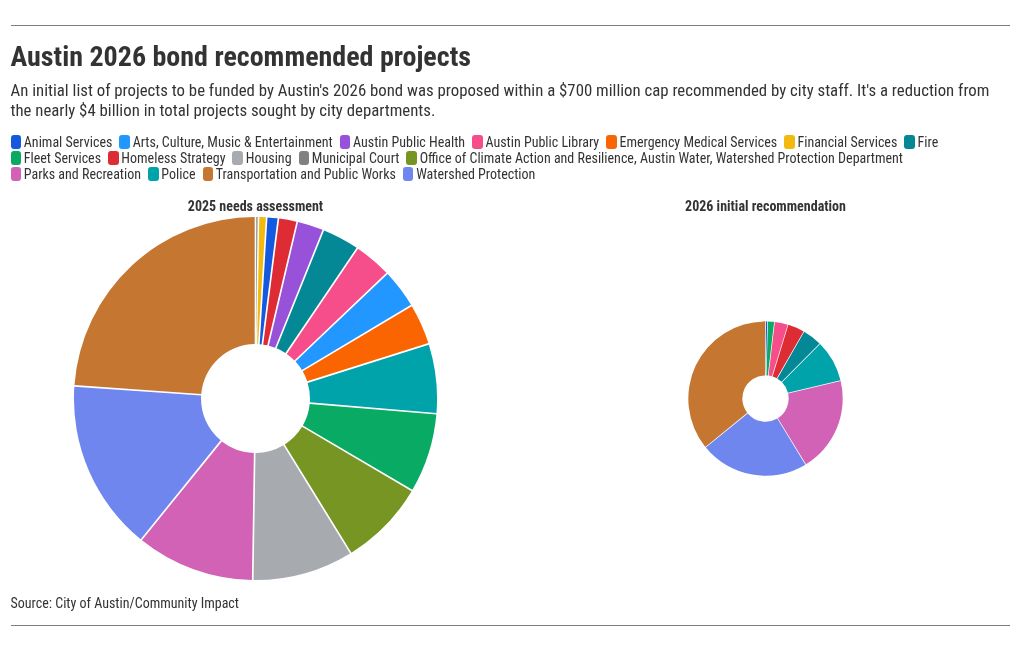 Reductions from last year’s needs assessment were made by an internal review board involving Austin Capital Delivery Services—the city’s project development department overseeing the bond process—every involved department as well as the climate, planning and equity offices.
The recommendation released this month accounted for that review board’s scoring, public input and discussions by the resident bond task force. The full project lists and city scoring can be viewed in Rogers’ January memo.
Also of note
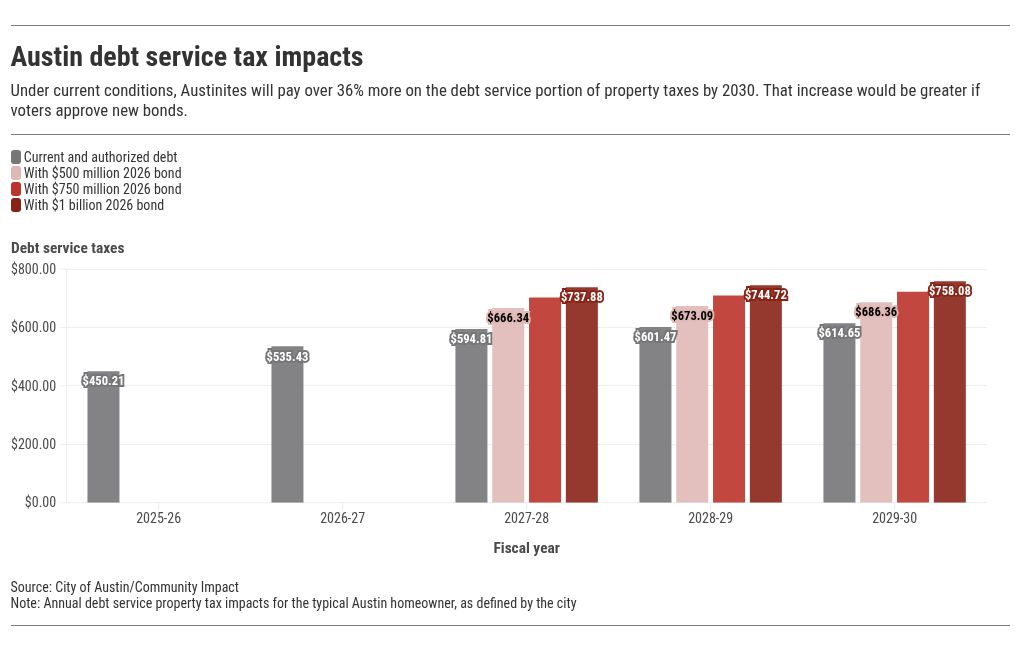
Debt like public improvement bonds is paid for through a portion of city property taxes. The owner of a median-valued home in Austin will pay about $450 in debt service taxes this year, a total expected to rise to about $615 by 2030 based on current conditions.
Every $100 million included in a city bond package now equates to about $14.34 in taxpayer impact, according to city staff estimates. Approving a $700 million bond in 2026 would result in annual debt service taxes of more than $700 for the typical homeowner by the end of the decade.
 What’s next?
The bond advisory task force continues to meet and is expected to produce its own project list by early May. Residents also have the opportunity to share input at task force sessions and public open houses scheduled throughout February.
Although council previously launched the overall process, officials are eyeing a new policy with formal steps for bond elections that could alter this year’s approach. More review of that framework is coming in February, and Rogers noted the January project recommendation isn’t meant to “circumvent” that work or “supersede” final council votes.
“The initial draft project list also does not speak to a decision on whether these projects are fiscally responsible but is being released to continue to inform and include the public in the decision-making process,” he wrote.
If a 2026 bond does advance, City Council would set the project list based on the staff and task force recommendations in May. A fall election would then be formally called in early August.