
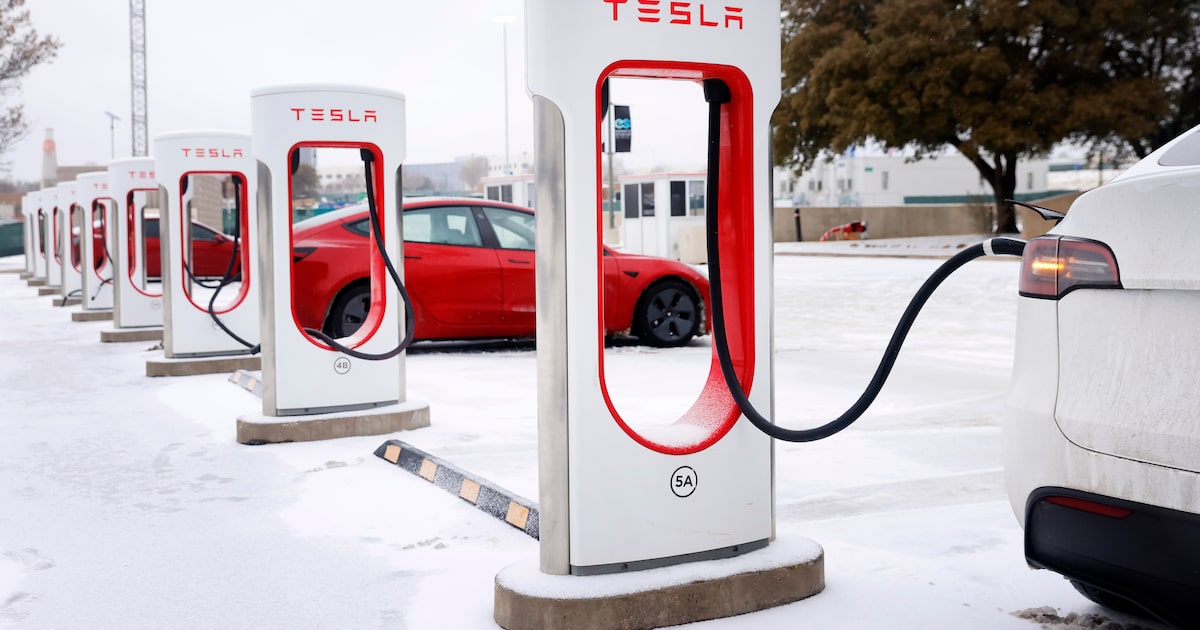
As North Texans bundle up in anticipation of freezing overnight temperatures, they may also need to winterize their cars. That includes electric vehicles, which make up a growing share of cars in Texas.
The state ranked third for registered all-electric vehicles, behind California and Florida, at the end of 2023, according to the United States Department of Energy. Many of Texas’ EV owners live in Dallas-Fort Worth, with almost 37% of the state’s EVs registered in the region, followed by Houston with around 25% and Austin with a little over 19%, as of Jan. 20, according to data from the Dallas-Fort Worth Clean Cities Coalition.
EVs are often touted for cutting fuel costs and reducing carbon emissions. But they tend to struggle in cold weather: Freezing temperatures can slow charging and reduce performance, which has affected EV owners before.
Here’s what happens to your EV during the North Texas cold and how to prepare your car to get the most out of it.
News Roundups
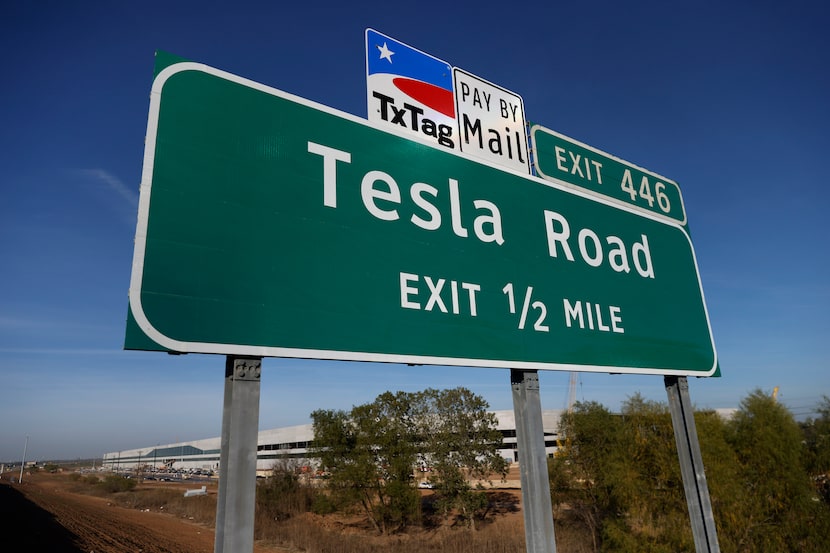
An exterior view of Gigafactory Texas, Tesla’s automotive manufacturing facility being constructed along Texas State Highway 130 at Tesla Rd. in Austin, Texas, Wednesday, Dec. 8, 2021.
Tom Fox
How do cold temperatures affect EVs?
Liquid-based lithium-ion batteries are the most common type of batteries powering an EV. Cold weather slows the chemical reactions in these batteries, with the lithium ions moving more sluggishly through the electrolyte liquid. The batteries therefore can’t release as much energy, which cuts down their range and sometimes drains them faster.
The same chemical slowdown affects charging. In colder temperatures, batteries can’t take in electricity as quickly, so charging takes longer. That’s especially noticeable at fast-charging stations, where EVs often need to warm the battery before they can charge at top speed.
Studies show freezing temperatures can cut an EV’s driving range by 25% to 41%, depending on conditions. An EV that can go 100 miles on a single charge at 70 degrees Fahrenheit may travel only about 59 to 75 miles in freezing weather, Inside Climate News reported in 2024.
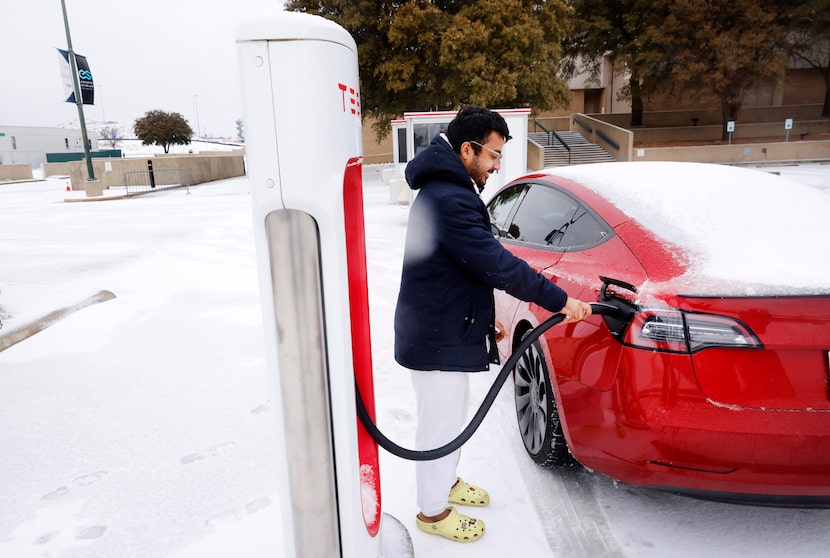
Ritesh Kumar of Arlington charges his Tesla Model 3 outside Esports Stadium Arlington after a band of sleet dropped about 2 inches in Arlington, Texas, January 31, 2023.
Tom Fox / Staff Photographer
Seattle-based Recurrent, which tracks EV battery performance, has found vehicles lose about a fifth of their range on average around 32 degrees Fahrenheit — in part because drivers run the heater, which draws power from the battery.
Newer EVs are becoming better equipped for cold weather, using heat pumps to help warm the battery. According to 2025 data from Recurrent, heat pumps can extend a vehicle’s range by about 10% at 32 degrees Fahrenheit, making them an important consideration for drivers in colder climates.
How to get the most out of your EV during the cold
The most important step is to heat your EV before you drive or fast-charge. Warming the battery — often for about 15 minutes — can improve performance, speed up charging and reduce strain on the battery in frigid weather. If possible, keep the car plugged in while the battery warms so the energy used comes from the grid, according to Axios.
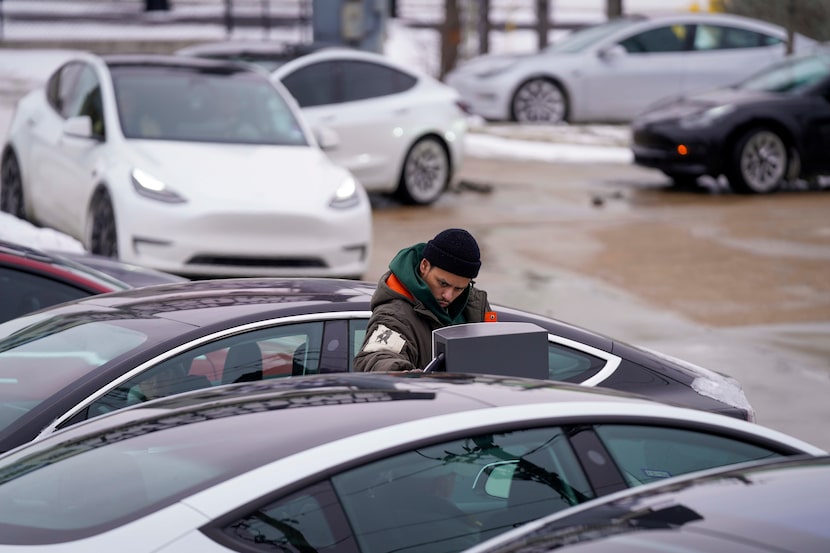
A line of cars waits for a charging station at the Tesla Supercharger on North Central Expressway near Walnut Hill on Tuesday, Feb. 16, 2021, in Dallas.
Smiley N. Pool / Staff Photographer
In cold weather, EV drivers may need to adjust their charging habits to protect range and avoid falling short of power. Instead of stopping at 80% for daily use, charge closer to 100% on especially frigid days because more energy is spent keeping the battery and cabin warm, according to Cars.com. It also helps to plan charging stops in advance — and have backup options — since stations can be busier and range estimates can drop faster than expected.
Cars.com also recommends EV drivers prioritize stability over efficiency. Dial back regenerative braking or avoid one-pedal driving — a feature that lets an EV slow down, and sometimes stop, just by lifting the foot off the accelerator — to reduce the risk of sudden deceleration on slick roads. Use Snow/Winter mode to soften throttle response and reduce wheel spin. Eco mode and Tesla’s Chill mode can also help with conserving energy.
Lastly, in extreme weather, the safest option is simply to stay off the roads if you can.
Miriam Fauzia is a science reporting fellow at The Dallas Morning News. Her fellowship is supported by the University of Texas at Dallas. The News makes all editorial decisions.