
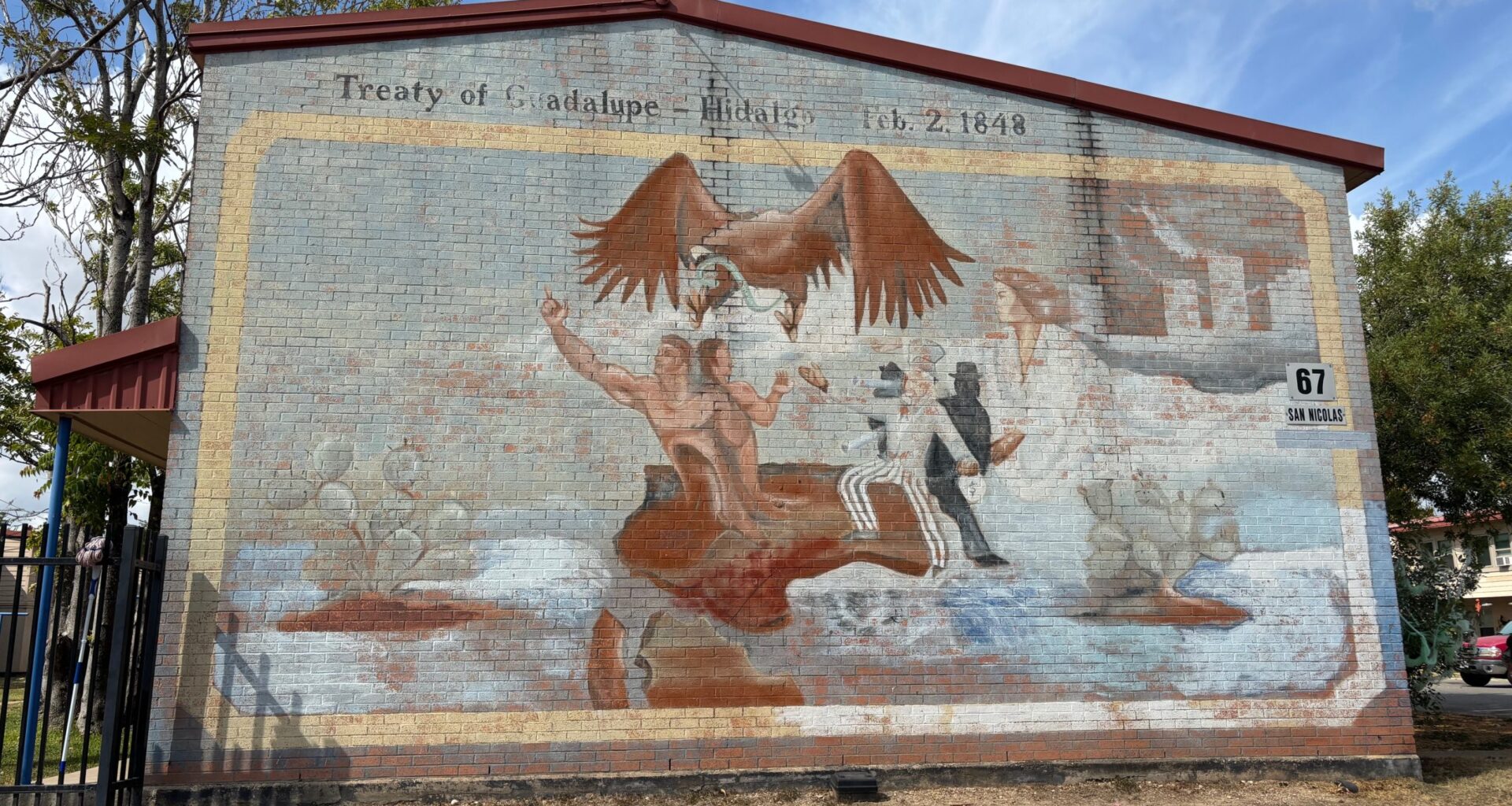
There’s an aphorism in Texas that says, “We didn’t cross the border, the border crossed us,” often used to challenge who is seen as a real Texan, or Tejano, and who is an outsider.
To explore the history that led to this issue of mistaken identity, Our Lady of the Lake University will host a five-day community conference focused on the treaty that gave way to Texas and other states becoming part of the United States: The Treaty of Guadalupe Hidalgo.
“So much happened when that border was created, when México lost the land,” said Amber Ortega, coordinator for the international folk culture center at Our Lady of the Lake. “Historically, it has been [seen] as the birth of the Chicano, the birth of the Mexican-American.”
The community conference titled “El Segundo de Febrero Community Conference: Stories of resilience since the Treaty of Guadalupe,” runs from Monday, Feb. 2 through Friday, Feb. 6. The event is free to the public and will include special screenings, presentations and panel conversations centered around how the treaty shaped diversity across the Southwest highlighting stories from the West Side of San Antonio.
Signed on February 2, 1848, the treaty ended the two-year war between the U.S. and México.
As part of it, México ceded about 55% of its territory, which today includes the states of Texas, California, Nevada, Utah, New Mexico, most of Arizona and Colorado, and parts of Oklahoma, Kansas, and Wyoming. The Rio Grande became recognized as the border between the two countries.
At the time, Texas had already been experiencing an identity crisis, as the U.S. had recognized the establishment of the Republic of Texas in 1836, but México had not.
With the formal annexation through the Treaty of Guadalupe Hidalgo came full recognition of Texas as a U.S. state, but the treaty also led to long-lasting land and citizenship disputes.
“It was also a point where women lost their voices. Women no longer could have their names on land deeds and property,” Ortega said. “Native identities were also shifted at that point. So many people just became Mexican-American.”
At Our Lady of the Lake, the signing of the treaty had been observed starting in 1977, when students and local activists brought it up as a way to tap into the complicated history that impacted many generations of Texans, Ortega said.
This custom has since expanded to other cities and states, but the tradition went dormant at the private university for some time.
Organizers say this is the return of the observance at the university, but now as a full conference intended to compliment events that have historically taken place around the community, including a traditional mass known as the “Blessing of the Seeds” at Christ the King Catholic Church at 2610 Perez St.
Our Lady of the Lake students will also participate in the restoration of a historic mural painted as part of a public arts project at the Cassiano Homes in 1980 by local Chicano muralists Anastacio Torres and Juan Hernandez.
On Monday, Feb. 2, at 4:30 p.m. Torres and Hernandez will have a public conversation about the restoration project. This plática will be held on campus at the Sueltenfuss Library, on the third floor.
“One of the major things that OLLU does is service learning, and that I think sets us apart,” said Suzy Gonzalez, program head and visiting assistant professor of visual and new media arts at the university.
“Part of that mission is that our students leave this campus after graduation with a sense of purpose in life, but also this idea that they’re going to be serving their communities,” Gonzalez added.
Understanding the treaty, its historical value and its ripple effects can instill a sense of solidarity and belonging, Ortega said. The goal is to hold this conference annually to dive deep into the many complicated themes linked to this moment such as women’s rights, land violence and the role of language.
For a full schedule of the conference, visit Our Lady of the Lake’s site here.
“We want to continue to make this an opportunity for native voices to be heard,” Ortega said. “So I hope that it [will] be encouraging… I would hope that people see at least in our communities, that we are still connected and we still have a responsibility towards each other.”
The San Antonio Report partners with Open Campus on higher education coverage.