
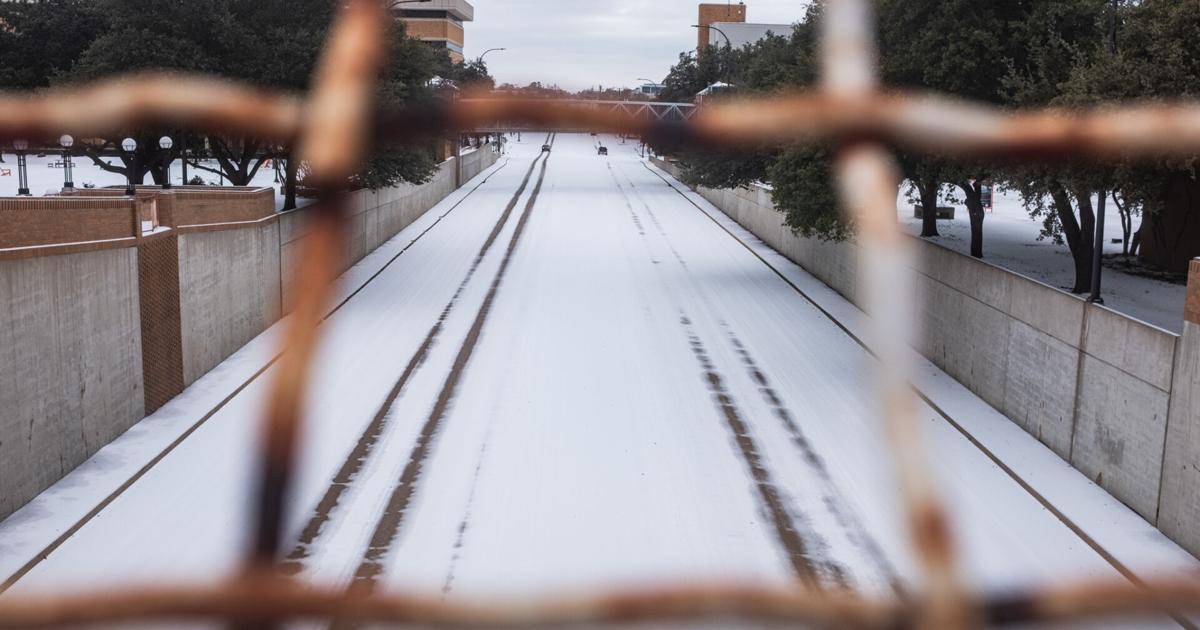

Snow blankets Cooper Street on Jan. 25 in Arlington. Brine, a saltwater solution, is placed on roads and pavements to prevent ice and snow from sticking.
As temperatures slowly start to rise back up from the lows of the winter storm, workers from the state, city and university continue to make sure everything is safe.
Here are some of the ways the Texas Department of Transportation, Arlington and UTA Police are getting through the snow and ice.
UTA
Icy spots began forming on campus in the middle of the winter storm. With slick roads and walkways, students could fall. UTA Police, as well as public safety officers, patrolled campus throughout the storm.
UTA Police Capt. Mike McCord said in an email that winter weather is a challenge for everyone on campus. UTA Police’s preparation was focused on communication with internal and external stakeholders, he said.
By keeping a line of communication, UTA Police ensures situational awareness and understanding of their role in carrying out campus plans to address the effects of adverse weather.
“Our field personnel remain mobile on campus to assist those on campus and identify any problematic issues,” McCord said. “We encourage our staff to remain mobile and visible, while also being cognizant of their safety and well-being.”
Texas Department of Transportation
The Texas Department of Transportation started preparing for the winter storm Jan. 21, operating around the clock to brine the highways ahead of expected ice, said Val Lopez, public information officer with the department’s Fort Worth district.
Brine is used to prevent ice from sticking to roadways, because once ice bonds to the road, it becomes very difficult to remove, Lopez said. Since the weekend, crews have been working on interstates in the Tarrant County area, clearing the ice using 10-yard and 6-yard sanders, briners, smaller pickup vehicles, bladed vehicles and other equipment.
Approximately 350 employees have been working 12-hour shifts to make the roads drivable and ice-free, Lopez said.
“This is going to continue through probably Friday. We’re going to have crews on tonight and probably tomorrow night, as well as working daylight hours. This was very much an all-hands-on-deck situation,” he said.
Typically, Texas’ winter storms last two or three days. Seven days into the winter weather operations, Lopez said the storm has been longer than usual, largely due to the immense amount of precipitation and the cold temperatures.
“This one had a lot of precipitation and lasted longer just because it got so bitterly cold,” he said. “It approached single-digit temperatures, and at night that becomes difficult to deice because the chemistry of it, because deicers are less effective when it’s colder.”
Crews from the east and south came up to help with the storm, Lopez said.
“This was a major effort through much of the state, not just North Texas, and so it was a significant event,” he said.
Despite the constant work to clear the roads, with the amount of precipitation and freezing temperatures, there still may be some ice on the roadways, Lopez said.
“There is not one tool or technique or chemical product that removes the ice. It’s a combination of all those things and hard work. And just because we had so much precipitation, there is a chance it could be out there,” he said.
After every winter weather event, the Texas Department of Transportation reviews its practices and looks for ways to improve, from doubling their inventory of plows on standby to being more aggressive with brine.
“We look for better techniques and better products all the time. So it’s a process, it’s an evolution, and we will continue to get better,” Lopez said.
Arlington
Susan Schrock, spokeswoman for the city of Arlington, said the city had an advanced forecast for the winter storm, allowing public works crews to prepare to keep roads safe since Jan. 21.
“Here in Arlington, we have more than 3,000 lane miles of roadways, and unfortunately, we can’t treat and clear all of those, but we do have a list of priority streets, and bridge crossings and hospital emergency department entrances that we do focus on,” Schrock said.
City workers have been out with salt, brine, sand and snow plows attempting to keep streets operational. Schrock said the greatest problem workers have faced is the temperature.
“Our biggest challenge is that it really hasn’t gotten back above freezing very much,” she said. “We just need that sun to come out and help more on the street so we can get this ice out of the way and get our commuters back to getting where they need to be safely.”
Over the past few days, some businesses have stayed open to provide for residents, first responders and essential workers. Schrock said this winter storm is comparable to ones in the past, and that there is something to be learned with each one.
“We have backup power where we need backup power, we have all the equipment that we need, we have more communication platforms to keep our residents informed,” she said. “I feel like each time we go through a winter storm, we learn something new as far as how we can help our residents.”
@atclements03 @wall035203