
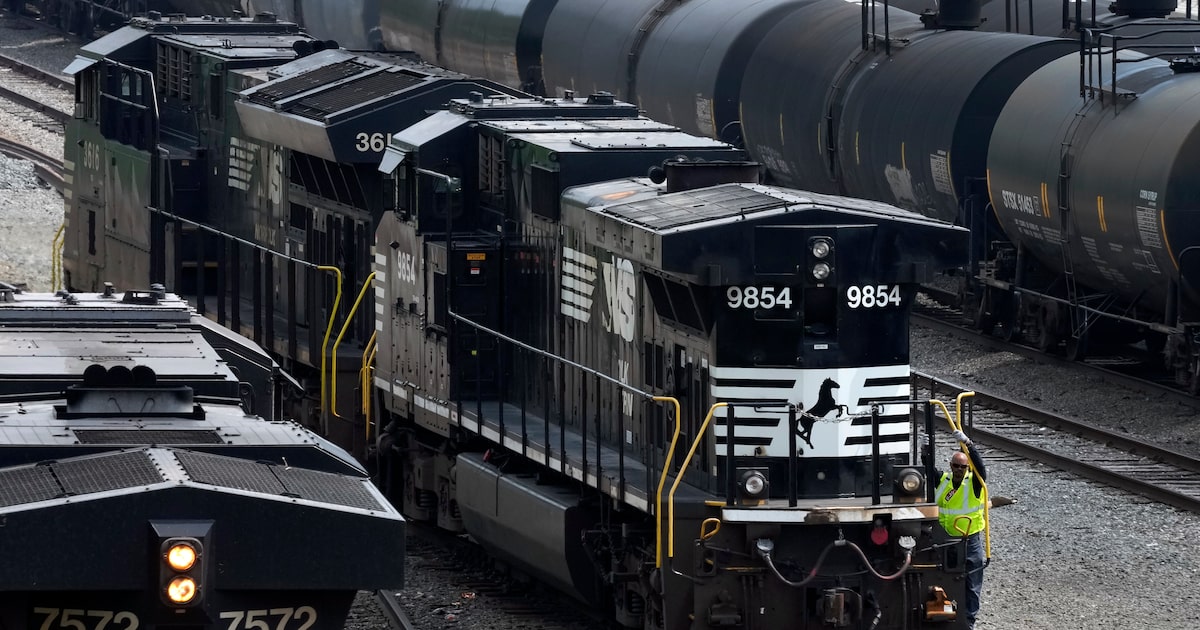
If you’ve been near Centerville and Garland roads and wondered why trains still blow their horns even though “Quiet Zone” signs went up years ago, you’re not alone.
Signs once posted near Centerville and Peavy roads announced the completion of a “Quiet Zone-Northeast Dallas” project around 2022.
But four years later, the horns are still blaring several times a day — and the “quiet” part hasn’t materialized in the way many locals expected.
Related

Curious Texas
Our reader Rex L Carpenter asked Curious Texas: “I noticed a sign at Centerville Road near Garland Road that listed the “Quiet Zone-Northeast Dallas” completion 2022. it’s almost 2026 and we still hear train horns multiple times a day. The signs on all the crossing streets, Centerville and Peavy as two all indicate quiet zone no horn but they are covered. I know this is an expensive improvement to a crossing and the work appears to have been done, divided lanes and control arms so now that we are about to enter 2026 what happened?
Here’s what’s going on.
What a quiet zone really means
A railroad quiet zone is an area where trains are not required to routinely sound their horns at public crossings, according to the Texas Department of Transportation.
Related

Under federal rules, train engineers are normally required to sound the horn at least 15 seconds before each public railroad crossing. But communities can apply to the Federal Railroad Administration to establish a quiet zone if they meet safety requirements.
That doesn’t mean complete silence. Trains can still sound horns within a quiet zone in emergency situations or if there’s a safety concern like a person, vehicle or obstacle on the tracks, according to the TxDOT.
A multistep process, not an instant fix
Getting a quiet zone approved is more than just installing signs. Cities must work with railroads and federal regulators, and add safety upgrades like gates, flashing lights, medians or four-quadrant gate systems so that motorists and pedestrians are protected even without a horn, according to TxDOT.
Related
In Garland’s case, a feasibility study showed the city planned improvements at more than 20 crossings along the Kansas City Southern line to meet federal criteria. That included new medians and other safety upgrades.
But meeting infrastructure goals is only part of it. Before a quiet zone becomes official, the city must submit formal documentation to the FRA and receive approval that all crossings meet safety standards, according to TXDOT. That approval can take time — sometimes years — as each crossing and safety measure is reviewed.
Related
 Why you’re still hearing horns
Even in communities where quiet zones are officially active, horns are still used for safety reasons. And in areas where the zone has not been formally activated or fully approved by the FRA, engineers are still required by federal law to sound horns at each crossing, according to the Federal Railroad Administration.
That’s why, despite the improvements and initial signs, train horns continue to be heard daily in parts of north Garland.