
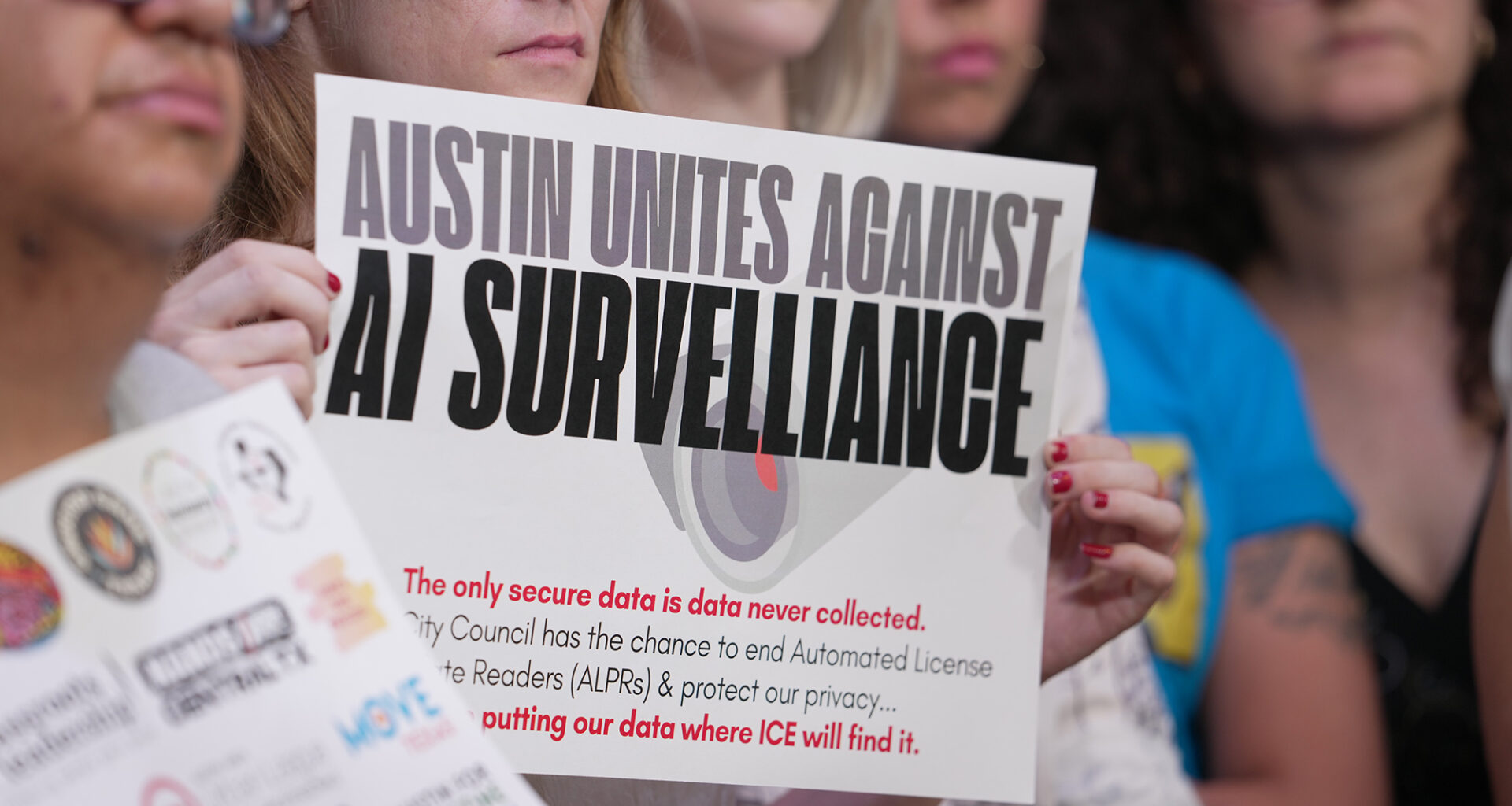
An activists holds a sign that reads “Austin Unites Against AI Surveillance” alongside council members during a press conference on the Austin Police Department’s controversial license plate reader program.
Ricardo B. Brazziell/Austin American-Statesman
Over the summer, the Austin City Council faced sustained public backlash over proposed contracts with two surveillance companies selling technology that can aid local law enforcement.

Privacy and criminal justice advocates urged council members to reject the contracts, arguing the tools could be used to infringe on civil liberties and potentially assist federal immigration enforcement efforts.
Article continues below this ad
Austin City Manager T.C. Broadnax ultimately pulled both items — automated license plate readers and mobile surveillance trailers at city parks — from council agendas in June and August after it became clear they lacked sufficient support. But he made clear the agreements would return for a vote at some point.
That’s set to happen next week, at least for one of the contracts. The City Council on Thursday will consider a five-year, $2 million agreement to place “mobile surveillance trailers” at city parks after a multiyear pilot program found their presence significantly reduced car break-ins. But the council will also vote on an oversight proposal by two council members that is designed to impose guardrails on all types of city surveillance contracts.
Council member Mike Siegel and Mayor Pro Tem Chito Vela, who have been the most vocally opposed to such technologies, told the American-Statesman they are proposing an ordinance dubbed the TRUST Act, which stands for “Transparent and Responsible Use of Surveillance Technology.”
The measure would establish new disclosure and oversight requirements for city departments seeking to purchase surveillance-related tools, including that staff prepare a “surveillance impact report” for council to consider prior to entering into any agreements with a company that collects data or provides surveillance tools.
Article continues below this ad
Read More: APD chief proposes major reorg to get more officers on street
Police officials have long said surveillance technologies like ALPRs and the park security cameras can help them work more efficiently amid persistent staffing shortages.
“Surveillance technology can be an important tool for public safety,” Vela said in a written statement. “But as these technologies become more powerful and pervasive, the City has a responsibility to be transparent, accountable, and clear about how they’re used, who has access to the data, and how residents’ rights are protected.”
Siegel said the TRUST Act would ensure the public is fully aware of how the city could use this kind of technology.
Article continues below this ad
“As a community we need to understand if a ‘parks camera’ contract is just for cameras or if it also allows artificial intelligence to determine when a person looks ‘suspicious’ or enables AI-enhanced search functions that could be abused,” Siegel said in a written statement.
Austin City Council members Mike Siegel, left, and Chito Vela discuss a new city budget at City Hall on Thursday, Nov. 20, 2025. The Austin City Council is set to vote on a budget that includes millions of dollars in spending cuts after voters rejected Proposition Q in November, a ballot measure that would have raised property taxes and generated $110 million in new revenue.
Jay Janner/Austin American-Statesman
Whether passage of the ordinance would influence their votes on the parks surveillance contract remains to be seen. Sigel said he was “skeptical” of the proposed agreement and Vela said he “needed more details.” Both said they looked forward to addressing the issue at a Tuesday council work session ahead of Thursday’s regular meeting.
Siegel said the ordinance would not necessarily change his position on automated license plate readers.
Article continues below this ad
“I do not view the TRUST act as clearing the way for me to vote for ALPRs,” Siegel told the Statesman. “But it will ensure the public is provided with detailed information about a new ALPR contract’s surveillance impacts should one make it to Council.”
The park surveillance contract council will consider is with a security technology company called LiveView Technologies to install mobile surveillance security trailers at Austin parks, though the cameras they have aren’t typical.
According to the company’s website, they use AI-powered software to “detect unusual behaviors” and then can “activate lights, loudspeakers, and cameras to deter suspicious activity” before a police response is required.
In 2022, the city installed similar trailers from a different company in the parking lots of 15 parks that had become hotspots for car break-ins and other criminal activity.
Article continues below this ad
Nine of those “experienced a decrease in reported incidents of crime during or after trailer deployment” over a two-year period, Austin Parks Director Jesús Aguirre wrote in a Jan. 26 memo.
That included a 58% drop in vehicle break-ins at Mount Bonnell, a popular Austin park.
Read More:Hays County officials warn against burglaries targeting disabled veteran vehicles
Aguirre’s memo outlined some of the security measures the city will take to protect video and data collected by the security cameras. Per the contract, the city will retain collected data for 60 days and LiveView Technologies will not be able to access it.
Article continues below this ad
Additionally, the cameras will not use “facial recognition, biometric identification technology, audio capture, or autonomous analytics,” Aguirre wrote in the memo. Only authorized personnel, such as Police Department employees, will be allowed to access the data. Usage will be monitored through a “time-stamped audit log.”
But opponents remain skeptical.
“There are better ways to increase public safety than surveilling our community,” said Savannah Lee, the director of policy and operations at Equity Action, the advocacy organization that helped lead the charge against license plate cameras last year.
Savannah Lee, with Equity Action, speaks to the press after a watch party in support of the passage of Proposition Q at the Brewtorium, Nov. 4, 2025.
Sara Diggins/Austin American-Statesman
Lee said that some community members are especially concerned about ICE agents gaining access to video and data collected by the cameras to aid in the agency’s deportation efforts. Recent reports describe how ICE has used cell phone tracking software to surveil activists in Minneapolis.
Article continues below this ad
City spokesperson Kanya Lyons did not directly answer a question about how much access federal law enforcement agencies would have to data collected by the security trailers, but said “all requests for security footage will be processed through formal legal channels and reviewed by our Law Department.”
For others, the privacy tradeoffs are worth increased public safety.
Joell McNew, an advocate for improved safety on the University of Texas at Austin campus who recently founded a consulting business that helps clients develop crime prevention strategies, praised the cameras.
She said they are especially helpful in cities that struggle with police patrol due to officer shortages.
Article continues below this ad
“These crimes are impacting the quality of life of so many,” McNew said. “People don’t feel safe to use these shared spaces, that’s a huge problem that needs to be addressed.”
Editor’s Note: This story has been updated to add a statement from the city of Austin