
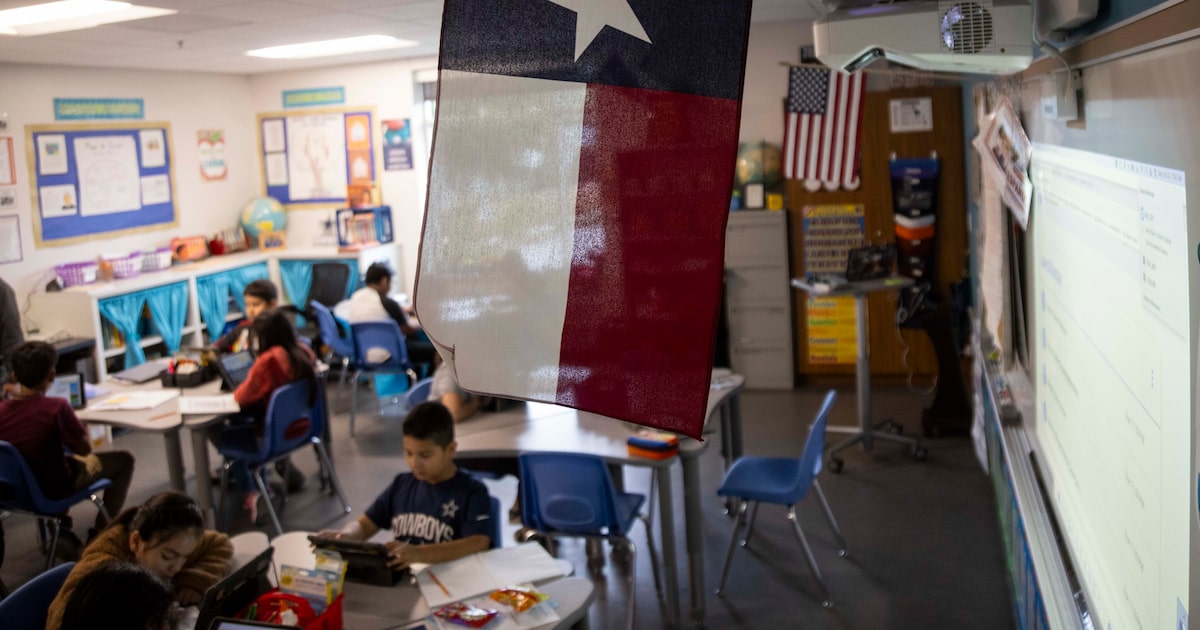
More than a dozen speakers asked Texas’ State Board of Education to include the contributions of people from all cultures, faiths and backgrounds as the board revises state standards for social studies.
The board is early in that overhaul process. Over the coming months, working groups will sort out details of what students across the state will learn in social studies and when they’ll learn it.
The board is expected to vote on the proposed key topics at a meeting Thursday afternoon. It is expected to vote on a set of proposed standards at its June meeting. The new standards will be implemented in 2030.
Last year, the board approved a chronological framework that places greater emphasis on Texas and U.S. history and downplays world history and geography. The framework eliminates a World Cultures course that students take in sixth grade.
The Education Lab
Related
At Wednesday’s meeting, the board discussed a list of key topics and subtopics developed by a panel of nine appointed content advisers to be included in the state standards. Those topics will be sent to volunteer working groups, which will craft state standards based on them.
During public testimony, several speakers pointed out content areas that were left out of the list of key ideas. Jennifer Blanchard Sayed, a doctoral student at Southern Methodist University, noted that the list includes European history and accomplishments, but focuses less on how European achievements depended on innovations from other parts of the world such as India, China and the Islamic world. For example, she said, the list discusses the roots of Western civilization in ancient Greece but makes no mention of Arab scholars preserving and expanding on Greek ideas and knowledge.
Related

“This historical amnesia fails to integrate actual global patterns of cultural and material exchange and knowledge transmission that shaped human history in the classroom,” she said.
Since 2010, Texas’ high school social studies standards have mentioned Sikhism alongside Buddhism, Christianity, Confucianism, Hinduism, Islam and Judaism as major world religions that students need to understand. The proposed themes that the board discussed Wednesday include a section on how Hinduism, Buddhism and Confucianism shaped societies in ancient India and China, but they don’t mention Sikhism.
Related

Savleen Singh, senior education manager for the nonprofit Sikh Coalition, told The Dallas Morning News that lack of inclusion is concerning for thousands of Sikhs living in Texas. Sikh students face bullying from classmates and, in some cases, teachers, she said. Much of that animosity stems from the fact that students don’t understand the history of Sikhism or why its adherents wear head coverings, she said. Including the faith in state standards could go a long way to creating greater understanding, she said.
Donald Frazier, a content adviser and director of The Texas Center at Schreiner University, said the advisers were clear-eyed about the responsibility of conveying an accurate picture of Texas and U.S. history to students, even when it comes to difficult topics like slavery. The revised standards have the potential to be “a very restorative balm” during a difficult time in the nation’s history, he said. He thinks growing rancor and polarization across the country is a symptom of declining emphasis on social studies education, and he hopes the new standards are part of a reversal of that trend.
“This is a big, big change,” Frazier said. “This is an exciting opportunity to bring social studies back into its proper position as one of the core content areas in the education space.”
Related

The DMN Education Lab deepens the coverage and conversation about urgent education issues critical to the future of North Texas.
The DMN Education Lab is a community-funded journalism initiative, with support from Bobby and Lottye Lyle, Communities Foundation of Texas, The Dallas Foundation, Dallas Regional Chamber, Deedie Rose, Garrett and Cecilia Boone, Judy and Jim Gibbs, The Meadows Foundation, The Murrell Foundation, Ron and Phyllis Steinhart, Solutions Journalism Network, Southern Methodist University, Sydney Smith Hicks, and the University of Texas at Dallas. The Dallas Morning News retains full editorial control of the Education Lab’s journalism.