
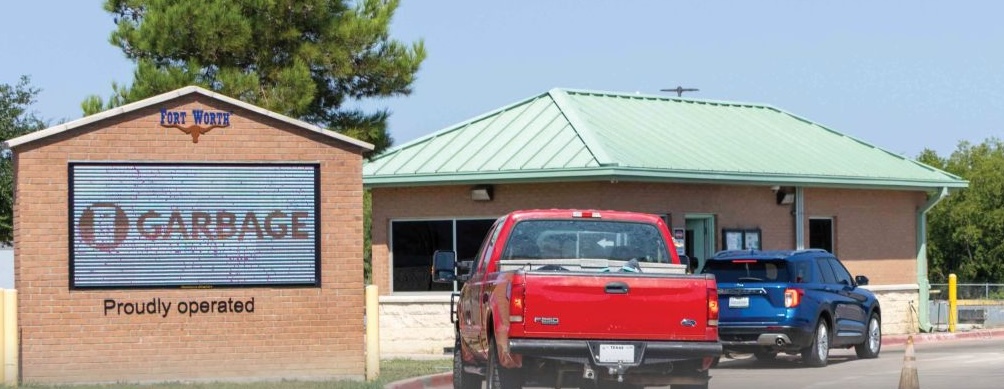
Fort Worth is moving forward with two sustainability initiatives that city staff say will reduce costs, modernize infrastructure and make recycling easier for residents.
Projected benefits include reducing the city’s streetlamp electricity costs by an estimated $1.2 million annually and establishing a program to create reuse centers at the city’s waste and trash drop-off stations.
Fort Worth Environmental Services employees recently updated the City Council’s Property Management & Environmental Services Committee on the progress of two federal grants — one focused on energy efficiency and the other on recycling infrastructure. Together, they represent nearly $10 million in investment over the next several years.
Streetlights and long-term energy savings
Jordan Balusek, environmental supervisor, outlined the city’s progress on an Energy Efficiency and Conservation Block Grant, a multipart program aimed at reducing energy use across city operations while helping residents better manage utility costs.
Central to that effort is a comprehensive energy efficiency conservation strategies document that the city is developing in partnership with Ameresco. Expected to be completed next month, the document will serve as a long-term road map for city departments involved in building retrofits, fleet upgrades and new construction.
Rather than requiring immediate capital outlays, Balusek said the framework gives departments practical, phased strategies based on energy audits already conducted across city facilities.
“It’s meant to be actionable guidance (that) departments can return to as funding becomes available,” Balusek said.
One of the most visible components of the grant is a retrofit of 1,650 streetlights to LED smart models. The project is part of a broader citywide effort to convert Fort Worth’s streetlight network, which includes about 71,000 fixtures. The grant-funded portion covers roughly 5% of the city’s remaining non-LED lights.
Fort Worth Transportation & Public Works estimates the retrofit will be completed by spring 2026. The upgraded fixtures are expected to extend streetlight lifespans 10-15 years and save the city about $1.2 million annually in energy costs. Those savings will be tracked and verified through Oncor audits to ensure accurate measurement.
Staff also highlighted a public education component of the grant. The city mailed 143,000 postcards, reaching about 55% of residential parcels, with a focus on neighborhoods facing higher energy burdens.
Each postcard includes a QR code linking to a sustainability website launched late last year, offering tips on water and energy conservation and information on existing city rebate programs.
Recycling infrastructure and reuse pilot
Avery Pesek, an environmental services senior management analyst, presented details on the city’s $4.8 million Solid Waste Infrastructure for Recycling grant, which will be implemented over three years.
The funding supports a range of improvements, including new equipment, signage and construction upgrades at city drop-off stations. About $1 million is allocated to launch a pilot reuse program and enhance recycling education, while $550,000 will fund new recycling compactors to increase capacity and reduce daily hauling trips.
The reuse program will launch at the Hillshire Drop-off Station before expanding citywide. The program will allow residents to drop off usable furniture, electronics and building materials for others to claim free of charge. Items not picked up within a set time will be donated to local nonprofits such as Trinity Habitat for Humanity, Goodwill and The Welman Project. Scrap metal will be excluded to avoid conflicts with existing recycling practices.
Electronic signage upgrades, budgeted at $133,000 will allow the city to update recycling messages remotely and more clearly communicate what materials are accepted. Pesek said this is a key step in addressing contamination, which currently stands at 27% in single-stream recycling.
The largest share of the grant, about $3.1 million, is reserved for construction improvements at drop-off stations, with the Old Hemphill Road Drop-off Station a top priority. Old Hemphill is the city’s busiest station, recording more than 123,000 visits in fiscal year 2025. Planned upgrades include flood control measures, improved fencing to reduce theft and redesigned traffic flow to improve safety.
Lou Chapman is a member of the Fort Worth Report’s Documenters crew.
If you believe anything in these notes is inaccurate, please email us at news@fortworthreport.org with “Correction Request” in the subject line.
At the Fort Worth Report, news decisions are made independently of our board members and financial supporters. Read more about our editorial independence policy here.
This <a target=”_blank” href=”https://fortworthreport.org/2026/01/30/10m-from-federal-grants-aimed-at-bettering-fort-worth-recycling-energy-efficiency/”>article</a> first appeared on <a target=”_blank” href=”https://fortworthreport.org”>Fort Worth Report</a> and is republished here under a <a target=”_blank” href=”https://creativecommons.org/licenses/by-nd/4.0/”>Creative Commons Attribution-NoDerivatives 4.0 International License</a>.<img src=”https://i0.wp.com/fortworthreport.org/wp-content/uploads/2021/04/cropped-favicon.png?resize=150%2C150&quality=80&ssl=1″ style=”width:1em;height:1em;margin-left:10px;”>
<img id=”republication-tracker-tool-source” src=”https://fortworthreport.org/?republication-pixel=true&post=384786&ga4=2820184429″ style=”width:1px;height:1px;”><script> PARSELY = { autotrack: false, onload: function() { PARSELY.beacon.trackPageView({ url: “https://fortworthreport.org/2026/01/30/10m-from-federal-grants-aimed-at-bettering-fort-worth-recycling-energy-efficiency/”, urlref: window.location.href }); } } </script> <script id=”parsely-cfg” src=”//cdn.parsely.com/keys/fortworthreport.org/p.js”></script>