
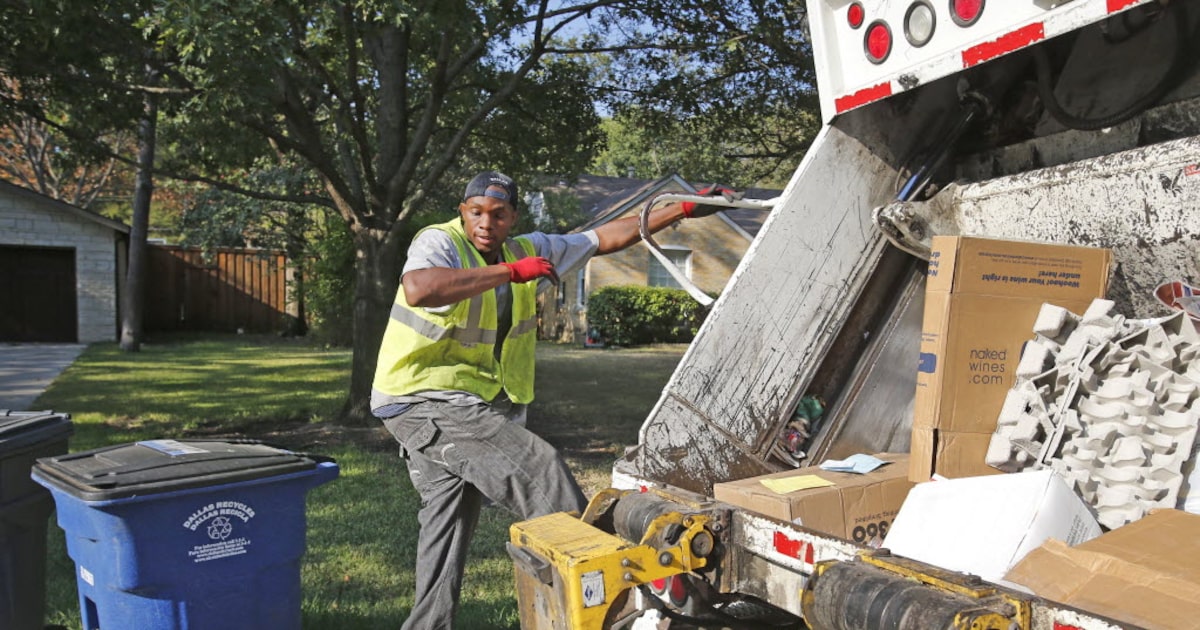
Thousands of Dallas residents have spoken: They want to keep alley trash pickup as it is.
City officials began surveying residents in November with alleys narrower than 9 feet to see if there was an appetite for curbside pickup or a willingness to pay more to retain their alley services.
Nearly 44,000 surveys were mailed. On Friday, results showed a majority, 77%, did not respond and were mainly in southern Dallas. Among those that did respond, 93% wanted to keep alley pick up, and 60% said they’d chip in more.
The City Council will be briefed on the survey results Wednesday.
Political Points
The city’s survey efforts began after it was forced to pump the brakes on transitioning 26,000 alley pickup customers to curbside, a move which residents strongly opposed. It was the second time in two years that the city had paused its plans to change sanitation services.
In the years prior, officials have offered several explanations of why they prefer making the change. Alleys in Dallas are typically eight- to 10-feet wide, which makes it harder for trucks to maneuver and causes damage to property fences and overhead utility lines. These scenarios are often dangerous for the sanitation workers picking up trash, officials say.
But years of backlash has made city officials reconsider their approach, and move on from ending alley service wholescale to preserving alley services where there’s clear community support. They’ve also changed pickup in areas they say aren’t feasible at all.
Officials maintain a “single, uniform solution” is not going to work for all areas, and there are plans to conduct research on emerging technologies and other kinds of delivery methods in areas. Sanitation Director Clifton Gillespie has floated a possibility of working with private providers.
City officials plan to get feedback in February. They will begin communicating with residents in June, and have plans to implement the changes in February 2027.
The city has pitched four trash collection options:
Hybrid approach: Continue with the city’s proposed hybrid plan that transitions 26,000 customers with alleys narrower than 9 feet, dead-end alleys longer than 200 feet and unpaved alleys, especially in areas where most homes have front driveways. Officials say this plan reduces property damage, improves worker safety, aligns with environmental goals and is cheaper for residents compared to other alternatives. Reduced transition: Research and develop ways to transition less than 10,000 households, all of whom have front driveways and a reasonable distance from front structure line to curb. Limited transition: Identify collection routes with the lowest survey response rates, and evaluate for transition. Less than 5,000 locations. No transition: Keep things as is.