
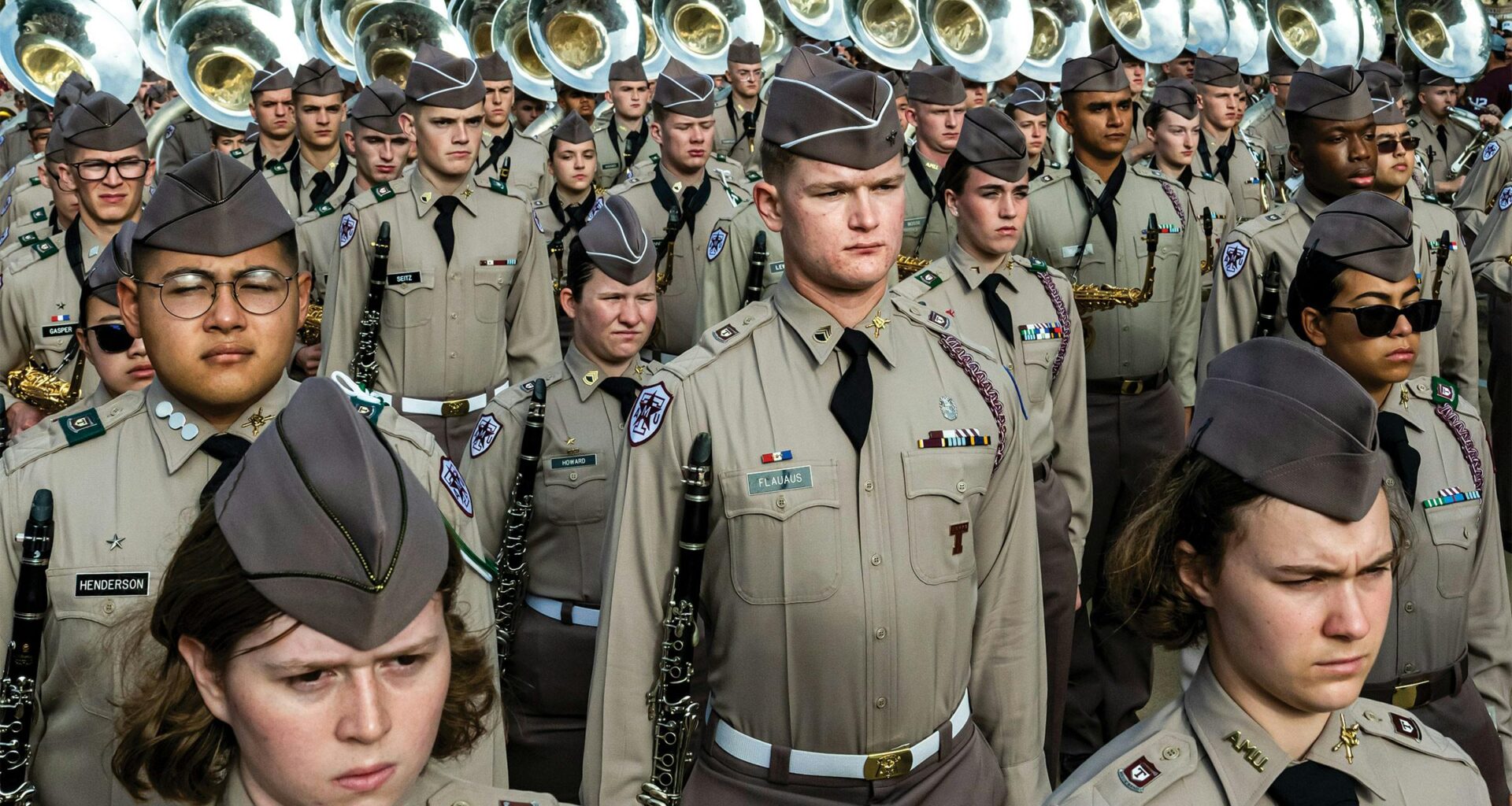
Few places on the main campus of Texas A&M University bear a stronger connection to the school’s civic religion than the altar near Rudder Tower, in the Rudder Theatre Complex, between the entrances to Rudder Auditorium, where Major General James Earl Rudder’s medals are on display for all time, the measure of a titanic man.
You know, Rudder! Class of ’32, a vintage of men from whom much would be asked. Commander of the Second Ranger Battalion who, in search of heavy artillery that threatened the Normandy beaches, climbed the hundred-foot cliffs of Pointe du Hoc with ropes and grappling hooks under machine-gun fire, in darkness, with too few troops, but who nonetheless cracked open fortress Europe and then drove a shiv into its dark heart.
Rudder! Who redeemed the honor of France, who repaid our debt to Lafayette again, who drove the boot toe of American democracy into the shin of one pig-faced fascist after another for four hundred miserable miles. Who received, alongside a dozen medals from his own nation, the French Légion d’Honneur and the Croix de Guerre with palm and stacked them like so much cordwood among recognitions from nations as far from Normandy as the Dominican Republic, many of them on display in College Station. Who was so decorated that the U.S. Army named a new award after him. Who came home and—in the manner of so many of the best of the Greatest Generation whose war service would have been enough—became a great man of peace, perhaps the best university administrator A&M ever had, and turned a backwoods trade school and military academy into a modern, prosperous, equitable, integrated, and coeducational institution. A better man—a harder man—could scarcely be imagined.
Past the medals, on the auditorium’s stage in March 2024, a new generation of Aggies were exploring different ways to be men. It was the fifth iteration of Draggieland, an annual student-run drag pageant, and the theme was Alice in Wonderland. We in the audience were through the looking glass. Bella Donna Fables, a student with a stage name, wore a tight, shiny purple bodysuit, fishnets, and fuzzy pink leg warmers. She dipped and swayed, teasing the audience of hundreds. Jets of purple smoke fired skyward. As members of the corps of cadets passed by outside, she dropped to the stage, kneeling in time with the plaintive wails of Chappell Roan’s “Pink Pony Club.” She bent backward, flattening herself, spreading her legs wide in the air, shredding on an unplugged electric guitar as the song crescendoed. The crowd, mostly young women, cheered ecstatically.
During the show, the moderator—a towering drag queen with a beard, a purple wig, and leather thigh-high boots—noted that Fables had been doing drag for only five months. Fables, our hero, had worked on the choreography and modified her outfits by hand. In College Station, day to day, there may have been parts of herself she had to hide. In the Rudder Auditorium, she was briefly a goddess.
After the fun was done, representatives of the Queer Empowerment Council, an ad hoc student group that popped up after the state legislature forced A&M’s LGBTQ center to close with 2023’s Senate Bill 17, got up onstage. “My pronouns are they, them, theirs,” one said. Draggieland provides “so much queer joy and community that this campus desperately needs.” They asked for donations. “F— Greg Abbott,” a member of the audience called. The crowd erupted in cheers.
In short order, its members wouldn’t have much to celebrate.
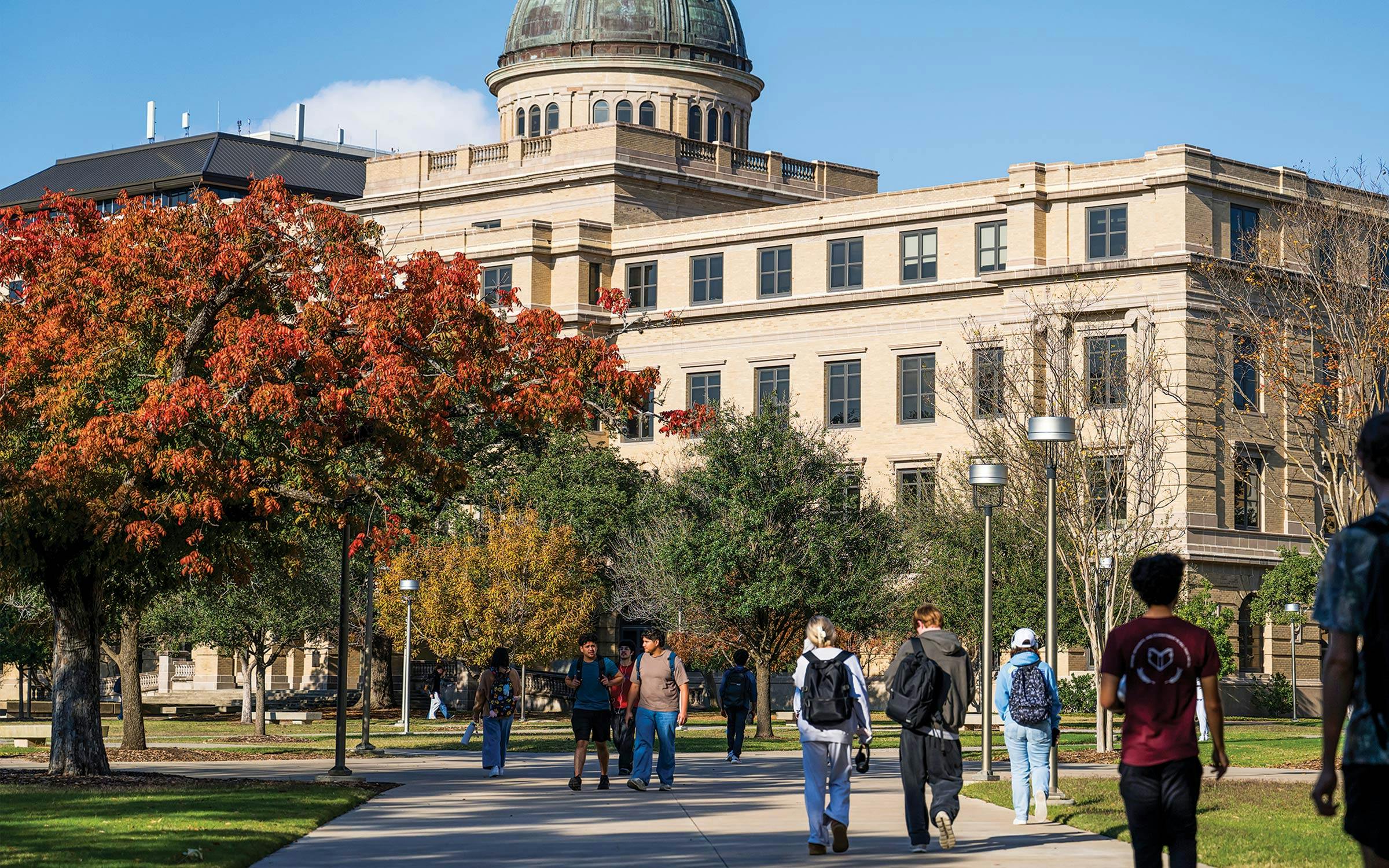 The fall 2025 semester started with President Mark Welsh resigning under pressure, but by the close of the term in December, it was business as usual for students heading into final exams.Photograph by Meridith Kohut
You know Aggies, or you may think you do. If you live in Texas, you at least know Aggie jokes, embraced in part by the school. A good-humored lot. And conservative, patriotic, upright. Or, as Longhorn snobs might have it, uptight, slow-witted bumpkins. Either way, there would seem to be an irresolvable distance between A&M’s sense of itself, its pride in tradition and belief that it is the inheritor of Rudder’s example, and the colorful, powerful curves of Bella Donna Fables.
Many graduates seem to agree. A right-wing media outfit that has been waging a campaign against the school, Texas Scorecard, sent a brave witness to Draggieland who reported back details as if he were surveying a NAMBLA convention. The Rudder Association, an activist group that has fought to de-woke-ify A&M, charged that the event was getting too much funding from the university. State Representative Brian Harrison, class of ’04 and the face of the school’s implacable opposition, whose central case has been that his beloved alma mater has gotten much too homo, called for anyone who authorized the show to be fired.
While other great Southern universities—such as Ole Miss—may be neurotic about race for the rest of time, A&M’s anxieties have been more about gender and sexuality. Women weren’t allowed to attend until 1963; the establishment of the first gay-student group came in 1984 after a seven-year court battle. And in February 2025 the A&M board of regents, the men and woman that Governor Greg Abbott handpicked to govern the school system, unanimously voted to ban drag shows, which it said were “inconsistent with mission and core values,” at A&M colleges. The contradiction was too destabilizing to be allowed. (A month later, a federal judge temporarily blocked the ban, and the Queer Empowerment Council continued with Draggieland as planned.)
We live in an era that is allergic to complexity and context, and in which the tolerance and mutual respect necessary to make democracy function are harder and harder to come by. Any great institution—and Texas A&M is one of the greatest the state has—is bound to be stranger and more capacious than its most simpleminded defenders would have it. In point of fact, rather than being “inconsistent” modern impositions, cross-dressing and drag would appear to be old and venerable Aggie traditions.
The closest thing the school has to an officially approved history, Henry C. Dethloff’s Texas A&M University: A Pictorial History, 1876–1996, has barely passed one-sixth of its length before the first men in dresses appear—a cast photo of the Illyrians, a theater troupe that staged an all-male production of Shakespeare’s Twelfth Night in 1911, at a time when many undergraduates still lived in tents. The play, you may remember, is a comedy whose main plot involves cross-dressing, which means a heroic corps of cadets man—thank you for your service, sir—played Viola pretending to be Cesario, presaging by about eighty years Judith Butler’s theories about the performativity of gender.
Aggies continued to put innovative research into the field of immersive gender studies in the ensuing decades. Starting in 1947 freshmen cadets were “required to wear lipstick and rouge and skip to class like girls on the week before Bonfire and the big football game [with the University of Texas at Austin]” by upperclassmen, according to a paper by A&M professor emeritus Jonathan Smith. When administrators tried to crack down on the practice, freshmen wrote in to The Battalion, A&M’s student newspaper, arguing for their right to “skip and wear makeup, and thereby earn ‘the privilege of saying they were True Aggies.’ ”
Homosexual overtones—in my College Station? In November 2025 the regents, motivated by ongoing conflict over gender and racial difference on the school’s flagship campus and the perception that A&M was being ruined by woke lefties, moved to bar the teaching of any form of “race and gender ideology” without prior approval. It was the latest in a string of crackdowns on the campus. Professors and administrators at the university have been persecuted for criticizing state leaders, preemptively fired for their advocacy for racial inclusion, punished for including “bad” books in their curricula, and castigated more generally for teaching seditious ideology, including classes on political Islamism.
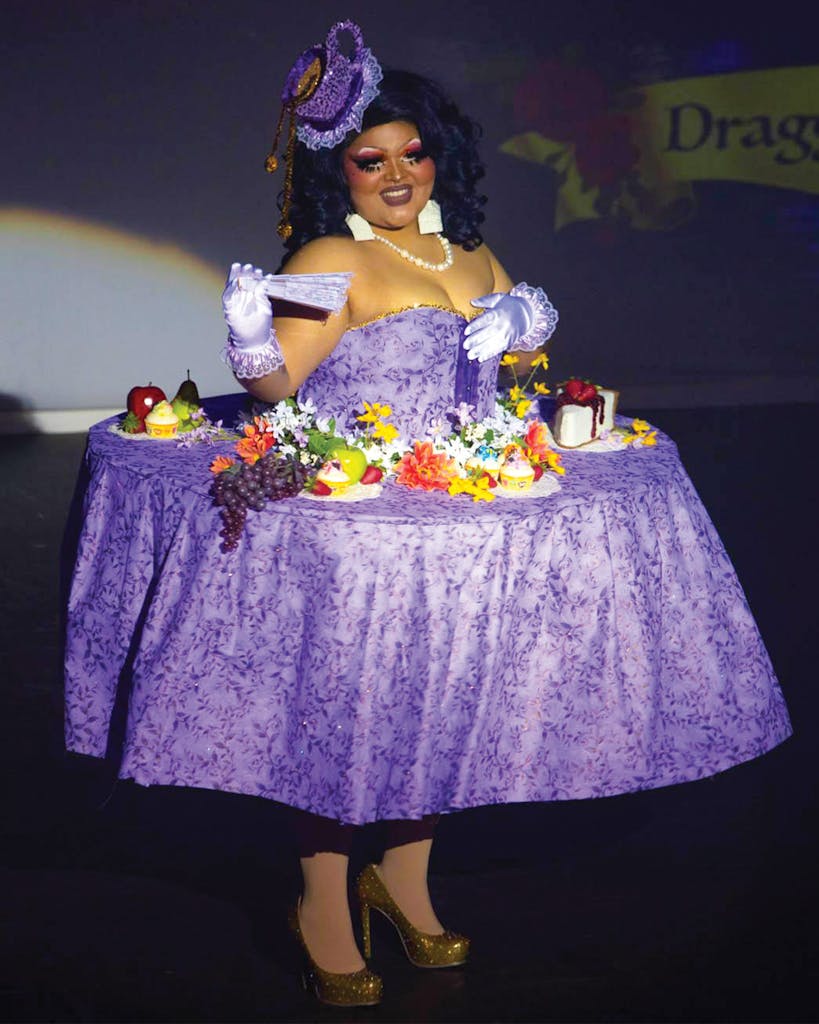 Drag queen Bella Donna Fables was the runner-up at the Draggieland pageant in 2024.Ashely Bautista/The Battalion
Texas has never known quite how to think about its universities. In almost every generation, our schools—most often the University of Texas—have come under attack by elected officials for being foreign bodies spreading a corrupting influence. But crackdowns have usually been met with strong pushback from other elected officials. When the corrupt Governor James “Pa” Ferguson tried to fire professors at UT, claiming they had criticized him, the Legislature impeached him and he subsequently resigned.
The Aggies are getting it worse than the Longhorns ever did, and this time there’s been very little backlash. The school is on its fifth president in five years and appears ungovernable to both insiders and external observers. It currently has what is in effect an occupation administration—the president and chancellor of the university system are both former Texas state senators with no real history in education.
“The mood right now is by far the worst I’ve seen, the worst in two decades,” said Professor Dale Rice, who served as the speaker of the faculty senate before the Legislature disbanded it in the 2025 session. Our state has long been able to boast of having not one but two extraordinarily successful university systems, but Rice told me that what is happening at A&M creates a risk that Texas “will not have them two decades from now.”
Even if you’re not an Aggie, you have a vested interest in the fight. There is, first, a material element. The flagship campus of the state’s largest public research university has historically upheld modernity in Texas, and that load-bearing institution is being diminished.
The other reason you should care is that the political questions facing Texas A&M are the most important questions facing the nation as a whole. In 2026, the university will celebrate its 150th birthday and the nation will celebrate its 250th. Who counts as a true Aggie? A true Texan? A true American? What is the purpose of higher education in Texas? Can we keep the great colleges we’ve inherited from Rudder, or will the heroic work of generations past be erased?
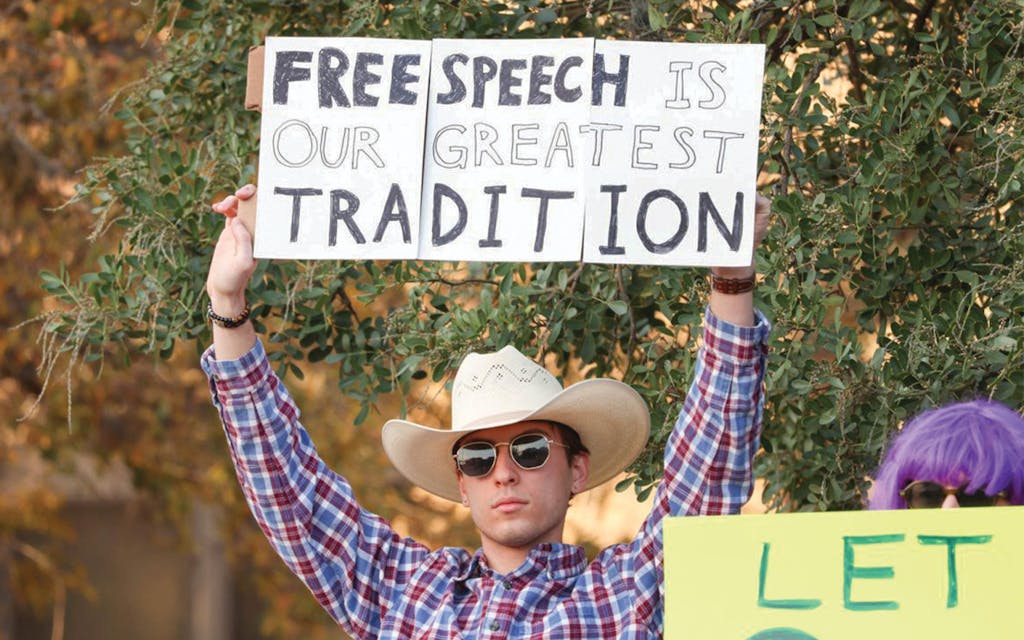
A protester in 2025 after the drag show was shut down.Jacquelyn Burns/The Battalion
The current conflict is a debate over the true nature of Texas A&M, so to evaluate it we have to ask what an Aggie is. Fortunately the school has produced dozens of books and journal articles on this question, from the riveting insights in Engineering Agriculture at Texas A&M: The First Hundred Years to comedic memoirs of student life to a walking guide of the campus and at least six cookbooks.
Dethloff’s history of the school offers two answers. His account is an affectionate chronicle that records crises large (the 1908 student strike that dethroned a president) and small (the puppy-napping of Reveille VI, the school’s collie mascot, by a UT student in 1993). The first version of the school’s origin is mythological. Like Rome’s, the story begins with wolves.
At the start of the fall semester in 1876, the Agricultural and Mechanical College of Texas held classes for its first six students, led by six professors, in a few buildings in a field overrun with “horned toads, scorpions, rabbits, and deer,” wild mustangs and Longhorns, along with wolf packs. “I’m killed! I’m killed!” a student named Martin Durkin is said to have yelled as he was “hit and knocked to the ground by a ball of furry fury” just after dinner at the end of the first week of classes. He lived: His fellows pulled him into the main building, upon which “wolves scratched and clawed on the window panes,” as if eager to enroll too. If the accounts are to be believed, it was one of two wolf attacks that year.
The school that was to be renamed A&M had very little to recommend it for many years to come. The Galveston Daily News reported in 1884 on rumors that the lout faculty “drank liquor and played cards.” A lawmaker vowed in 1893 that he would “as soon give his boy a pony, six shooter, bottle of whiskey and deck of cards and start him out to get his education as to send him to the AMC.” Students periodically burned their own outhouses, perhaps because there was nothing to do on “campus” except obtain permission from the administration to visit Bryan, more than an hour’s walk away. Out of this nothingness, a modern university grew. This is a typical frontier narrative—the heroes start with nothing and end, victoriously, with everything. There’s surely a lot of truth in it.
The second origin story in Dethloff’s book, the political version, is that Texas A&M is the product of the foresight of a set of ex-Confederate, post-Reconstruction Democrats, first among them Governor Richard Coke, “the founder of higher education in Texas.” Coke spoke at the college’s dedication on October 4, 1876. “Let honor be your guiding star,” he told the students, escaping town before the wolves descended.
There’s truth in this narrative, too, but it’s obscuring a much stranger, equally essential story. Texas A&M is a 150-year sleight of hand, a trick conducted with the best of intentions and to the great benefit of the state. Dethloff hides this illusion with one of his own in the book’s first two sentences: “Texans, who in the fragile days of the Republic of Texas had dedicated public lands to higher education, shared the great vision and aspirations of Senator Justin S. Morrill, who introduced the bill to establish the land-grant system of public higher education. The dream could not be shaken by bloody Civil War or by bitter Reconstruction.”
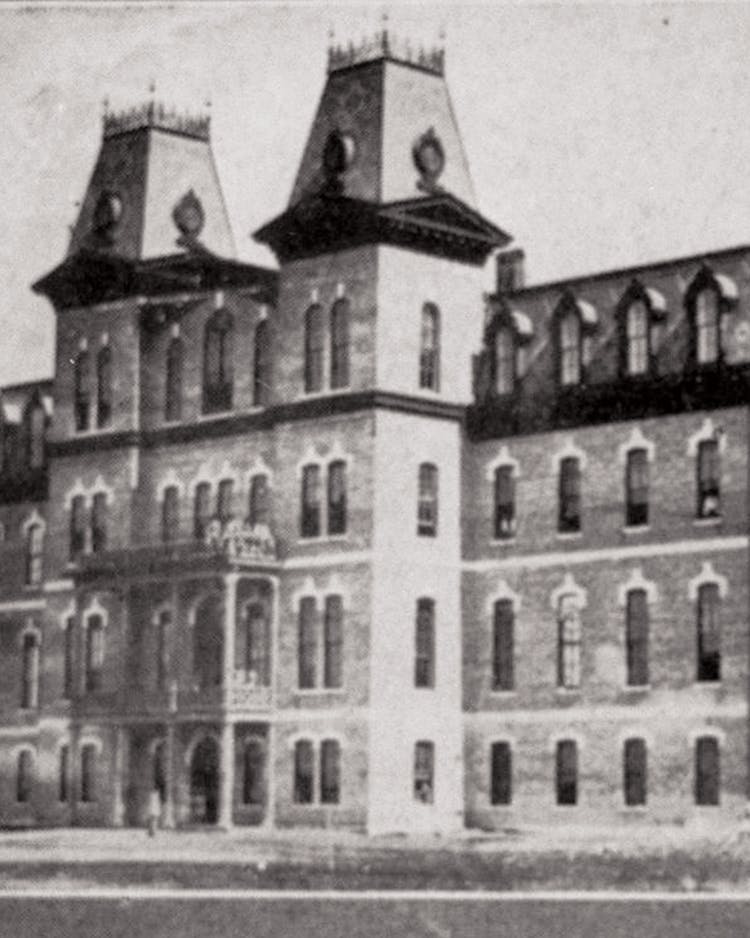 One of the first buildings at Texas A&M University in 1877, when the campus was said to be overrun by wolves. University of North Texas Libraries, The Portal to Texas History, Hardin-Simmons University Library
 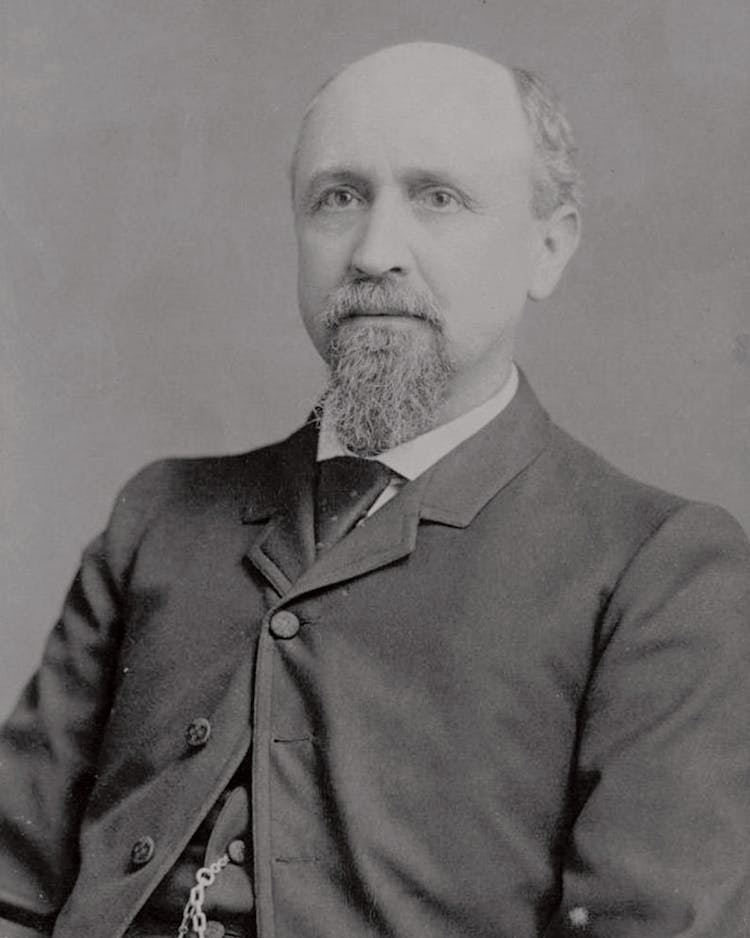 Confederate general and first A&M president Lawrence Sullivan Ross. H.R. Marks/Collections of the Confederate Memorial Literary Society/Virginia Museum of History & Culture
In any official history, as the besieged humanities faculty of Texas A&M could tell you, you should first look for the ellipses, the things missing and downplayed. You would not know, from this passage, who Morrill was—a Vermont Republican abolitionist—or when the bill was passed—in 1862, the worst year of the Civil War, when no Texans sat in Congress. You would not know that many did not share Morrill’s dream of a nation of universities. Chiefly, you would not know that Texas A&M is a product of “bitter Reconstruction”—of the victory of the Union Army and military rule in Texas.
Fear of the university was a continual presence south of the Mason-Dixon Line. Many colonists worried that their few colleges, staffed with imperial professors, were turning good American boys toward Mother England. After independence, universities bred like rabbits in Massachusetts and the North. Thomas Jefferson argued, in Virginia, the keystone Southern state, for a universal public-education system totally devoid of religious instruction and for an expansive, freethinking university. (In these respects, he would have opposed recent sessions of the Texas Legislature.)
His plea mostly failed. Fellow Southerners saw education and the hard sciences as Northern things. One representative example in Texas was that of Senator Louis Trezevant Wigfall, one of the strangest men in American history. In the prewar period, Wigfall’s priority was to maintain the sickly social order that allowed Southern gentlemen a decent living and leisure time through slavery. The south had no “cities,” no “literature,” no “navy,” and no industry. “We don’t want them,” he told an uncomprehending Irish journalist, nor did they want any “mechanical or manufacturing classes.” Texans were a “primitive but civilised” people who were content to keep sending their bloody cotton to market on other people’s ships to other people’s factories.
Morrill introduced his land grant bill in 1857. The South didn’t want it. It was vetoed in 1859 and passed in 1862 only after the Southerners had unelected themselves from Congress. Looked at one way, Morrill’s bill was an act of extraordinary, high-minded generosity. At a time when Southerners, including future A&M President Lawrence Sullivan “Sul” Ross, were killing Northern boys on the field, the North made a provision for Southern states to start universities with the proceeds from the sale of federal land once they rejoined the nation.
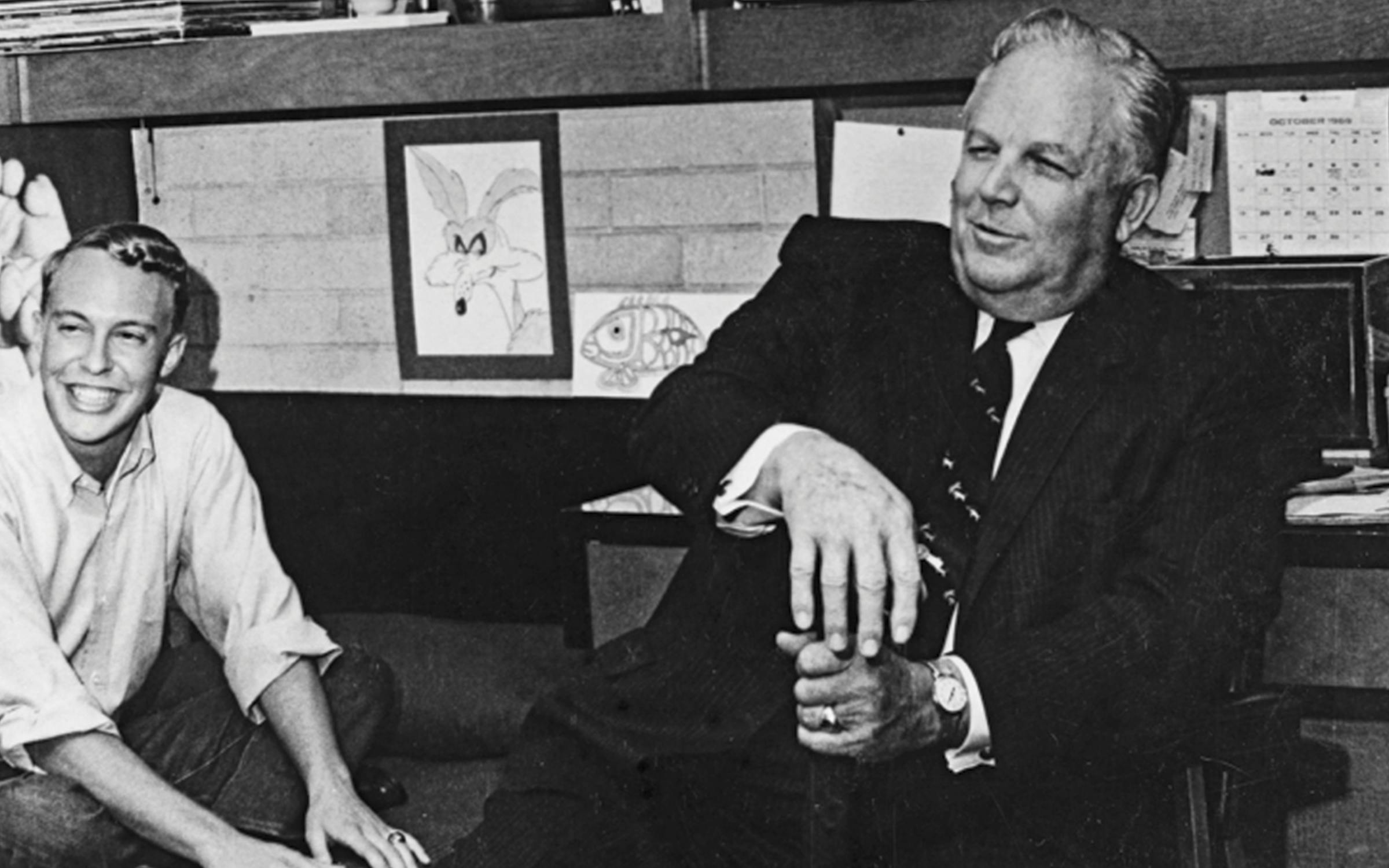 Texas A&M President James Earl Rudder kicking back in a dorm in 1969.Courtesy of The Battalion, Texas A&M University
Looked at another way, the universities were a just and holy punishment from a vengeful nation. Texas, whether it liked it or not, would be forced to progress. Morrill’s bill contained guidelines for the kind of education schools should offer, all of which would come to be embodied by A&M. Land grant universities would, in effect, offer instruction and research in scientific, labor-saving agriculture so as to point away from labor-intensive slave agriculture. They would offer courses in engineering to spread an industrial economy all over the nation. They would offer military training so that graduates might serve the mighty federal government in a future time of need. And while a liberal arts education was not mandated, it was permitted.
A&M opened in 1876. The University of Texas followed in 1883. They had fundamentally different missions from the start. UT was supposed to be “a university of the first class,” i.e., a Texas Harvard, a place to train the state’s elite, its nerds, its dorks. A&M had an infinitely harder and arguably more important job: It was given the task of teaching the state’s roughest-hewn men to become upstanding citizens. It was a revolutionary institution. It would go on to overturn the existing agrarian social order and to prepare Texas for the twentieth century.
How did it succeed? The school’s leaders used tradition and hierarchy to mask what it was really doing. The former president of the Confederacy, Jefferson Davis, was asked to serve as university president, but he declined, and in time Sul Ross took over. Ross had also fought to defend the old social order. As his troops approached Yazoo City, Mississippi, in 1864, they killed some fleeing Black soldiers. He warned the city’s Federal commander, whose forces included freed slaves, that if he won the day, he could not guarantee the protection of both Black soldiers and their white officers.
After the war, though, Ross took seriously the work of bringing about modernity. As president of A&M he advocated for the Black land grant college that would become Prairie View A&M University against the racist views of other white leaders and helped start a program there to teach Black farmers.
For almost a century the generally impoverished and overlooked men from rural Texas who made it to College Station were placed in a strict military hierarchy, the A&M corps of cadets. They were instilled with tradition, a sense of masculine pride, and a reason to feel they belonged. The rituals of the corps—like “whipping out,” in which freshmen were required to perform greetings to upperclassmen—often doubled as a form of hazing on the one hand and training to join polite society on the other.
Meanwhile, administrators went about the work of bringing the state into the present. One of the first engineering classes built a steam engine; science classes began experimenting with novel methods of farming and agriculture. A&M made modern ranching possible and provided the workforce that helped maintain the state’s oil boom. One of three degrees offered in the year of the wolf was in language and literature. While Draggieland is strange to some, there surely has been no more incongruous a sight in the history of the college than the effort to teach farm boys Lord Byron in a field in the fall of 1876.
Many grads failed to see what administrators did. They came to believe that the sugar that made the medicine go down, the tradition that leavened modernity, was the medicine itself. They believed—wrongly—that A&M was a bulwark against change rather than the embodiment of change.
Tensions came to a head after World War II, when the school appeared to be in terminal decline. Young people had less desire to join the monastic life of a military organization in the era of taillights and Ed Sullivan. In 1959, the year Rudder became president, A&M had 6,914 students—all members of the corps, all male, mostly Anglo. Rudder integrated the school, made it coed, and eliminated the requirement that undergrads serve in the corps. He was accused by critics of wanting to destroy the university.
The critics were correct: The school was destroyed, and a much better one was put in its place. Like Texas as a whole, it became something new in every generation. When Rudder died, in 1970, the student body had more than doubled. By 2024, A&M had almost 79,000 students. Today, paradoxically, Rudder is seen as the great symbol of the school’s continuous tradition. The example he actually set—one that Ross set too—was something else. Rudder showed that Aggies don’t have to be afraid of the future.
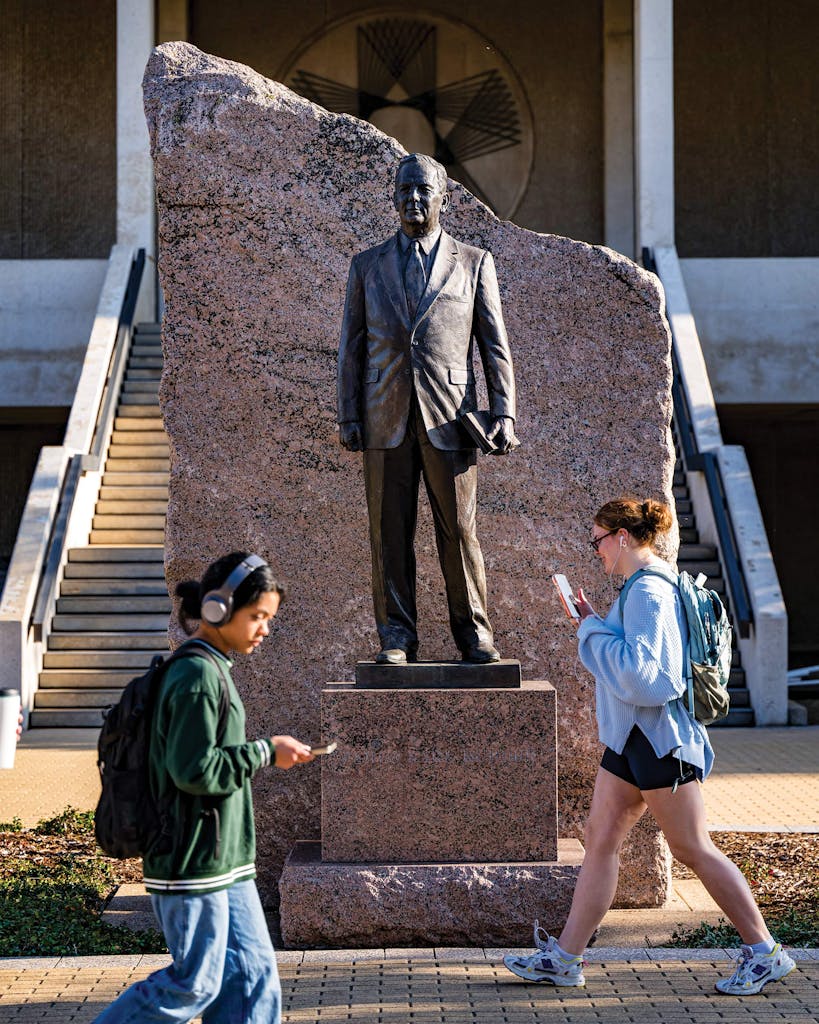 A statue of Rudder.Photograph by Meridith Kohut
The debates about A&M’s identity continued for decades and took physical form in College Station’s academic plaza at the end of the 2010s, in front of the statue of Sul Ross. The statue, on which generations of Aggies had dropped coins before exams for good luck, was one of the most important symbols on campus. But a group of students from a new generation began advocating for its removal or the addition of a plaque that would acknowledge Ross’s role in the Confederacy.
A more divisive argument about A&M could not have been designed in a lab. It became much more heated in 2020 when the pandemic and the summer of George Floyd protests seemed to briefly make unthinkable things thinkable. Sully’s statue was vandalized in June—decorated with a rainbow wig and red spray paint that read “BLM / ACAB / Racist.” (The protesters denied that they had done it.) The rallies that year elicited new forces of reaction that organized themselves into the Rudder Association, an alliance of alumni and students who say they act out of love for the school. The association’s founder, a graduate of the class of 1974 named Keith Hazlewood, came to show up for old Sully after his desecration, bringing a flag and a boom box to confront protesters. The Battalion quoted Hazlewood, who had apparently not received media training, as saying, “When they say Lawrence Sullivan Ross is a traitor, it’s like telling a Black man that his dad was a—you know what.” (Hazlewood, who is no longer affiliated with the Rudder Association, did not respond to an interview request. The current president of the group directed me to past statements.)
The Rudder Association was to become an important pressure group, one leg of the forces arrayed against the administration. It mostly consisted of older men who were feuding with college students. But perhaps because this felt even to them a bit unseemly, the association has cast itself through the years as fighting against a shadowy cultural force directing the young people. Reporters on the scene during the protests clearly identified the anti-Sully side as students, but the association’s account reported that the Ross demonstrations began when “protesters [were] bussed in.” Do you see how far the conspiracy goes?
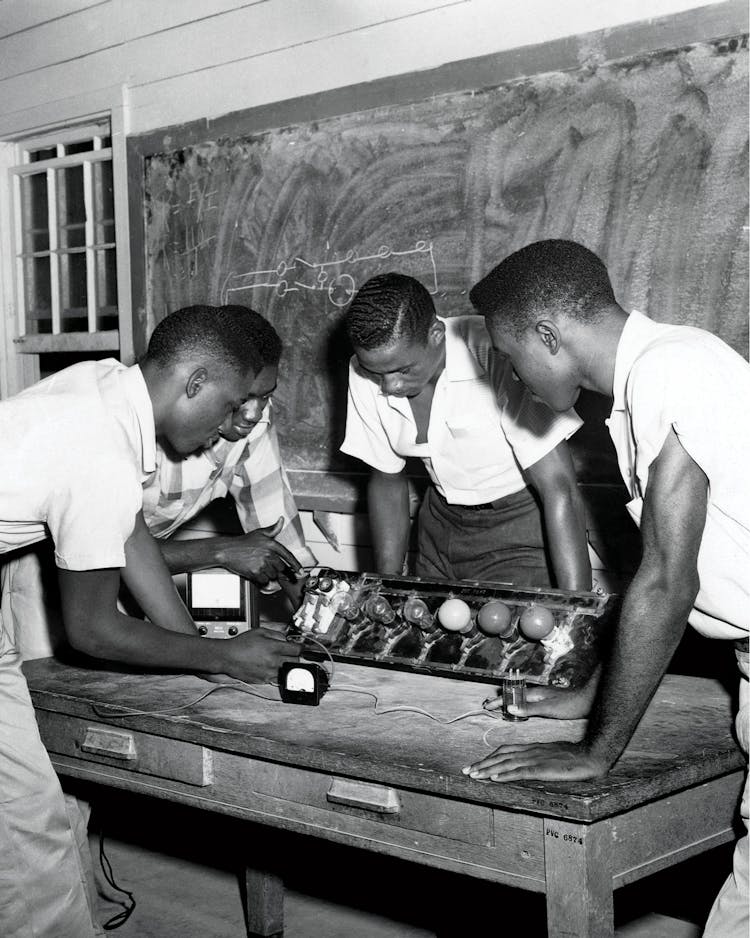 Black students at Prairie View A&M University preparing electric circuits in 1960, a few years before A&M desegregated under Rudder. Prairie View A&M University via Getty
 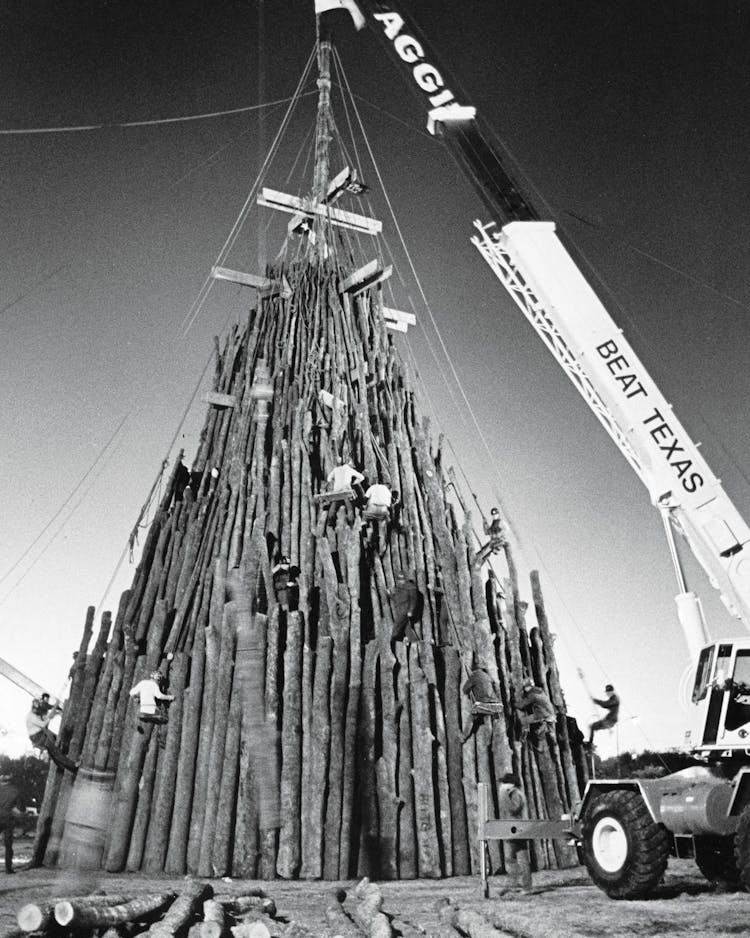 Texas A&M students constructing the Aggie bonfire in the late seventies. Bob Daemmrich/Alamy
The statue stayed, with school leaders vigorously rejecting the protesters’ demands. But the culture wars were just beginning, and the Rudder Association began formulating more expansive plans to take back the university from the “poisonous theories” that it had uncovered. In 2021, The Battalion published an article that included several internal documents from the association that cast the debate over A&M in grandiose terms: “The front line of the battle to preserve America for our children and grandchildren runs through our college campuses.” (The association characterized The Batt’s story as “an assault” and baselessly accused the paper of hacking its website.)
Fighting the forces that conservatives often call “cultural Marxism,” the association adopted the tactics of the enemy: It literally wanted to seize the means of production of new Aggies from the school itself. The association formulated a plan to take over Fish Camp—the celebrated traditional orientation program for freshmen held in the East Texas town of Palestine. The camp was “leaning toward ‘diversity’ training,” Hazlewood wrote in a July 2020 newsletter, pointing to a comment the group had received on Facebook complaining of the attendance of a transgender Aggie. To replace Fish Camp “may require stealth,” he noted.
Madness had taken hold. The adults proposed starting their own student newspaper as an anti-woke counterbalance. And the association recommended using Ancestry.com to research the family trees of professors, beginning with the anthropology, sociology, and psychology departments, the last of which might have offered some useful therapeutic assistance.
The association has since gained some acceptance in official circles—enough to attract proud Aggie son Rick Perry to speak at one of its annual gatherings—but it still has just a touch of John Birch about it. “The protection of identities is paramount to the operation of The Rudder Association,” it says on the page where it solicits dirt from whistleblowers on the current operations of the school. “The identities of the authors of all email and direct Association contact will be kept confidential and guarded unless otherwise directed at the author’s direction.”
Old guard alumni associations are nothing new to A&M. But the Black Lives Matter protests had succeeded in producing an organization that was unusually robust and unorthodox in its methods and pressure campaigns. It would soon have a clear mechanism to convert its anger into political clout.
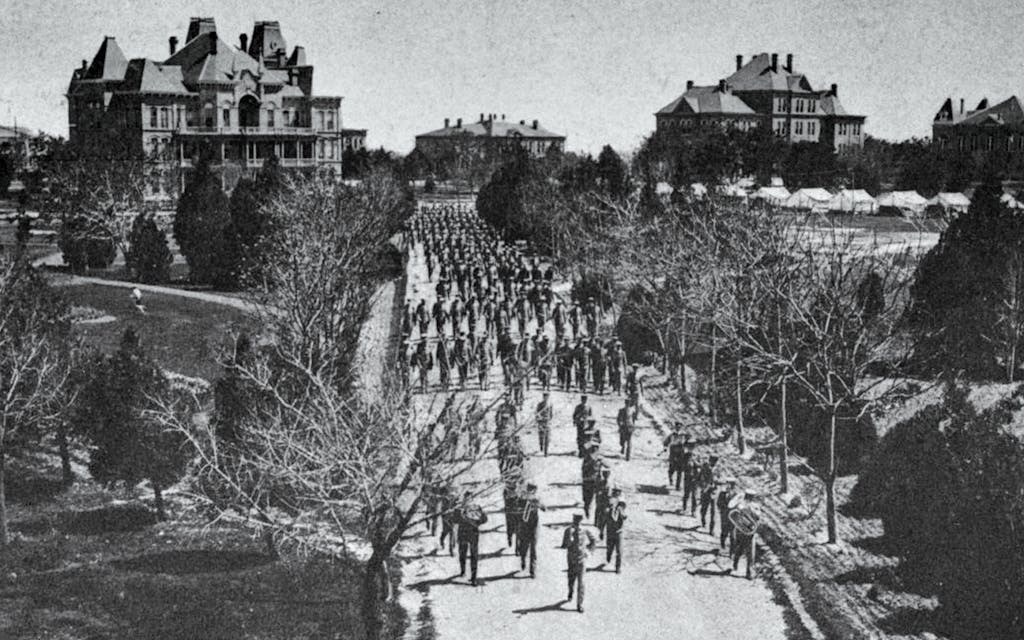 The corps of cadets marching circa 1908.University of North Texas Libraries, The Portal to Texas History, Hardin-Simmons University Library
In 2022, as the tidal surges of cultural change and revolution and reaction threatened to subsume the university, Ana Renfroe entered Fish Camp, which the Rudder Association had failed to annex. She did not detect there the baleful influence of cultural Marxism.
Renfroe is a native of Bryan. Her mother, a Mexican national, cleaned the Bush School of Government & Public Service, where she took out the trash of the dean, Mark Welsh, and at times also cleaned the homes of faculty members. Ana grew up in the orbit of the university but did not think she was likely to ever go there. “When I applied to A&M, I didn’t think I was particularly that smart. Even now, I don’t think I’m particularly that smart. I think I’m just kind of average,” she told me in the Memorial Student Center last spring.
Renfroe is uncharacteristically unperceptive on this matter. She was sixteen when she applied to A&M and seventeen when she graduated from high school a year early. She was accepted with a combination of scholarships and grants that covered her attendance. But as a first-generation student of a hardworking mother who made very little—and as a natural introvert—she was not set up to succeed at college, or even to accept that she deserved to be there. She struggled with impostor syndrome.
At Fish Camp, Renfroe got an education in the traditions and culture she’d be expected to uphold in the coming years—training in chants and yells; relentless, silly, earnest rituals; and indoctrination into a group identity of an intensity to rival Scientology. At first it was hard. “I did not have the best time,” she told me. “I had to force myself to be so extroverted the whole time.” Thinking more about it, though, she started smiling and conceded that it made her feel like an Aggie. “I mean, I do have good memories.”
A&M’s deep and often mocked traditions are helpful to its mission in this way. The class ring, worn everywhere; Silver Taps, held after a student’s death; and Muster, which commemorates deaths from the previous year and was famously held in the Philippines in 1942, as the Japanese army bore down—all communicate to students that they’re part of a wider community to which they truly belong. Today, Renfroe, who graduated in three years, takes off her ring only to shower and do dishes, lest it wear down. Turning it over, she showed me patterned bumps on the bottom of the ring. “Those are called teasip [the colloquial pejorative for UT students] assholes,” she said.
But traditions also have to change to relate to students like Renfroe, who needed places to find community outside the traditional, “red-ass” Aggie mainstays. She initially disliked football games, for one. For a time she found a calling at The Battalion, one of the oldest and most venerable institutions on campus outside of the corps of cadets. In late 2022 she became a news editor, a job that would task her with covering the unraveling of the school and give her an intimate lesson in how power works in Texas.
At the time she assumed the role, Renfroe said, she was only dimly aware of the board of regents—an elusive body she had a hard time getting student reporters to take interest in. This would change, and reporting on the regents would become The Battalion’s primary beat.
Though the board is charged first with maintaining the independence and integrity of the university system, in 2022 a new generation of regents were coming to see their primary job as protecting state leaders from political criticism. According to the Texas Tribune, almost all the regents appointed to the boards of all Texas schools are major donors to Abbott, and the A&M system is no exception. The chairman, Robert Albritton, has given more than $3 million to the governor.
Last spring Renfroe showed me The Batt’s alumni “Hall of Fame.” On the wall was a plaque honoring Kathleen McElroy, class of 1981. “When I was seventeen, I decided to attend Texas A&M over Princeton because the Aggies had a better football team,” McElroy is quoted as saying. “I’ve never regretted the decision.” McElroy’s trajectory brought her from The Batt to The New York Times, where she served in a series of high positions.
In June 2023 the school announced that McElroy would be coming home to lead the journalism program, which administrators were hoping to reinvigorate after it was dismantled in 2004. “It was very exciting to meet her,” Renfroe said, “and suddenly have these high hopes about the journalism program.” McElroy was not only accomplished but clearly loved the school. That she was also Black did not immediately attract controversy. Why would it?
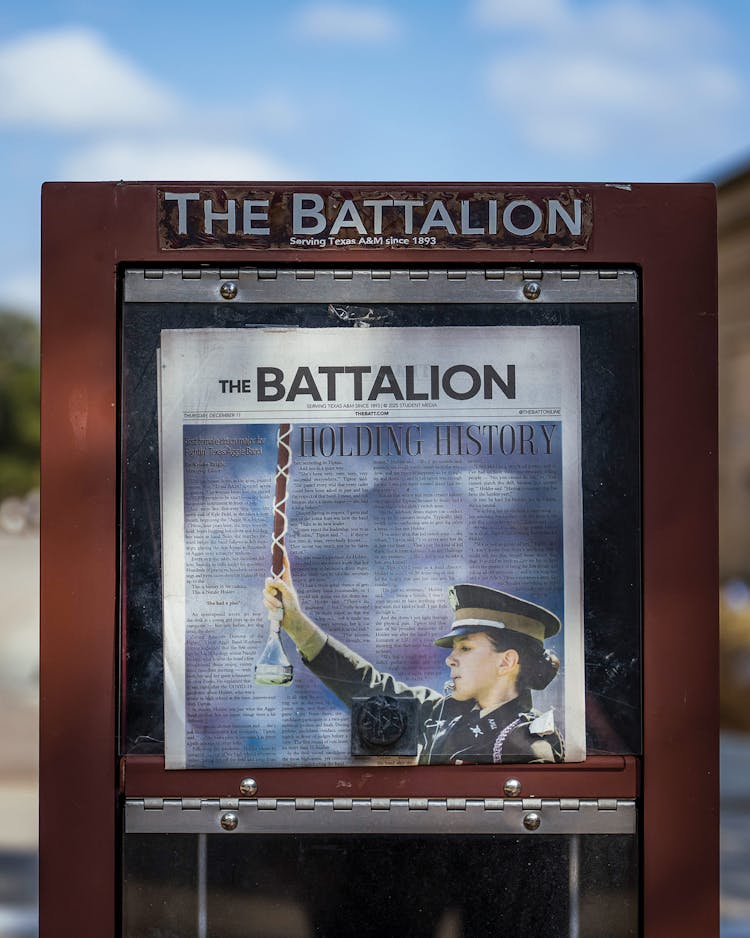 The Battalion has kept a watchful eye on A&M since 1893 but has recently come under fire from an activist group. Photograph by Meridith Kohut
  Ana Renfroe, a former Battalion editor and current A&M employee, went on a date with her boyfriend to Draggieland. Photograph by Meridith Kohut
Then appeared an article by Valerie Muñoz, a Battalion alum, in Texas Scorecard. The website was founded as an arm of Empower Texans, a now defunct right-wing pressure group mostly funded by Midland oilman Tim Dunn, a Christian nationalist. Muñoz’s article was headlined “Aggies Hire NY Times ‘Diversity’ Advocate To Head Journalism Program.” At the time, the political valence of “diversity” efforts was shifting, but it was not yet clear by how much. The Scorecard article alleged that McElroy was a disciple of “DEI,” which in plain language meant that she had, over the course of her career, advocated for Black and other minority journalists and attempted to help them navigate the institutional structures that she had so successfully navigated.
“It was friendly fire,” said Renfroe, who remembers Muñoz as a quiet part of The Batt’s staff in 2023. Muñoz, who did not respond to a request for an interview, had written just a few pieces for the student paper. In one, she condemned the decline of “traditional masculinity,” pivoting off an incident when she was asked to help a bus driver; in another, she argued that “everyone should be using AI.”
The Rudder Association got involved in the campaign against McElroy too. Its new president wrote to the regents’ spokesperson warning that there was a “misalignment between the hire and the recently expressed will of the citizens of the state of Texas.”
The board pressured A&M President M. Katherine Banks to rescind the job offer. (The Batt would later report that the regents distrusted McElroy in part because she did not seem likely to produce the kind of “high-quality journalism with conservative values” that it intended for the program to produce.) A&M repeatedly altered the job offer and then, caught in a series of contradictory statements that undermined her credibility with the faculty, Banks resigned. The university had to pay McElroy a $1 million settlement.
The debacle sent a message to existing and prospective faculty. DEI is a new term for an old principle, one that was not controversial at A&M until recently. Diversity programs began at A&M in the 1980s, supported by the regents. When the school was designated a Hispanic-Serving Institution in 2022, federal recognition that comes with additional funding for schools with a student population that is at least 25 percent Hispanic, interim provost Tim Scott said it was “indicative of how seriously we take our land-grant mission to serve all the citizens of this great state.” The happy frontier story again—onward, upward, ever better.
But within a year or so of Scott’s statement, it became completely impermissible to talk this way. In 2023 the Legislature prohibited DEI initiatives. The programs that had helped strengthen A&M for decades were airbrushed out of the picture as though they were victims of one of Joseph Stalin’s purges.
After the McElroy incident, Renfroe and The Batt continued to take note of other strange developments that pointed to ways in which the university was newly vulnerable to political pressure. In early 2023, Joy Alonzo, a professor at A&M’s pharmacy school, gave a lecture at UT’s medical school in Galveston during which she allegedly criticized Lieutenant Governor Dan Patrick. Unbeknownst to Alonzo, her audience included the daughter of land commissioner Dawn Buckingham, a Republican and former member of Patrick’s Senate. Daughter snitched to mother, who passed it on to Patrick. Before Alonzo finished her drive home, John Sharp, the chancellor of the A&M system, sent Patrick a text message that Alonzo had been placed on leave and would be investigated.
Alonzo ultimately kept her job after the suspension. But Aggies had been sent another discouraging message. Renfroe and some of the paper’s staffers signed an editorial asking, “how much shame will university leaders subject Aggies around the world to?” As long as the administration continued “to put the demands of outside political actors above the well-being of our campus community, this embarrassing and destructive downward trend will continue.”
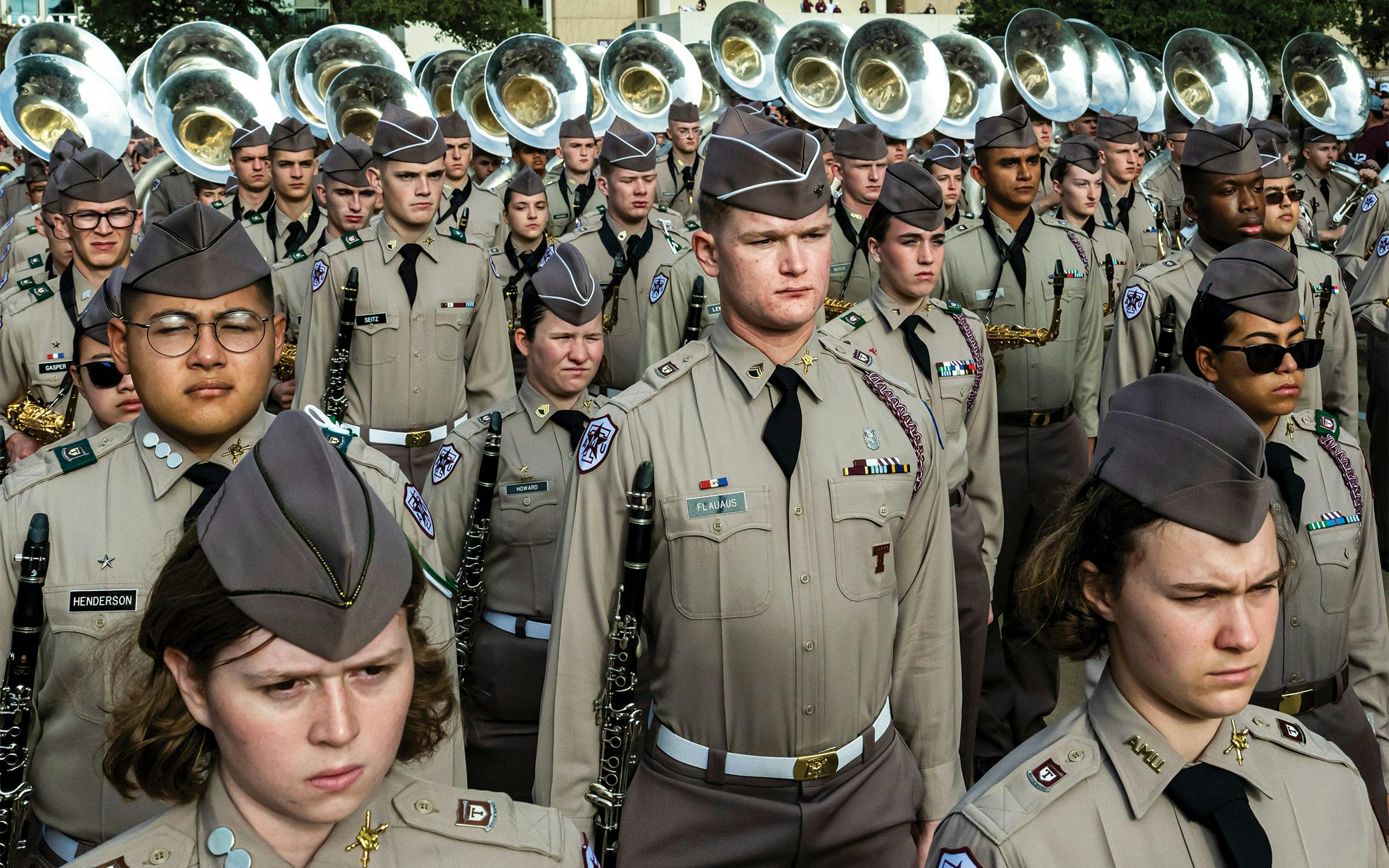 The Fightin’ Texas Aggie Band marching to the stadium.Photograph by Meridith Kohut
An irony of the regents’ desire for A&M to turn out journalists with conservative values is that some of the most prominent conservative journalists the flagship campus has produced have been notably hostile to the institution. There’s of course Muñoz. And there’s Michael Quinn Sullivan, a longtime right-wing influencer and the publisher of Scorecard, the outlet in which Muñoz had railed against McElroy.
Sullivan, who did not respond to an interview request as of press time, got his start in small-town newspapers. His right-wing digital outlet is not likely read by many Texans but is very closely followed by elected leaders, including the governor, who fear Republican primary challenges.
When he launched Scorecard, it was the University of Texas that was in Sullivan’s sights, as he supported the efforts of regent Wallace Hall to unseat UT-Austin president Bill Powers. But that was politics. Sullivan is an Aggie, and Scorecard’s focus on A&M, starting with the McElroy saga, was a matter of the heart. The speed with which the outlet was able to derail McElroy’s hiring proved that higher ed was a much more conciliatory climate for pressure campaigns than the Legislature, where Sullivan had made himself persona non grata.
Scorecard carved a beat out of A&M, starting with the McElroy affair. According to a Texas Tribune analysis, it published more than an article a week for two years warning of the rot in College Station. A representative one from August 2024 written by Muñoz reported breathlessly that “Texas A&M signage on campus includes a photo of students sporting temporary tattoos featuring an LGBT flag with the university’s logo.” This was in reference to a picture that appeared in a collage on a wall of the Memorial Student Center. Muñoz noted at the end of the piece that Scorecard raised the urgent issue to the board of regents and received no response.
The other articles might have silently passed, too, but a public face to boost them emerged: state representative Harrison of Midlothian. Harrison is aligned with Scorecard and also served in the first Trump administration’s Department of Health and Human Services. That part of his résumé both endears him to the MAGA right and presents a problem: He worked in the agency while it developed the COVID-19 vaccine, which is not a strong foundation for a Republican primary bid. So he has found a new campaign to bolster his MAGA bona fides.
A pattern got established. Sullivan’s outlet would seize on a new outrage at A&M, and Harrison, a born striver with a perfectly symmetrical face and a triangular smile, would blast the news to his followers. “The ripple effects from my actions are kind of hard to overstate,” Harrison told me over the phone recently. He expressed considerable pride in the number of “educrat” scalps he’s collected. “I mean, you’re seeing universities all across the state of Texas watching what I was able to do at Texas A&M, [going] like, okay, we don’t want to be next.”
Harrison described himself to me as a “First Amendment absolutist.” In his telling, his crusade is simply a fiscal one. “There’s absolutely no excuse, period, whatsoever, for tax money to ever be spent on leftist, Marxist, socialist, transgender propaganda.” The poor students besieged by the gay agenda at private universities cannot, we take it, rely on his protection.
Harrison succeeded in pushing the most powerful people in Texas into action. In the fall of 2023 the contents of Scorecard’s reporting would become a matter of state in the governor’s office. In November, according to a piece in the Texas Tribune written by Kate McGee and Nicholas Gutteridge, a former editor in chief of The Battalion, new university President Mark Welsh went to Austin to meet Abbott. He had just assumed the presidency after Banks resigned, jumping from his post as head of the Bush School at A&M.
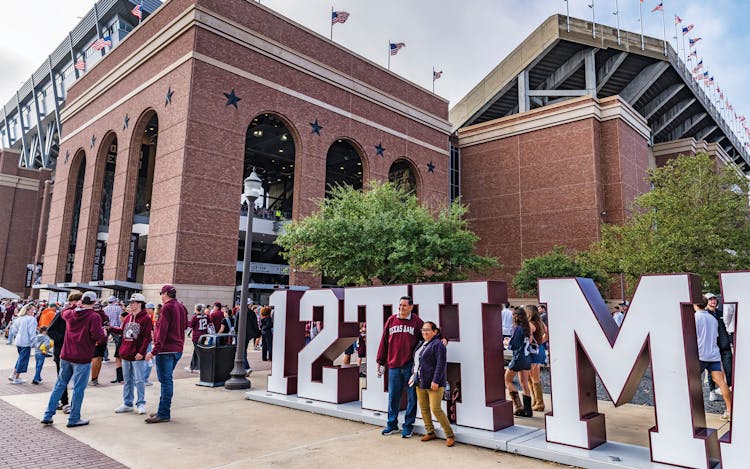 A&M would lose its 2025 College Football Playoff game against the University of Miami, but Kyle Field was abuzz beforehand. Photograph by Meridith Kohut
 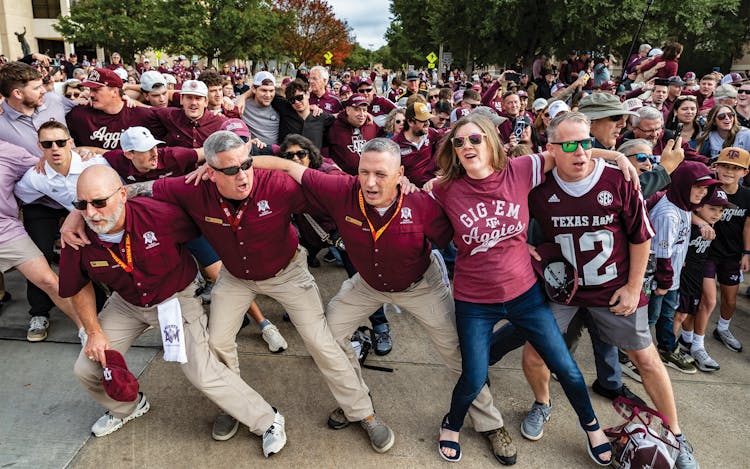 Fans singing the “Aggie War Hymn” before the game. Photograph by Meridith Kohut
To many folks on campus, Welsh seemed to be exactly the right kind of man to rescue the school from its political difficulties. It is generally believed that Rudder held on as president for as long as he did—and kept the school together under similar pressure from reactionary alumni groups—because he was a war hero. Welsh was something of a hero himself. He would apologetically note that the reason he was one of the few people in four generations of his family to not attend A&M was that he had wanted to be a pilot and went to the Air Force Academy instead. He served, flying the F-16 and A-10, and earned his own chest full of medals. He later was an associate director of the Central Intelligence Agency and a chief of staff of the U.S. Air Force.
Just like the Rudder Association, Welsh would hug Rudder’s memory with the force of a bear. In an MTV Cribs-style video uploaded in September 2024, he led Aggies on a tour of his office, noting the portrait of Rudder facing his desk, which he said inspired him to do good. Then he pointed out that the desk was actually Rudder’s. “We found it in the storeroom in the basement,” he said proudly. He eagerly added that his view, facing northeast across a large quad, was the “same view General Rudder had when he was in this office.”
Welsh also made a real effort, after Banks’s disastrous departure, to be open and available to the entire Aggie community. He started with student media, inviting Renfroe, at The Battalion, up for an interview in August 2023, shortly after she signed the editorial that criticized school leaders while expressing support for him as president and noting that he was “uniquely qualified to lead the university through this troubled time.” During the interview, Welsh showed her a cardboard cutout of John Wayne that he kept to remind him to stand for something. He wanted to demonstrate to Aggies that he believed in their best selves—that A&M was a “shining city on the hill,” an institution that “stands for pride and patriotism and faith and family and loyalty and honor and respect and integrity and courage.”
These values, it turned out, are better appreciated in College Station than in Austin. When Welsh traveled to the Capitol to meet Abbott, he was accompanied by Albritton, then the vice chairman of the board of regents. The Rudder Association and some members of the board had already been expressing concern about him, citing his previous support for diversity initiatives during his tenure at the Bush School. But this meeting with the governor should not necessarily have given Welsh cause for alarm.
Abbott should not have cared about the outrage in Scorecard, which belongs to a faction of the party that has been bitterly critical of him. The governor is not at risk of losing a primary and is cloaked in immense power, which should have insulated him from pests like Scorecard and Harrison. Instead, the governor’s mansion trapped all the bloodsuckers in with him.
When they met at the Capitol, Abbott peppered Welsh with questions about Scorecard’s articles, reported the Texas Tribune. He was “apparently unsatisfied” with Welsh’s responses, according to folks privy to the meeting.
The English department would call this “foreshadowing.”
The magnum opus of Scorecard’s campaign against A&M is titled “Den of Degeneracy.” It appeared in two parts, some seven thousand words total, in February 2024 with an extraordinary charge: “Taxpayers are funding woke classes at Texas A&M, and woke professors there are promoting antisemitism, LGBT ideology, critical race theory, and degeneracy.” A&M, Scorecard reported, even taught classes about political Islamism (which, it would seem, is an important thing to study, particularly at a school that trains a good number of future CIA officers).
The first part was mostly a long list of professors who had some history of studying topics the website considered problematic. Sarah Beck, Scorecard said, was a “scholar,” in scare quotes, who used “feminist and queer theorizing.” Lu Tang had the temerity to condemn people who opposed vaccine mandates while supporting abortion restrictions. Then there was the ur-degenerate: Professor joey lopez (who doesn’t capitalize his name), whom readers learned has expressed an interest in the dark arts of “Chicana Feminism” and “automotive journalism.” Scorecard quoted his bio from the university’s website disapprovingly: “he is often described as a degenerate who is looking for other degenerates to cause ‘otherness’ with.”
Scorecard got approximately one thing right in this lengthy treatment, and it got it right by accident. The “den” of the title is meant to be metaphorical. But lopez actually has one, in the basement of Bolton Hall, just to the northwest of the Sul Ross statue. He’s the co-coordinator of the Creative Media Lab in the Department of Communication and Journalism, and the assembled hardware of the lab fills multiple windowless rooms. It’s a little like a well-funded A/V club.
The campaign against A&M works by reducing its targets to stereotypes, so as to more effectively induce strangers online to hate and fear them. It is extraordinarily difficult to imagine one of those strangers hating or fearing lopez upon meeting him. He’s a goofy, big-hearted, and earnest man from San Antonio, a weight lifter who has a passion for Texas barbecue. Some tenured faculty resent having to teach; lopez teaches extra classes and uses the additional money to purchase equipment for his students and the media lab. He’s guilty of being a bleeding heart—he talks passionately about how Texas state parks are places for neighbors to come together—but he’s the opposite of the fat-cat radical folks may imagine when they think of an academic, and he’s committed to a career that doesn’t pay very well because he deeply loves his students.
An environment of collegiality and respect persisted at A&M through the years even as those qualities seemed to go into decline in wider America.
The implication of Scorecard’s criticism of lopez was that he is an outsider—a rootless cosmopolitan corrupting Texan children. But as a Texan, his credentials are unimpeachable. “I’m an eighth-generation Texan,” he told me by the dim light of his office cave. He added that there were two Tejano signers of the Texas Declaration of Independence—José Francisco Ruiz and José Antonio Navarro—and that he’s a relative of both of them. Lopez’s wife works at Navarro Elementary in Bryan, where his son attended. His father’s family tree also boasts the inclusion of Jovita Idar, a legendary Laredo journalist who helped document lynchings perpetrated by the Texas Rangers.
I asked lopez what he meant when he referred to himself as a degenerate. He approached this point differently over the course of several conversations, eventually playing for me Dwight Yoakam’s 1988 hit “Streets of Bakersfield,” recorded with Buck Owens and Flaco Jiménez. An all-around good song, he noted. He explained its larger relevance: Yoakam was a young hillbilly from Kentucky, Owens a grizzled child of sharecroppers who cut his teeth in California farm country, and Jiménez a norteño accordion player from San Antonio. Three underdogs from three different cultures—three degenerates. “This is, like, to me, what being an Aggie, or from Texas, is all about,” he said.
Every semester, lopez said, he receives, in like the tide, a wave of students who come from radically different backgrounds and contexts. As a professor of media production, lopez can’t teach them how to build a bridge or operate a nuclear reactor, like some of his colleagues can. What he can try to point his students to is their “shared humanity,” to remind them that “all of us have felt less than.” Being an underdog—as many Aggies are—can be a source of power and pride. “My job is to empower,” he told me, to help students along the “radical trajectory” of learning to understand themselves and one another. He stressed to me over and over that his aim isn’t to change his students’ politics but to make their worlds bigger.
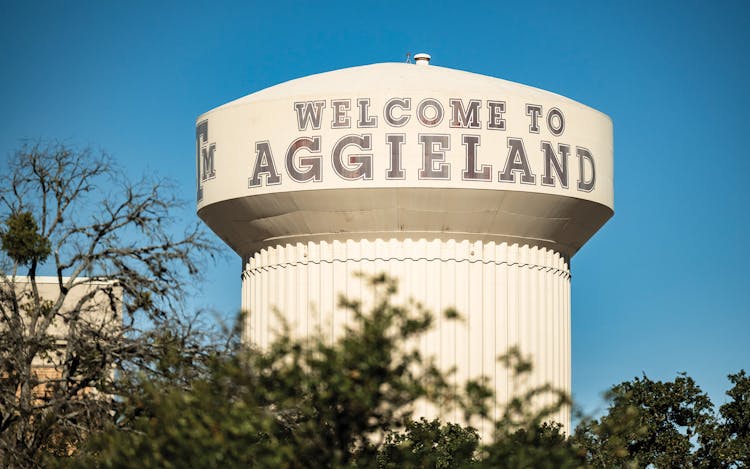 The Texas A&M water tower. Photograph by Meridith Kohut
 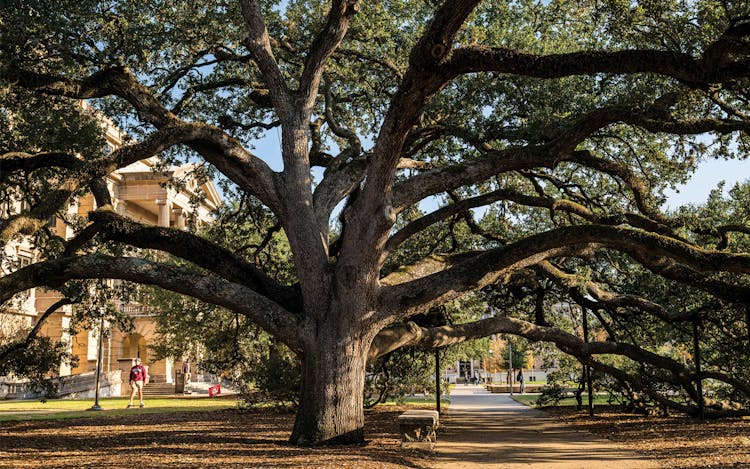 The Century Tree, one of the first planted on the College Station campus, where many Aggies now propose marriage. Photograph by Meridith Kohut
He now worries that everyone’s world is getting smaller. The intrusion of politics and the climate of censorship have made it much harder to reach students at an individual level. “What’s going on has just made it really hard for people to even want to speak up, let alone go into those kinds of discussions.” Most students still want those moments very badly, he said.
Indeed, the general impression I heard from professors is that their students are polite and deferential in a manner found on almost no other college campus. Dale Rice, the former speaker of the faculty senate, said he was deeply touched by the “amazing level of respect that students had for professors” when he started teaching at A&M eighteen years ago.
During one class in his first year, Rice gave his journalism students frequent quizzes on current events, hoping to force them to read the news. A student complained, calling the tests useless. This hardly made an impression on Rice, a veteran newspaper reporter. “I’m sorry you feel that way,” he recalled telling the dissident, and then he forgot about it. That night, as he was grading the tests, he realized that “on the back of all the other quizzes were long statements from the other students.” They wrote to reassure their professor that they appreciated him and were grateful for the work he made them do, and they apologized for their classmate who failed to share the proper respect. Rice felt like he had landed on Mars.
This astounding environment of collegiality and respect persisted through the years even as those qualities seemed to go into decline in wider America. Some years ago, Rice’s husband, a professor in the communications department, had a double lung transplant. He had serious complications and spent eight months at Houston Methodist, during which Rice drove back and forth every day that he didn’t have to teach. His students got wind of this and “took up a collection and bought a gas card,” Rice told me, getting a little emotional. He’s sure he’s had students who didn’t approve of the fact that he’s gay—but none of them have ever said so. That’s not the Aggie way.
The old ways aren’t dead, but Rice said things have started to change. A strange countercurrent has developed—a culture of snitching on professors with the goal of getting them fired, stoked by outsiders. One professor, who requested total anonymity to avoid retribution, told me about an experience in the week after the assassination of Charlie Kirk, the right-wing influencer. When the professor entered class and saw a sea of sad young people, they set aside the lesson plan and asked students to share feelings and thoughts about what had happened. In response to students’ questions, the professor tried to talk about the harm political polarization had done and the origins of political violence, and asked the class to join in a moment of silence for Kirk and his family.
After the class, the professor received a disturbing shock. A student had lodged an anonymous complaint with the department head accusing the professor of minimizing Kirk’s death. “I thought, ‘This is it, I’m fired,’ ” the professor recalled. They couldn’t understand what they might have done wrong. The professor and department head each wrote lengthy apologies to the students of the class without quite knowing what the objection was. Had the professor misspoken? Had a student taped something that might be blaring on Scorecard’s website soon?
Here, some of the old Aggie spirit came out. Conservative students in the class wrote notes to the professor with reassurance that the professor had handled the discussion with great empathy. The students appreciated that the professor had tried to speak to them as adults. They valued discussion, as Kirk had. At the end of the semester several students also left handwritten notes thanking the professor for acknowledging the assassination. At least one noted that no other professor had done so.
Other teachers had presumably been too afraid to discuss the controversy in class. That was with good reason.
 Texas A&M Professor joey lopez, photographed in San Antonio on December 22, 2025.Photograph by Meridith Kohut
In July, Melissa McCoul was teaching a class on children’s literature that included a middle-grade book titled Jude Saves the World, in which the main character is nonbinary. Such books are banned in Texas public schools. But the ideal candidate for a university education is a person mature enough to withstand the psychological torments of what some might consider a distasteful kids’ book. Not everyone in McCoul’s class possessed this maturity.
Instead of having a conversation with her professor after class, a student began recording video in the middle of the lecture. “I’m not entirely sure this is legal to be teaching,” she said. Hadn’t President Donald Trump recently declared in an executive order that there were only two sexes? She would not stand by while others “promote something that is against our president’s laws, as well as against my religious beliefs.” A second student offscreen spoke up for McCoul—“My gender is not illegal,” they said. The filming student then seemed to start to make the case that Trump had, in fact, made the other student’s gender illegal, at which point McCoul interjected and told her that “if you are uncomfortable in this class, you do have a right to leave.”
The student brought the video to Welsh. He rebuffed, in no uncertain terms, her demand that McCoul be fired. But the student was also recording him. She soon leaked both the classroom video and the audio of Welsh to enemies of the administration, and the situation changed. Brian Harrison tweeted both out and called on Abbott to fire “all A&M officials involved.”
Shortly thereafter, Welsh fired McCoul for “teach[ing] content that was inconsistent with the published course description,” a rationale echoed by chairman of the board of regents Albritton. Then Welsh demoted McCoul’s dean and the head of the English department.
The firings were not over. Abbott called Albritton and let him know that he supported Welsh’s termination, according to the Tribune, though he had no statutory ability or standing to demand it. The regents, who are supposed to act independently, started looking for Welsh’s replacement. Faced with being canned, he resigned. He had been in the job for just over two years. The fire hose of earnest feeling he had tried to deploy on the school had not been enough, wouldn’t be enough. A&M would be moving on to its fifth president in five years.
And yet, as Welsh walked out of the administration building at the center of its College Station campus for the final time last September, he was not leaving in disgrace. More than a thousand A&M students, faculty, and other admirers gathered to say goodbye. As he left the building, John Wayne followed, folded wrong side out, like the flag of a ship in distress.
The throng flanked the steps of the administration building, leaving Welsh a wide corridor to travel as he was honored. A student on the stairs held a sign that read “Welsh for Governor,” a poke at Abbott. Another gave Welsh’s wife, Betty, a bundle of roses. The crowd was a broad cross section of the school’s diverse body—a white student from rural Texas next to a woman in a hijab, people of all ages, all races, cheering and clapping for the entirety of Welsh’s nearly nine-minute walk to his black Escalade.
As he approached his car, Welsh swiveled around to acknowledge the assembled students and faculty, stretching all the way back to the steps of the building. They had started singing the school’s alma mater, “The Spirit of Aggieland.”
We are the Aggies—the Aggies are we
True to each other as Aggies can be
We’ve got to FIGHT boys
We’ve got to fight!
We’ve got to fight for Maroon
and White
Welsh began to sing too. Half a dozen more hugs later, he was finally able to open the driver’s side door. After a final round of thank-you-for-your-services, he disappeared and drove away from the campus for good.
A History of A&M Through TM Covers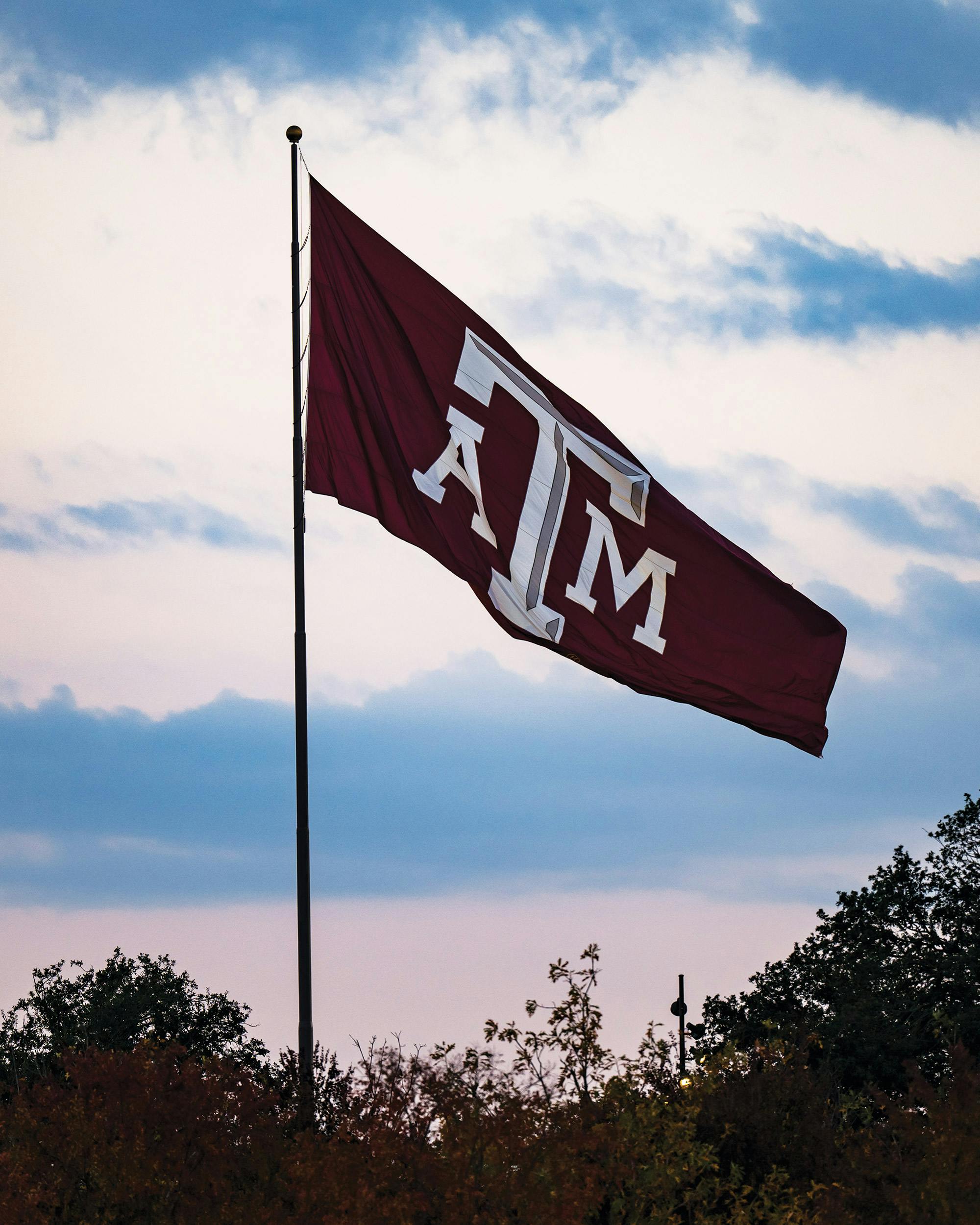
Welsh’s firing was a shock to the system. He was replaced by an interim leader, former state Senator Tommy Williams, who has no experience in education but does have a longtime, close relationship with Abbott. In November the A&M board of regents revised the school’s policies to require professors to obtain the administration’s approval for any lesson plan that might “advocate race or gender ideology.” The system also banned discussing “controversial matter” not connected with the “classroom subject.” The regents reportedly would set up a phone hotline for uncomfortable students, like the one in McCoul’s class, to use if they feel like trying to set a purge in motion.
Regent Sam Torn’s explanation that the change is to “make sure we are educating and not advocating” will sound like common sense to many outside the school. The problem is that there are still no clear senses of what “race ideology” or “gender ideology” mean across the many disciplines taught at A&M, despite the regents’ attempt to provide definitions.
The rules could not help but produce farcical results. In January a group representing some A&M faculty publicized an email one philosophy professor had allegedly received in response to an attempt to gain approval for a proposed syllabus. The teacher could be reassigned to a different course, or they could “mitigate” their proposed “content to remove the modules on race ideology and gender ideology, and the Plato readings that may include these.”
Professors are now incentivized to stay far clear of any subject that might cause a single conservative-leaning student discomfort. Which is, of course, the goal: A campus on which it’s harder to be one kind of Texan, whose identity is subject to strict scrutiny, than it is to be another, whose beliefs are to be protected and elevated. After a decade of cultural unrest, we’ve arrived at a Wokeness of the Right, with safe spaces for conservatives.
This, too, may eventually precipitate a backlash. But it will certainly dampen the essential spirit of A&M. After Welsh’s departure and the regents’ ruling, a sense of pessimism I hadn’t registered before crept into my conversations with students and professors. It felt un-Aggie.
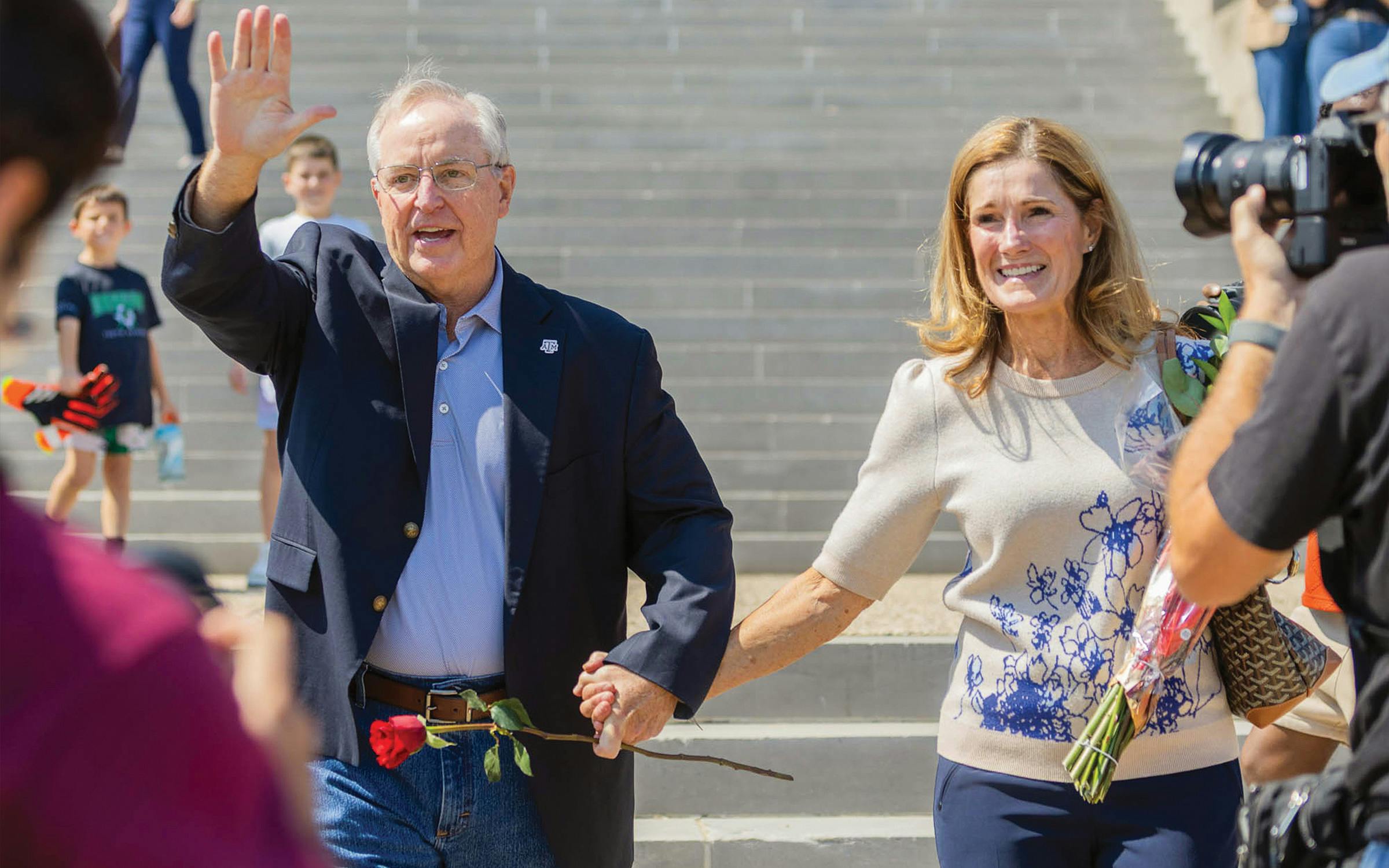 Mark Welsh was forced out as president, but as he exited the administration building for the last time, he was met by a crowd of supporters.Ashely Bautista/The Battalion
In October I met with Renfroe, who has taken a job as a communications officer with the architecture school. As she gave me a tour of its surprisingly attractive brutalist building, I thought on the one hand about the wolves and on the other about how much of what she showed me could be subject to a potential crackdown. Projects on display by would-be urban planners, for example, discussed the problems of disadvantaged communities on the border. Was this “racial ideology”?
Renfroe is careful about what she says, now that she works for the school, and emphasized that she was speaking in a personal capacity. “What I can speak to,” she replied when I prodded, “is that Welsh was a really good president, because he cared a lot about the students.” Renfroe, who plans to marry her Aggie boyfriend and stay in Bryan, still sleeps with her class ring on. But she has a friend who has stopped wearing his. “I love A&M,” Renfroe said. But the political turmoil “definitely hurts a lot.”
I met lopez in his den a month later. The regents’ recent decision had changed something on campus, he said. The situation felt “ominous.” Members of the faculty were “scared to be themselves now,” and though he badly wanted to stay at A&M, he couldn’t deny that it had become a “hostile work environment.” He wondered if he could talk about his ancestors in class now. Is being proud of your Tejano heritage “DEI”? How can you teach anything worthwhile while avoiding “controversial subjects”? He now has a lawyer look over his public statements.
The forces harassing the school are a tiny group, lopez told me, playing a game of their own devising. But it’s “at the expense of human, day-to-day relationships between thousands of people,” he said. (When I read this quote to Harrison, he laughed out loud.) Somehow, too many were forgetting that “difference can have togetherness,” the kind of warmhearted thing I’d grown used to lopez saying. Except now he added a warning: “Because if not, we’re just gonna destroy ourselves.”
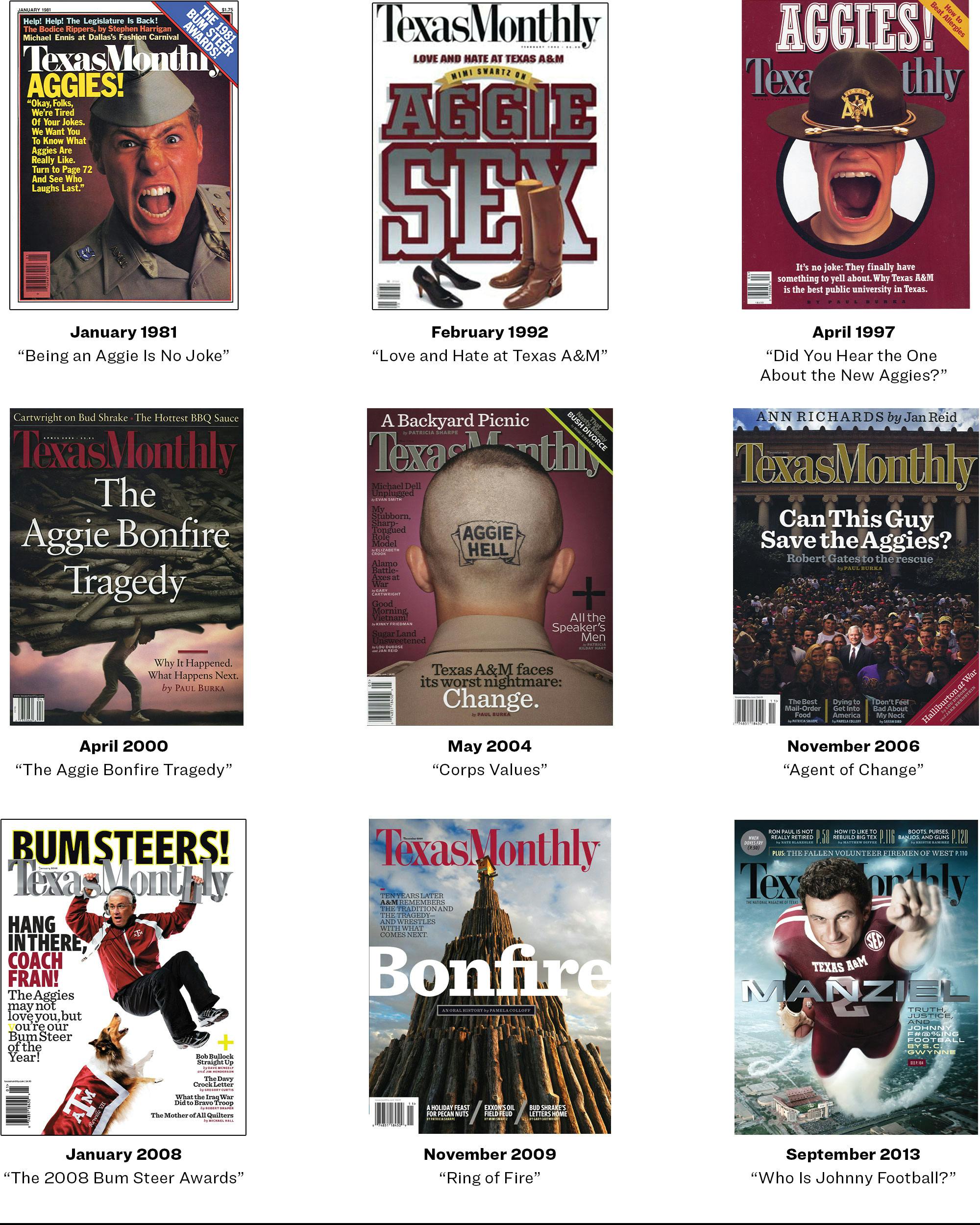
The Texas A&M flag still flying despite statewide leaders’ best efforts to sully it.Photograph by Meridith Kohut
It was dark by the time I finished with lopez. The campus was emptied out; the buildings were poorly lit, a little foreboding. I walked over to the Rudder Auditorium with three students and asked them about the events of the past few months. “We think it’s pretty lame,” said a senior from Houston who came to College Station to be an engineer but is now applying to grad schools for ethnomusicology. “But we don’t really know what we can do about it.” As we got closer to the Rudder shrines, the student heard drumbeats from an event in the plaza. “They’re trying to summon the last Aggie spirit left,” he said to his friend.
Reflected light from the fountains sparkled off the concrete of Rudder Tower—where some kind of formal reception was happening on the top floor—and it looked a little like fire. Being performed in the auditorium that night was The Post-America Variety Show, whose script had been worked out by some students collaboratively. When I took my seat, a pianist was playing “Pink Pony Club,” Chappell Roan’s anthem that Bella Donna Fables had danced to in drag the year before. The show’s program contained an acknowledgment that A&M “is situated on the land of multiple Native nations.”
What do you do when the world makes you feel bad and you’re an Aggie theater kid? You take your ambient anxiety and put on a show. In the play, set some decades into the future after an apocalypse, the performers of a variety show gather in the shell of College Station for a “nostalgic look back at a time that never was: the Roaring 2020s, a time when people from different points of view were able to set aside their differences.” Most Aggies work in the fields and mines for TU, the tyrannical hand from Austin, which has banned free expression and any form of fun. The performers, though, gather illegally to have it anyway. They sing songs and perform skits about the “urine detective,” a hard-boiled gumshoe in search of clean water. Because this is still A&M, it all works out in the end: The performers evade arrest and celebrate in the musical finale that there is still, in the world, “space for you and me.”
Here in the Late American Reality Show, however, the end is yet to be determined. The frenzied political squabbling over buzzwords, both at A&M and in the nation at large, obscures what is really being debated every day now in a thousand different forms: whether we can keep a plural, tolerant, diverse republic, or whether those who currently have power can mandate ways of thinking, ways of being, and a social hierarchy based on difference.
This is in fact what we have always been debating—a single continuous argument that stretches back past the founding of the country. It is the debate that Rudder was having at Pointe du Hoc, that lopez’s great-aunt was having with the Texas Rangers, that Black soldiers were having with Sul Ross at Yazoo City. It is the debate that motivated the establishment of this university in the first instance. It is the debate we will be having forever.
Right now, there’s a shortage of belief, a reticence to fully commit to the proposition that we can peacefully disagree, that a nation can consist of many different kinds of people, that diversity is the central American strength. The kind of earnestness, the can-do spirit, that would put some heft into the defense of it all seems to be in short supply most everywhere. But I now know where to find it.
This article originally appeared in the February 2026 issue of Texas Monthly with the headline “A&M’s Melting Point.” Subscribe today.
When you buy a book using a link on this page, a portion of your purchase goes to independent bookstores and Texas Monthly receives a commission. Thank you for supporting our journalism.
Read Next