
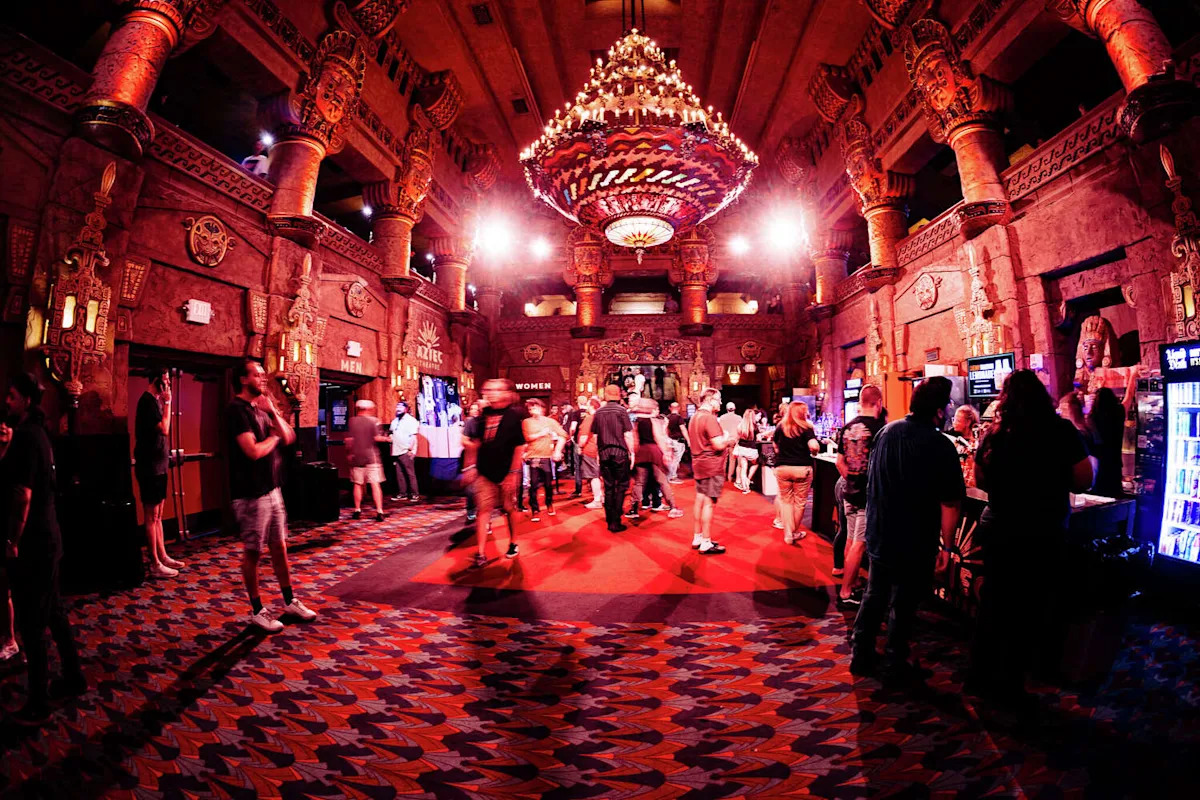
San Antonio residents who roam the city’s downtown can spot – and more likely – hear the happenings at the Aztec Theatre from half a mile away. Yet, a century ago, it was known for the polar opposite: silent films.
Built in 1926, the iconic 35,000-square-foot building was designed by the firm Meyer and Holler. Architects with the company only created three worldwide, with the others based in Los Angeles, per the venue’s website.
With its original chandelier, installed the same day the stock market crashed, the theatre is a time capsule. Today, that fixture towers over trendy performers like Modest Mouse and Role Model. Yet, it is one of several elements inside the space that have stood the test of time.
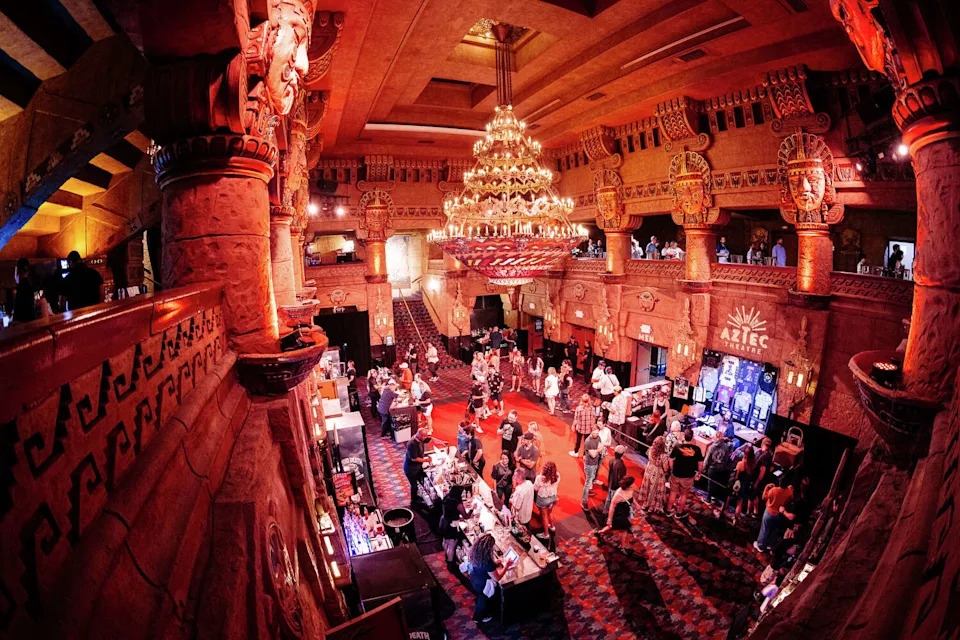
Indie cult rockers Modest Mouse performed at San Antonio’s Aztec Theatre on Thursday, August 21, in front of a packed house. (Chris Stokes for MySA)
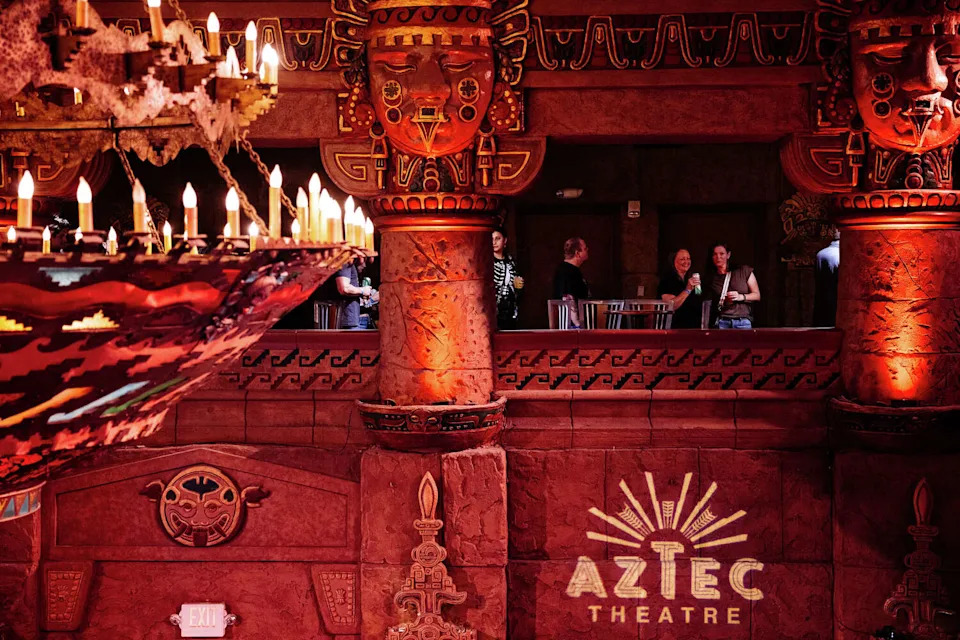
Indie cult rockers Modest Mouse performed at San Antonio’s Aztec Theatre on Thursday, August 21, in front of a packed house. (Chris Stokes for MySA)
Several authentic reproductions of Meso-American artifacts, like the murals seen on the lobby’s walls, reflect the era’s larger affinity for motion picture palaces with distinct themes. Decades ago, the building was one of several third spaces across the U.S. offering guests a place to unplug – not from the online world, but reality itself.
“Large theater rooms, typically accommodating five hundred seats or more, were constructed or renovated to create atmospheres of surprise and emotion,” author Sheila Schvarzman wrote in a study published by the University of Texas Press. “From the facade to the lobby, the architecture of ‘escape and excessiveness,’ a phrase coined by Lewis Mumford (Bordat and Etcheverry 1995, 39)-a concept never entirely aligned with contemporary design-sought to transport viewers beyond their daily lives: wherein exoticism emerged as the most prominent trait.”
Located in the heart of the city at 104 N St. Mary’s St., San Antonio, TX 78205, the spot has been modernized to better suit the needs of residents. It hosts “state-of-the-art lighting and sound, custom menus,” a VIP lounge, and a reservable River Walk terrace.
Moments in Aztec Theatre history
Much has transpired within the venue walls. In 1927, a year after its opening, the theater presented its first talking picture, the venue’s website states. It showed Don Juan, a romantic drama starring John Barrymore, who some considered “the most celebrated Shakespearian actor in the world,” and Mary Astor, another beloved American actress.
Five years later, tragedy struck when six people were burned after a sulfur bomb went off in the lower level of the theater, the venue website states. Ghost City Tours cites that a nineteen-year-old Warren Dunn and a twenty-five-year-old C. R. Green suffered first-degree burns on their hands and faces while trying to put out a fire that began afterwards. No one was arrested for the incident, per the outlet, and it was one of four San Antonio theatres to see a stench bomb attack by 1932.
Come 2006, it reopened as Aztec on the River. It hosted “Multi-sensory” experiences with a lobby show, theater pre-show, and light-effects at its Riverwalk level. Though unique, it was short-lived and closed the following December.
Live Nation, a well-known, global entertainment company, took over venue operations in 2015. Investors began building up its reputation as a place where Texans could catch comedy, music, and dance performances. The theatre can seat 1,500 people, while the main floor can handle 800.
The business kicked off 2026 with a new logo, honoring 100 years of “unforgettable movies, concerts, and events.” It boasts an old-fashioned feel, complete with polka dots and gold accents, a color the Lubbock Avalanche Journal cites as on brand with society’s longing for “exuberance and experimentation” at the time.
This article originally published at A San Antonio gem’s journey from silent move theatre to bustling music venue.