
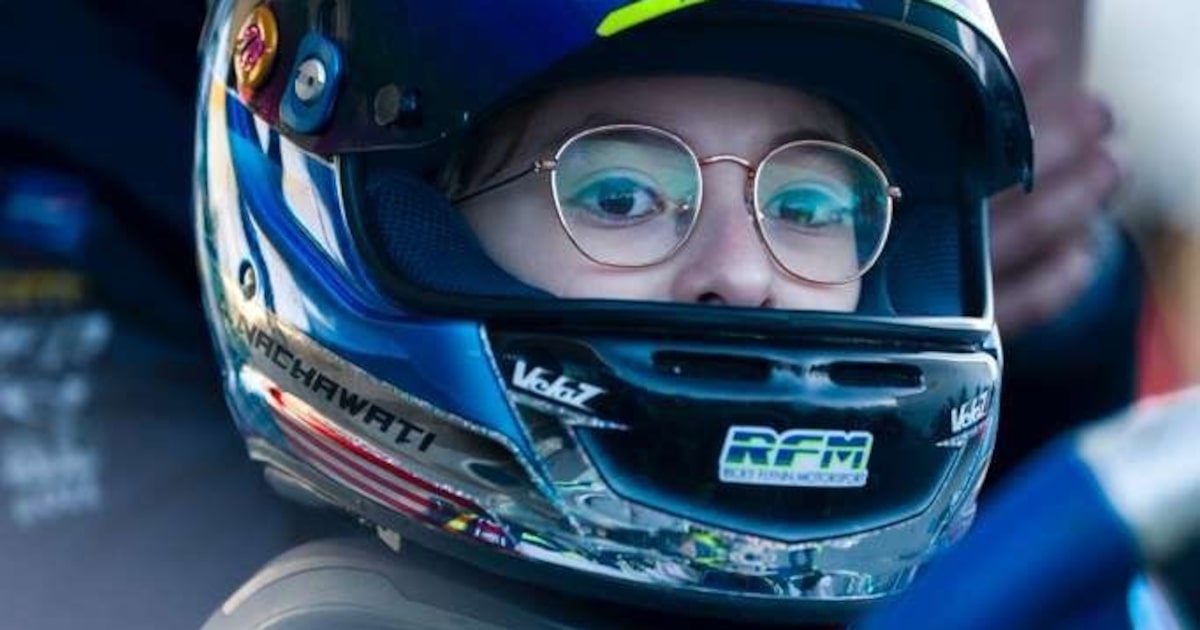
For most of 2025, 11-year-old Liam Nachawati lived out of a suitcase. He started November in Italy, then jetted over to Las Vegas, flew back to Italy, then headed to Dubai, each spot on the map home to a track where he would slide into his kart, a deceptively small machine that can scream along the asphalt at 60 miles an hour as he tries to outflank other young drivers.
By December, Liam was in Pasadena, where he appeared on a radio show with Jay Leno, famously a gearhead with nearly 200 cars.
“What you’re looking at here is the equivalent of an Olympic athlete,” said Leno, gesturing to the boy from Dallas with the round Harry Potter glasses and wearing a white zip-up racing uniform. “In 10 years, he could be world champion.”
What Leno understood was that today’s racing superstars — from current F1 world champion Lando Norris to seven-time world champion Lewis Hamilton — started in karting. Liam is part of a rarified cohort of young racers who travel the globe to compete in the hopes of one day reaching Formula One, whose visibility in America has exploded thanks in part to movies like F1, starring Brad Pitt, and the hit Netflix docuseries Drive to Survive, which follows F1 drivers through each grueling and glitzy season.
News Roundups
The industry is cut-throat and eye-poppingly expensive. Between travel, training and equipment, a driver at Liam’s level can expect to pay $300,000 per year, a number so prohibitive that one Washington Post story on competitive youth karting described it as “a traveling carnival for the global elite, a series of racetrack parking lots colonized by parents in luxury athleisure wear.” In Liam’s case, the investment is more about a father who grew up with nothing, hoping to ensure his son has opportunities he did not. So far, the gamble is working. In 2025, Liam won two national races, one in Orlando and another in Indiana.
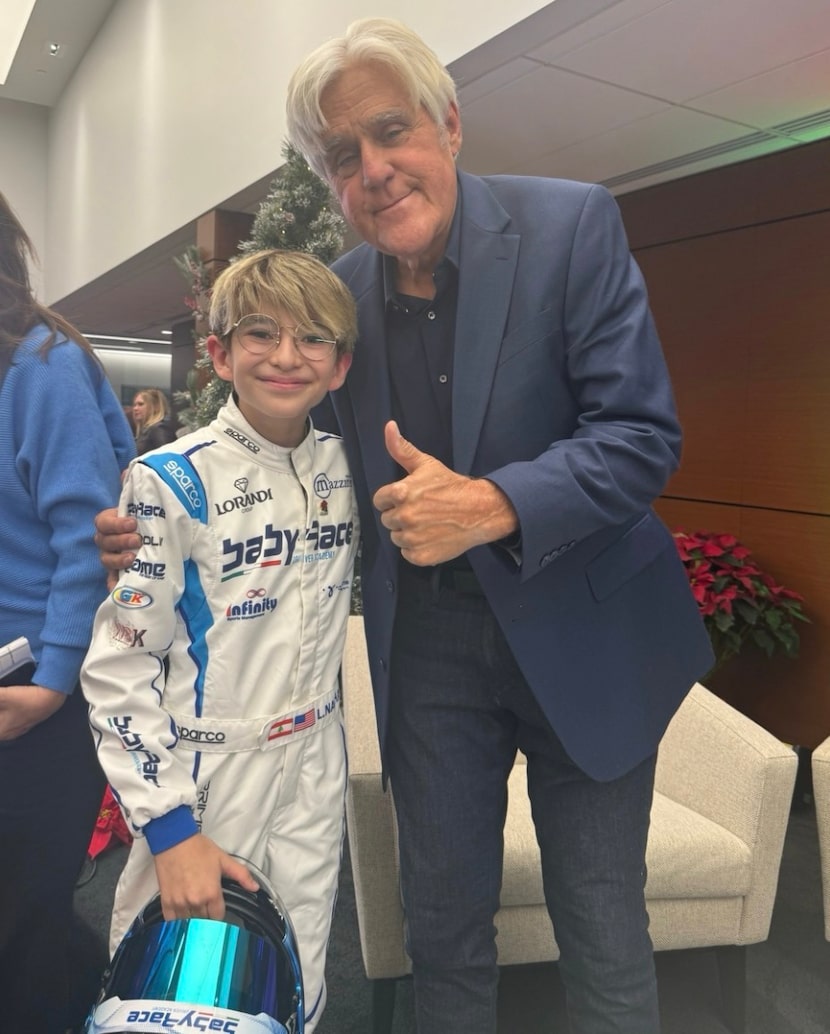
In December, 11-year-old Liam Nachawati, left, appeared on a radio show with Jay Leno.
courtesy Liam Nachawati
“Everybody thinks, oh, you’re just driving a car, how hard can that be?” continued Leno, as Liam sat quietly beside him. “The g-forces, the lightning reflexes. It takes very, very special people to be able to do this.”
“Thank you,” said Liam. For an aggressive competitor, he is unfailingly polite.
Later, Liam’s mom asked him how it felt to meet a late-night legend, but the kid was born in 2014, the same year the talk-show host went off the air. Liam had no idea who Jay Leno was.
‘Start young and race nonstop’
The story of how Liam Nachawati became one of the top young drivers in the country began with something of a whim. During the pandemic, his uncle spotted a kart on Facebook Marketplace and suggested it might be a fun way for a cooped-up kid to get fresh air. Liam was 6. The uncle split the cost with his brother, Liam’s dad, and they headed to North Texas Karters, a track for young drivers in Denton County. It wasn’t long before Liam was smoking older kids who’d been training on that track for years.
“What struck me was how quickly he was advancing,” says Alex Cruz, a Denton-based karting coach who began working with Liam when the boy was 6 ½. “He moved from the back of the field to the front and onto the podiums.”
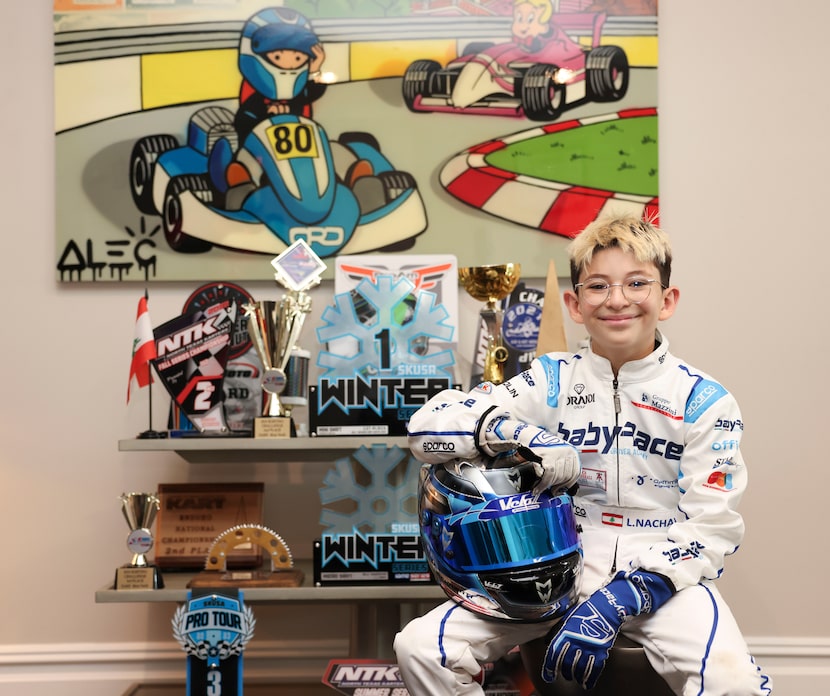
Competitive kart racer Liam Nachawati with trophies at his home near White Rock Lake on July 17, 2025.
Shafkat Anowar / Staff Photographer
A good driver needs fast reflexes, laser focus, a hefty dose of fearlessness, but the only way to improve is long hours at the track, which Liam put in, making micro-adjustments and building muscle memory. “A lot of the kids are just there because the parents want them to be,” Cruz says, “but when you start seeing a kid who loves the sport, that’s when you realize: OK, we have something here.”
By 9, Liam had reached an inflection point. Cruz, who had a full-time job as a firefighter and paramedic, could only take him so far. If Liam wanted a shot at racing’s top seats — his dream was F1, although he was also looking at NASCAR and the IndyCar series — his best move would be to join one of the elite youth racing academies, many of which are based in Europe (where F1 is more culturally dominant), and spend as much time as possible racing.
“That’s the only way to have a chance at the big leagues,” says Cruz. “You have to start young and race nonstop.”
A father who never played sports
Parental involvement in youth sports has long been trending in one direction: more time, more money. What was once a casual school-based extracurricular has proliferated into a series of pay-to-play club sports that require weekend travel and can cost thousands a year, leaving participation out of reach for many families. Competitive international karting represents an extreme version of this shift, since even affluent parents might balk at the notion of a sport whose price tag runs well into the six figures.
“Our philosophy as parents is to let your kids pursue their passion, whatever that may be,” says Liam’s father, Majed Nachawati, touring me around the family’s well-appointed home near White Rock Lake, where the upstairs game room is a boyhood paradise of karting sims and F1 paraphernalia. “I didn’t have that opportunity as a kid.”
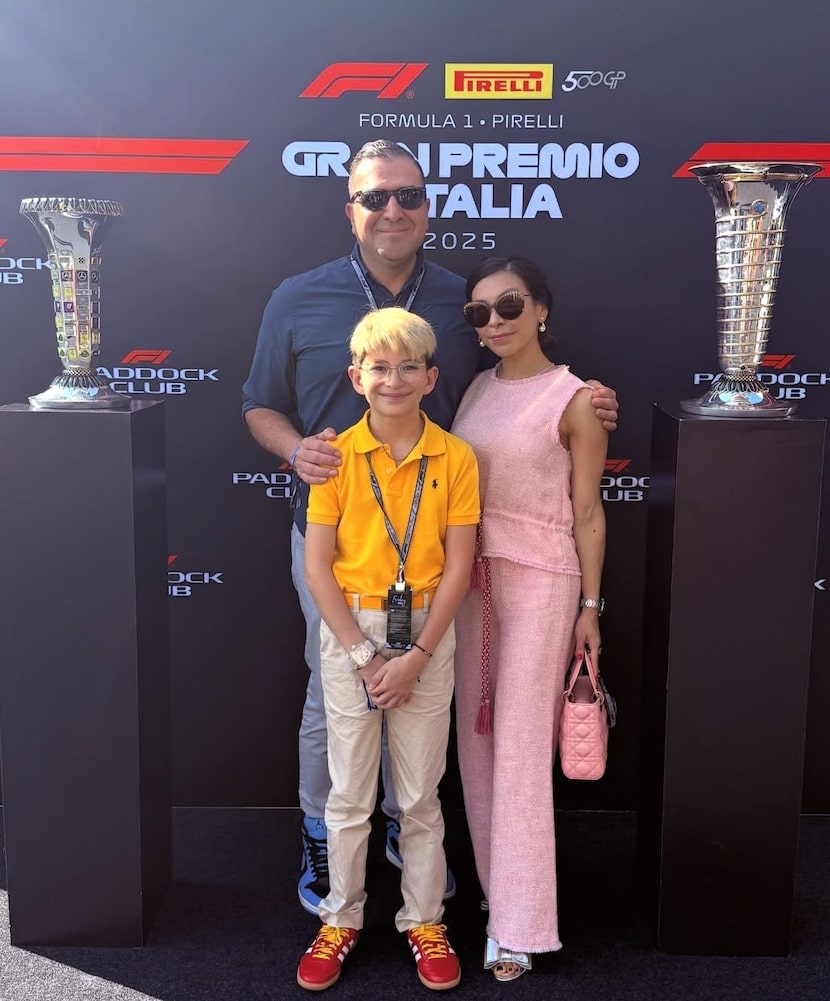
Liam Nachawati attending the 2025 Formula One Italian Grand Prix in Monza with his father, Majed, and mother, Alma.
courtesy Liam Nachawati
Majed’s father came from Lebanon and spent 30 years working on the line for General Motors in Arlington. Growing up in North Richland Hills, one of eight siblings, Majed was on the free-lunch program at school; even YMCA sports were off the table. He slung sandwiches at Arby’s and Subway through high school and worked his way through a community college till he landed a scholarship to Southern Methodist University, where he continued to work full-time.
“My only passion was getting out of my economic circumstances,” he says. “Nothing would get in my way.”
After law school at the University of Houston, he co-founded a legal firm in 2006. Nachawati Law Group has represented states in litigation against opioid manufacturers, among other high-profile cases. By the time Liam was ready for the next level — the global circuit that would include trips to Italy to compete in the World Series of Karting — Majed was in a financial position that allowed him to spare no expense.
‘You’re just one with the car’
In 2025, Liam joined BabyRace Driver Academy, based in Italy, competing in the Mini category for kids 10-12, a level above beginners that’s roughly equivalent to the Mini Swift class in America (where drivers tend to be 9-13). BabyRace is a kid karting school of such renown that Ron Howard’s Imagine Documentaries started developing a docuseries about it last year. “Their lifestyle is like no other: kids and their families arrive from all over the globe and employ a traveling entourage of coaches, sports psychologists, social media managers, photographers, and more,” reads the announcement in Deadline, which featured a photo of Liam, his little glasses visible through the opening in his helmet.
Trips to compete in Sarno, Cremona and Franciacorta became so disruptive that Liam could no longer stay at Parish Episcopal, the private school his 16-year-old sister, Isabella, still attends, where she participates in the comparatively normie pastimes of tennis and cheerleading. Liam began fifth grade at Laurel Springs, an online school often used by elite athletes. The decision to leave Parish was hard, but the Nachawatis were also chasing a dream — to give their kids a future with a horizon as broad as possible.
“We don’t ever want him to look back and say, what if?” says Liam’s mom, Alma Nachawati.
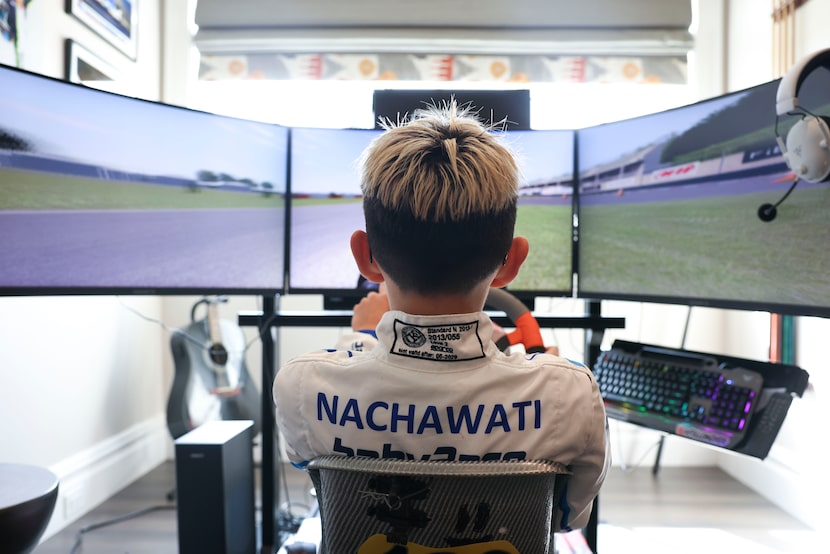
Liam Nachawati demonstrates a kart racing simulator in his home near White Rock Lake.
Shafkat Anowar / Staff Photographer
In person, Liam is sweet-natured and on the quiet side, the only hint of wildness the hair he likes to dye playful colors (pink when I first met him, though more recently just blond). It was a bit tough to pull from him what made racing so special, maybe because he’s 11 and maybe because trying to explain extraordinary experiences can steal their magic. I mentioned a line I’d heard former F1 driver Kevin Magnussen say about racing in Drive to Survive. “For me it feels like flying. It’s almost like having superpowers.”
Liam nodded, taking in this description. “There are some moments in the car where everything basically just goes quiet,” he says. “You’re just one with the car, and you’re laying down really fast laps. It feels amazing.”
The dangers of karting
Perhaps the most common question about youth karting, aside from the gobsmacking price tag, is injury. What if these kids get hurt? Liam did, early in the 2025 season, racing at the Speedsportz track near Houston. He was heading into a right turn when the kart behind him tried to overtake him, but their tires hit instead. The collision wasn’t dramatic, but the wheel in Liam’s hands jerked to the left with so much torque that it snapped his wrist.
“One minute I was fine,” Liam says, “and then we made contact, and my wrist was broken.” He worried the accident would spook him, but after two months of recovery, he came back strong, winning the Mini Swift category of the Indiana Grand Prix in the U.S. Pro Kart Series over the summer.
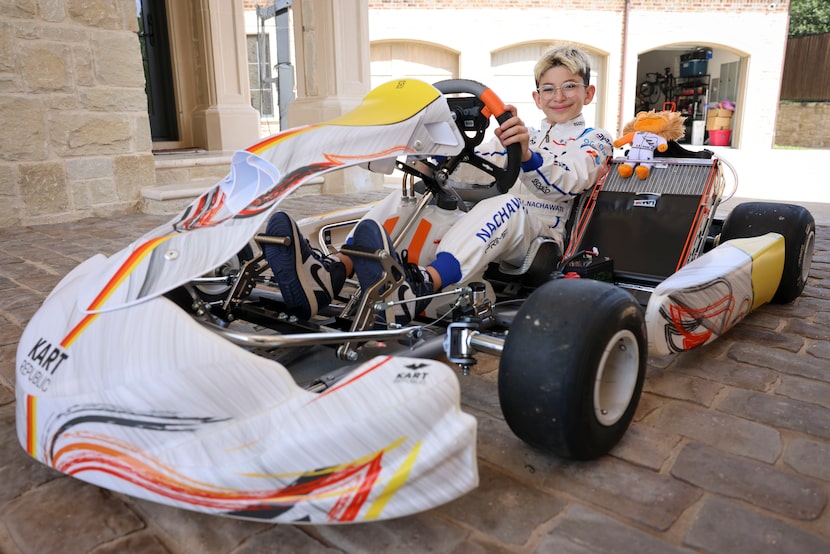
Dallas-based competitive kart racer Liam Nachawati outside his home near White Rock Lake.
Shafkat Anowar / Staff Photographer
Anyone familiar with racing — or shows like Drive to Survive, where stories pivot on split-second twists of fate — knows how quickly fortunes can crash and burn. What casual observers might not know is the safety precautions the sport has implemented. Liam drives with a brace around both his ribcage and neck, the latter of which became mandatory in the sport after the 2001 death of Dale Earnhardt. The broken wrist was a freak accident, but those happen in other sports, too.
“With this sport comes injury,” says Alma. “As his mom, it’s terrifying, but I’m also proud of him and exhilarated by his success. I’m letting go of control, and that’s the hardest part.”
Sometimes the drama unfolds to the side of the track, where parents can get a bit too heated. Earlier this month, Liam was once again competing at the track near Houston when a fight erupted between two fathers whose sons were racing. One was former F1 driver Antonio Pizzonia, who wound up arrested on an assault charge that was trumpeted in a headline on TMZ.
“Forget Drive to Survive,” Alma says. “Someone needs to mic the parents!”
But what if nothing comes of this?
Recently, Liam moved up to the junior division, which meant leaving the kid-karting world of BabyRace and taking a spot with Ricky Flynn Motorsport, based in the United Kingdom, a team whose roster of former racers includes F1 world champ Lando Norris. Driving at the junior level requires a heavier, faster car — this one can go 90 miles an hour — and a bigger price tag, closer to $400,000 a year. This is how it goes with competitive youth motorsports. The higher you climb, the more you pay. A season in F4, the step after karting, can cost close to a million, and the next level, F3, costs more than a million.
“I’m blessed,” Majed says, referring to his finances, “but I’m not Bill Gates blessed.”
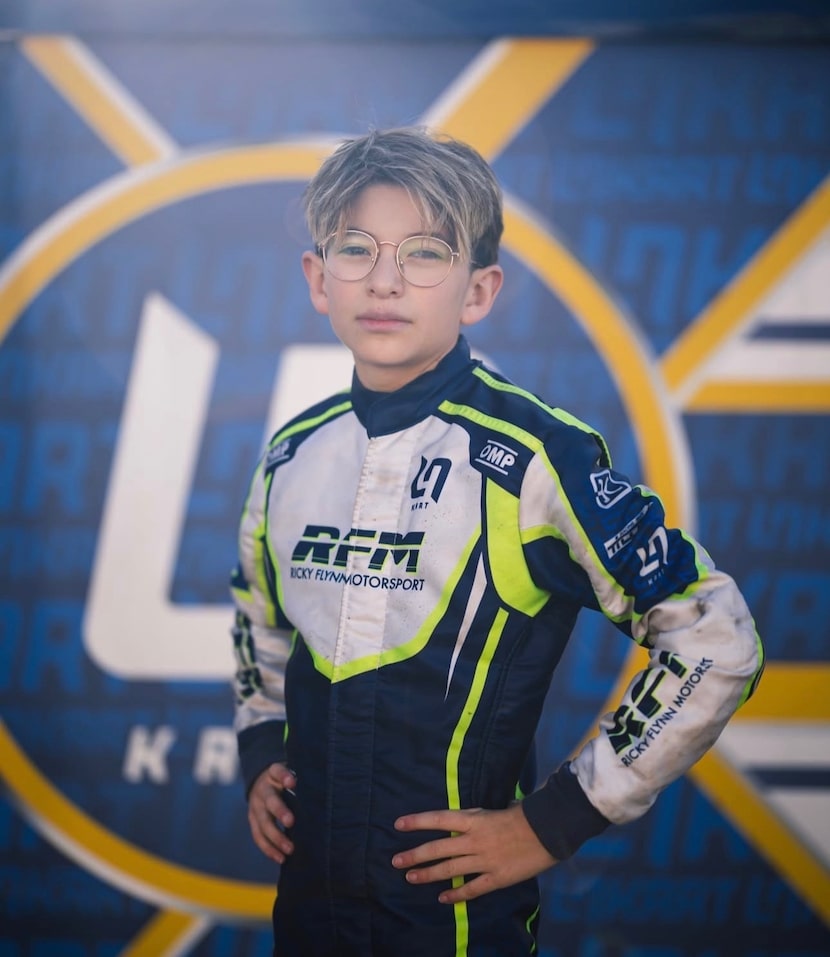
Dallas-based competitive kart racer Liam Nachawati, 11, recently moved up to a junior class and competes with UK-based Ricky Flynn Motorsport.
courtesy Liam Nachawati
At some point, costs may exceed his capacity, and he would look for outside forms of sponsorships. But for now, the family is footing the bill. Time will tell whether these extraordinary experiences are the building blocks to a professional racing career or just a very unusual childhood. The insight Liam has gained about mechanics and physics could point toward multiple professions, not to mention working in the growing industry of karting professionals: coaches, engineers, telemetry experts, media managers. Majed knows success is far from guaranteed in this sport, and Liam’s dreams could flame out any day.
“If he decides tomorrow to be an artist, I’m perfectly fine with that,” Majed says. Whatever makes his son happy is what he wants.
Liam seems to be having fun, at least according to his Instagram, where he has more than 300,000 followers thanks to playful reels that offer glimpses of his high-flying youth. One viral video features him persuading F1 star George Russell to say “6-7,” the nonsense numbers that became an inside joke among kids in 2025. But Liam’s favorite reel was his interaction in a crowded meet-and-greet line with another F1 racer, Kimi Antonelli.
“Rock, paper, scissors to follow me on Instagram!” Liam blurted to the young Italian, who gamely played along. When Antonelli put out a flat hand for paper, and Liam threw down scissors, Liam was so ecstatic he jumped up and down and squealed like the 11-year-old boy he is.
 The North Texas singer inspired by The Cure, Olivia Dean and … ‘My Little Pony’?
Five questions with Remy Reilly, one of the most nominated performers in the upcoming Dallas Entertainment Awards.
 Hepola: Sports broadcaster Jake Kemp’s rehab stint had a ripple effect — for listeners
After the former Ticket personality and current “Dumb Zone” host quit drinking, some middle-aged men in the Dallas area took it as their own wake-up call.