
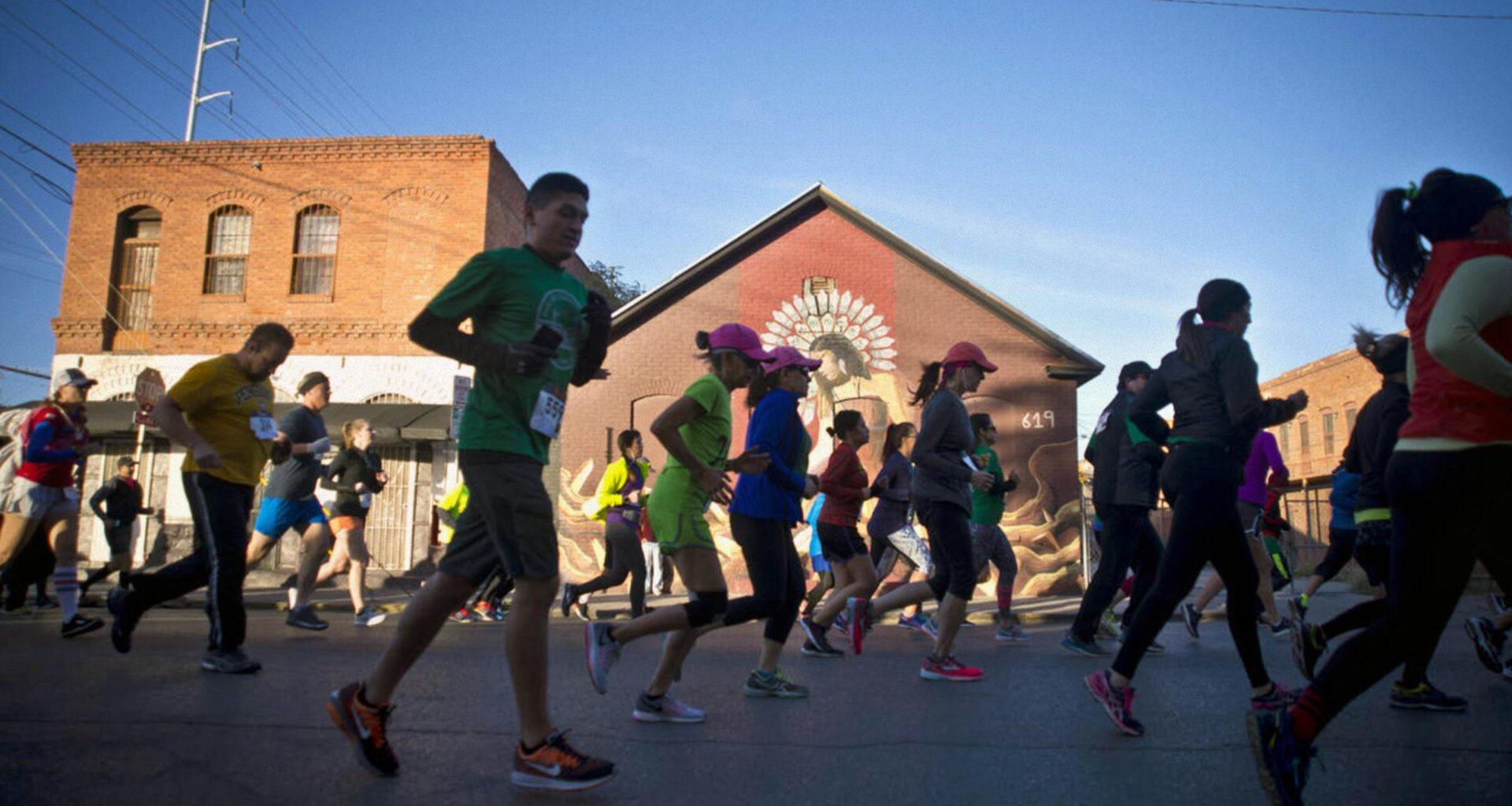
Among the three thousand runners at the seventh Run Internacional 10K, in El Paso and Ciudad Juárez, a few outfits stood out. Rarámuri runners sported flowing, colorful skirts. A group calling themselves the Mascarunners wore lucha libre attire. But perhaps no runner’s dress better embodied the spirit of the event than Roman Sandoval’s. The El Pasoan wore a matching top and bottom depicting a U.S. and Mexican flag being stitched together. “I’m a U.S. Army combat veteran, so I went to war for America, but my mom’s from Mexico,” he said. “Gotta represent both sides.”
Kicked off in 2015 as the culmination of a U.S.-Mexico border conference organized by then-Congressman Beto O’Rourke, Run Internacional celebrates the region’s binational identity. Half the race—which skipped 2018, 2020, 2021, and 2023 due to a mix of pandemic- and border-related challenges—takes place in El Paso, and then runners cross into Juárez and cross the finish line just before reaching the U.S. border. There are similar races in San Diego–Tijuana and Laredo–Nuevo Laredo, but Run Internacional’s organizers say theirs is the oldest still-running cross-border 10K in North America.
Home to more than 2.4 million people, El Paso–Ciudad Juárez is one of the largest “twin cities” on the continent. El Pasoans see the two municipalities as one metropolis. They might have family, a favorite restaurant, or an affordable dentist in Mexico. Roughly 35,000 personal vehicles and close to 18,000 pedestrians cross into the Paso del Norte region from Juárez every day, according to PDN Uno. El Pasoan Georgina Hernández, who was running the race this year, told me the 10K was symbolic of how normal the commute is between the two cities. “Obviously, the race makes it accessible for you to cross faster, but it’s part of the community that we have,” she said. “Even though there’s a lot of border towns, we have that closer proximity compared to other ones.”
For locals, Run Internacional is a way to reconnect with friends and family, celebrate the region, and counteract the narratives of violence and chaos that dominate U.S.-Mexico border discourse (El Paso actually has one of the country’s lowest crime rates among big cities). “El Paso is one of America’s friendliest cities. We are a very loving city,” Mayor Renard Johnson told me. “We don’t see the border maybe like other communities see a border. We see a community in one region.”
By guiding runners through the streets of the two cities, the race also allows out-of-towners to hear, smell, and feel what daily life looks like on the border.
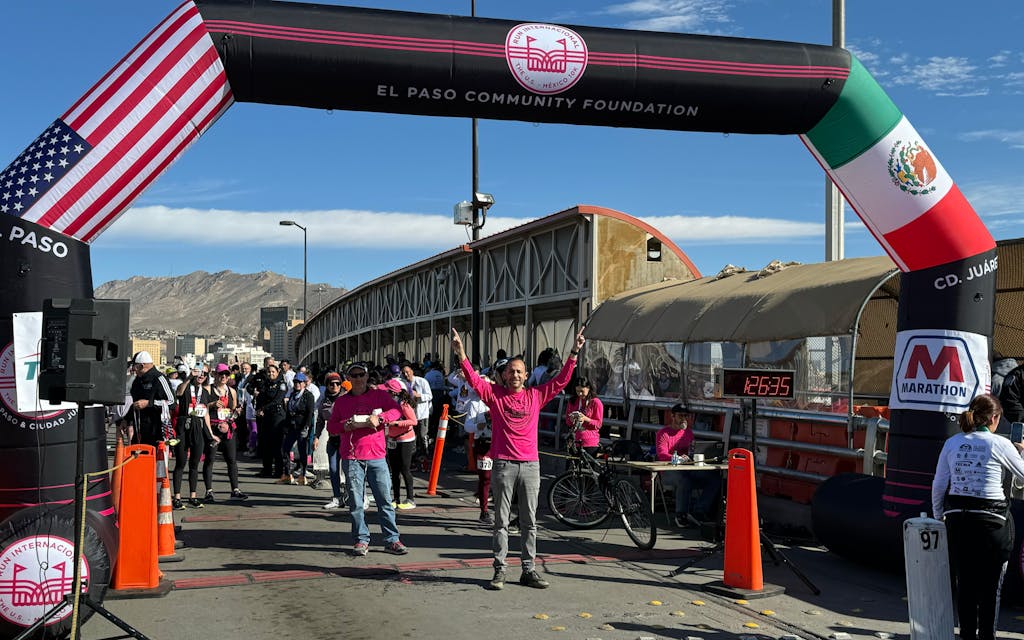 Mario Porras, the organizer for Run Internacional and El Paso Community Foundation’s vice president of international affairs, in March 2024.Courtesy of Run Internacional
Mario Porras, the El Paso Community Foundation’s vice president of international affairs, spearheaded the first race, in 2015, when he was O’Rourke’s director of special projects. Though born in El Paso, he grew up in Juárez. This year’s race was his first since he suffered a stroke less than three weeks after the 2024 event. It took the 44-year-old a little more than a year to fully regain his speech; he spent time in a wheelchair but can now walk with a cane. The experience made him reflect on the meaning of his life and deepened his commitment to the border region. Along with others at the foundation, he continues to help lead Run Internacional.
The 2025 race had extraordinary demand. While previous years had capped the event at two thousand runners, this year’s would include three thousand. Runners’ descriptions of the registration process made it sound like snagging Taylor Swift tickets. “You have to be on it with the tickets,” Marguerite Mauritz, who works at the University of Texas at El Paso, told me. Her partner, Maggie Barnes, said they registered at 6 a.m. The first 2,500 slots opened on August 15 at midnight and sold out within sixteen hours. A second registration opportunity opened with 250 slots and sold out in three minutes, and a third, with the final 250 slots, sold out in two minutes.
Then the race, scheduled for November 15, 2025, was postponed due to the U.S. government shutdown. Putting on the international event requires cooperation between the two cities’ consulates and border-security operations. Shortly after the shutdown ended, organizers announced January 17 as the rescheduled date. With some runners backing out, a new registration window opened. Those three hundred slots sold out within twenty minutes.
I was impressed by the cities’ zeal for running. Folks belonged to running groups, like JRZ Running Team, the Antisocial Run Club, and Run for It. Some belonged to multiple groups, or even ones on both sides of the border. Ruth Sofia Ortiz, a member of JRZ Running Team, ran the race in a Rarámuri-style skirt. The Indigenous group is native to Chihuahua and is known for its members’ ability to run long distances. In fact, some had completed a 540-kilometer run from Los Angeles to Las Vegas in 2024.
“I struggled with it, because it’s heavy,” Ortiz said of the red-and-green skirt. “It catches the wind.” While she’s not Rarámuri herself, she gained respect for the group from wearing their attire while running. Verónica Palma, one of the Rarámuri runners who completed the 540-kilometer run, said a 10K is shorter than she prefers, but she appreciates the significance of the race, which she ran wearing a purple-and-green Rarámuri skirt and a long-sleeved Run Internacional T-shirt. “It was important to me because it unites us.”
I immediately noticed the diverse age range on race day. Some recalled running in the Carrera Internacional de la Amistad when it took place on both sides of the border from 1968 to 2001 (after 9/11 heightened border security, that 10K became limited to Ciudad Juárez and has remained there since). Some couples pushed their children in strollers. Adrian and Lauren Zepeda brought their daughter and son. Despite not crossing the border regularly, Adrian, who grew up in El Paso, sees the two cities as closely linked. “If you look overhead from an airplane and you come in, it looks like one big city,” he said.
The crowd took off at 8 a.m. We weaved our way through downtown El Paso, around Southwest University Park and past a group of colorfully dressed folklórico dance performers. I ran alongside Barnes, who’s originally from the Midwest, and Mauritz, originally from England, who both moved to El Paso in 2018. “There’s a lot of rhetoric about dangerous immigrants and border invasion, and I don’t feel like I see that here,” said Barnes, who participated in group bike rides on both sides of the border when she first moved as a way to explore both cities. “The militarization is way overboard. Seeing the concertina wire along the Rio Grande is just really sad.”
Shortly after parting ways with Barnes and Mauritz, I crossed the Stanton international bridge into Ciudad Juárez. The Juárez symphony orchestra greeted us with music. We rounded a corner, running along a highway parallel to the Rio Grande and past a line of classic cars. I spotted Sandoval. His outfit was hard to miss. “I’m dying over here,” he said. The race was halfway over. Sandoval had wanted to do the run for years but had missed the registration window until this year. “I hate this,” he confessed. “I’m doing this for them.” By “them,” he meant his family living in Mexico.
As we kept moving, a fire truck with hanging U.S. and Mexico flags blared its siren. The Mexican side gave Sandoval renewed life. “This side is way more turnt up,” he said excitedly. Sandoval takes pride in the uniqueness of border life, something that other Texans might not understand. “A lot of people in Central, East Texas, they’ll laugh and joke that El Paso is not part of Texas. I mean, they’re kind of right,” he said. “We’re a whole different community out here. We’re in a different time zone. We’re right next door to the border. A lot of people come in and out for work. We go over there regularly to go visit family, and they don’t have that. I don’t fault them for not understanding, and I don’t fault them for saying we’re different, because we are.”
As the race progressed, Juárez was waking up. It was a little before 9 a.m. We maneuvered through the picturesque Plaza de Armas and up to the Catedral de Ciudad Juárez, where mimes performed. A lucha libre–dressed runner noticed a restaurant opening its doors. He beckoned to the proprietor for a burrito, to no avail.
Police and border security on both sides reveled in the event’s adrenaline. “Dale,” they yelled as runners passed.
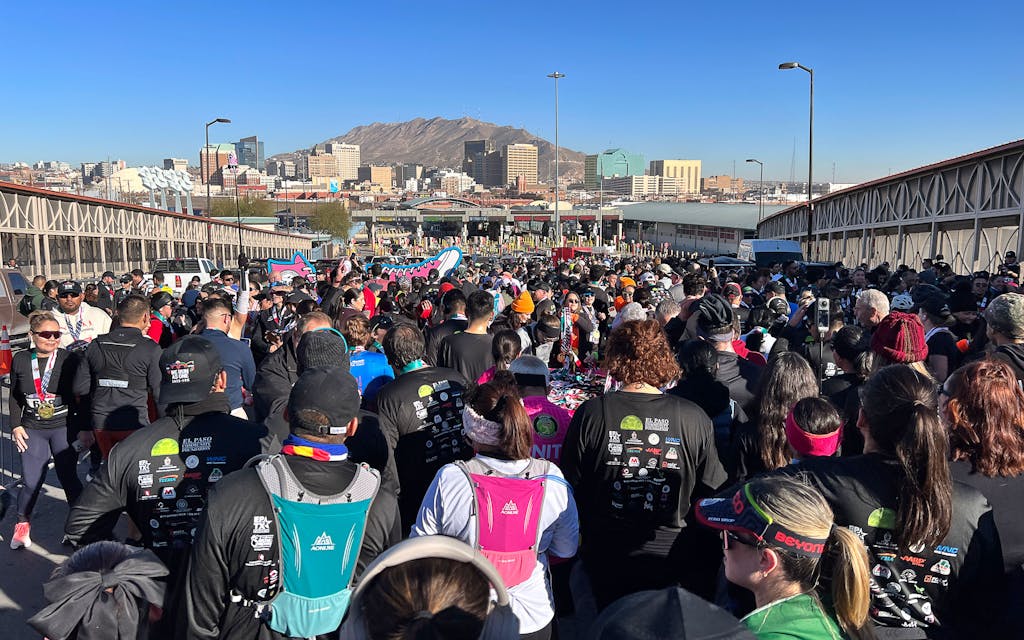 Runners at the finish line on the Paso del Norte bridge.Benton Graham
Nearing the finish, I took off toward the Paso del Norte bridge and sped up a steep, 635-foot uphill stretch that Hernández had warned me about before the race. I huffed and puffed across the finish line, collecting my participation medal. Along with the 2,480 other runners who finished, I’d run a 10K across two countries.
The significance was personal to Jesus Camarena and Annas Rios. They’d driven eight hours from Fort Worth and showed up on race day wearing Nike hats, one black, one white. For Camarena, who was born in Guadalajara, Mexico, but has lived almost his entire life in the U.S., the race involved two important firsts. It was the first time he entered the U.S. with his newly obtained resident status. And it was the first time he’d set foot in Mexico in 33 years. He ended up breaking his 10K personal record. He admitted to feeling some “first-time jitters” at the border. Growing up, he’d been taught to be cautious around law enforcement. In the end, following the run, his experience was smooth. “Crossing back with nothing to worry about felt amazing,” he said.
I took in the thousands amassed on the Mexican side of the bridge, waiting to reenter the U.S. Standing in the long line with my passport in hand, I realized that plenty of folks were wearing jeans and sweatshirts. They weren’t race participants. They simply wanted to cross. A family of seven in front of me was surprised by the line, but mostly, they were excited. It was their first time visiting El Paso from their hometown of Juárez. This type of crowd at a border crossing might become a major news story and be portrayed as chaotic. But that wasn’t what I was seeing. It was two cities, one community.
Read Next