
A University of Texas student dreamed of being a doctor since she was a little girl. She wanted to connect with people, and as a doctor, treat the whole person, not just the condition.
“It sounds cliche, but that’s what I’ve been my whole life. Just a number, just something to be accounted for, but not really a person,” she said. “I didn’t want that to be the situation when I treated patients.”
Attending UT, the student excelled in neuroscience and pre-med classes while interning at a faculty lab. She studied for hours in the library with friends, taking breaks to laugh and talk about boys. She was two semesters away from graduation when she learned she might not get her chance to walk the stage.
On June 4, a friend texted her an article, reporting that a North Texas judge had struck down the state’s 25-year-old Dream Act. Over the last quarter-century, the law gave in-state tuition to Texas high school graduates without legal immigration status if they promised to pursue citizenship. The judge blocked the law just six hours after the United States Department of Justice sued Texas. The state declined to fight.
As the Trump administration cracked down on illegal immigration, Texas Attorney General Ken Paxton celebrated the quick decision, arguing the law was unconstitutional because it gave special benefits to non-U.S. citizens — even though the act prescribed more stringent residency standards than for other students. NBC News reported that the DOJ coordinated with Texas to kill the act, citing a recording of a Justice Department official.
The legal battle changed everything for the student, who used the Dream Act to make higher education affordable in her first three years at UT.
The student, who the American-Statesman is not naming to protect her identity, does not have legal immigration status. After the judge’s decision, she saw her Fall 2025 tuition skyrocket from $5,883 to $22,485. She paid what she could, meeting the initial deposit. But after two weeks of classes, she was $17,000 short. She had to withdraw, only recovering some of the initial payment.
“My whole life, my identity has been based on being a student,” she said. “Whenever that is taken away from you, it just feels like the sky is falling.”
The student, who was born in Mexico but has lived in Texas since she was 2 years old, was one of an estimated 57,000 students across Texas left in limbo after the judge’s preliminary injunction. But the case isn’t closed — and Latino UT students who have legal status are determined to ensure people recognize the consequence of the change.
READ MORE: Nonprofit fights back after Texas ends in-state tuition for undocumented students
UT’s chapter of Sigma Lambda Beta, a Latino-based fraternity, and its sister sorority, Sigma Lambda Gamma, have signed on to an amicus brief to show the court the harm of repealing the law. They were the only UT-based student organizations to sign the legal document, which the U.S. Fifth Circuit Court of Appeals will read before deciding how to proceed in the coming months.
Motivated by a desire to advocate for their members and ensure they can finish their education, the students testified, met with lawmakers and worked with nonprofits to ensure students without legal status have a voice as their education is threatened.
“The Texas Dream Act is now in litigation. Some people think it’s repealed. Some people think it’s gone, but that’s not the truth,” said Marco Julian Gonzalez, a fraternity brother and student at the University of Texas McCombs School of Business. “I want people to remember. Don’t forget about these students.”
How the Texas Dream Act lawsuit changed everything
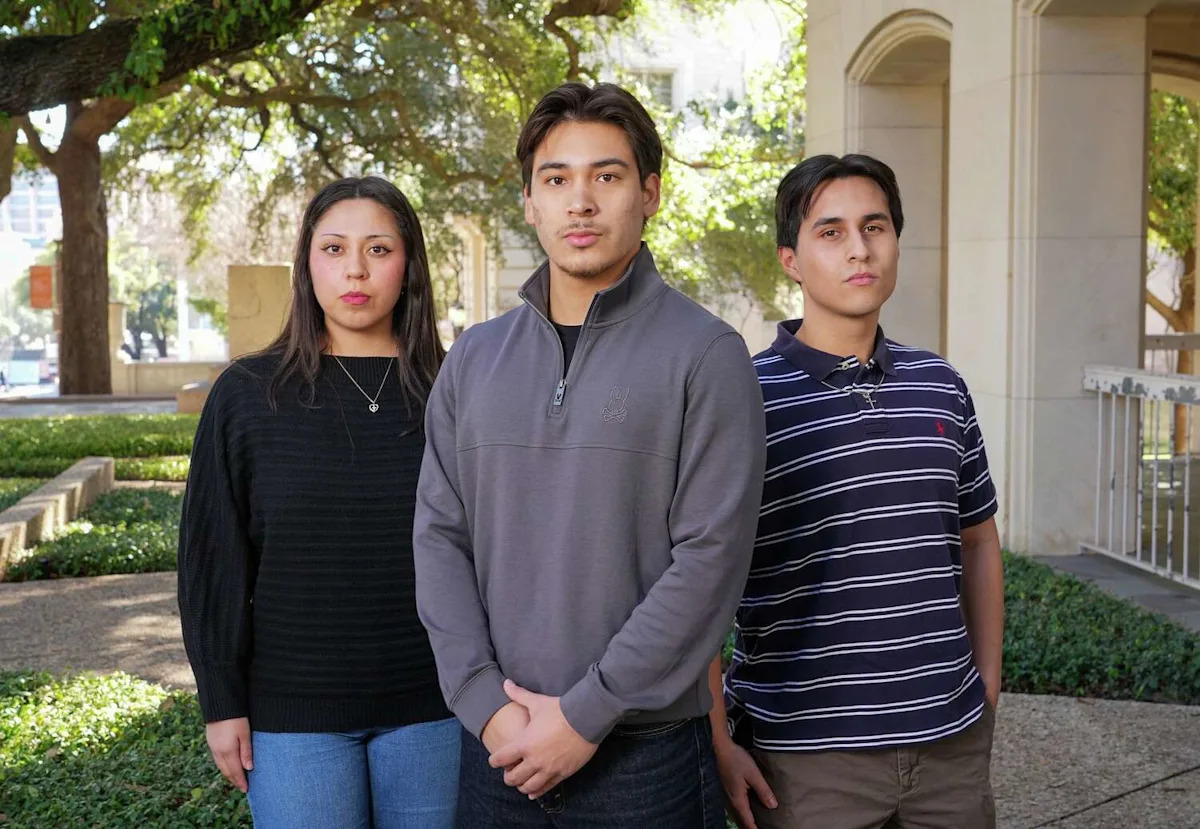
University of Texas students Eduardo Vazquez, from left, Amy DonJuan and Marco Julian Gonzalez pose for a photo on Wednesday, Jan. 28, 2026. The students signed on to an amicus brief to stop a Texas judge’s ruling to end in-state tuition for undocumented students. (Jay Janner/Austin American-Statesman)
Dozens, including Austin Community College, have petitioned for the Dream Act to be restored after the swift ruling. Several parties are currently appealing a judge’s refusal to let them join the case.
The student the Statesman spoke with said she couldn’t tell her story with her name without fear of getting death threats, being deported and being separated from her family. But other UT students are signing their names onto the legal battle to stand up for their peers.
“They’re state educated students like anyone else, right? But they’re being treated differently,” Gonzalez said. At a time he felt no one on campus was standing up for students, his fraternity had to, he said.
RELATED: ACC board to join lawsuit over Texas Dream Act repeal
The fraternity’s advocacy over the Dream Act started a year ago, Gonzalez said, when a Republican senator filed a bill to repeal the law. The UT chapters of Sigma Lambda Beta and Latina-based sorority Kappa Delta Chi testified in front of lawmakers to represent their peers who would lose in-state tuition with the law’s elimination.They met with lawmakers from both parties, worked with writing tutors to craft testimony with Dream Act students and held a protest last February for immigrant rights at the capitol with more than 300 people in attendance.
When the bill died, Gonzalez thought they had won, he said.
But two days after the legislative session ended, Gonzalez learned otherwise. He was on a train with his family when he got a news alert: A judge had blocked the Dream Act from being enforced. No student without legal status was heard before the ruling was made.
With school out of session and the injunction in place, uncertainty crept in. Students without legal status couldn’t speak out without fear of deportation, and universities were rushing to determine how to implement the ruling.
This summer, UT sent an email to 952 students asking them to submit documentation proving their legal residency. It is not known how many were reclassified as out-of-state students in accordance with the judge’s ruling. Students could face legal ramifications if they misrepresented their status, creating a culture of fear, advocates said.
“Students were scrambling trying to come up with thousands of dollars,” said Amy DonJuan, a Kappa Delta Chi member and UT Plan II student who testified with Gonzalez.
A fraternity steps up as undocumented classmates are pushed out
As the summer went on, the fraternity members texted frequently to determine their plans.
“With everything that’s going on, we understand that either way, our students are being targeted,” DonJuan remembers thinking. “And so if they’re being targeted already, we need to speak out, and we need to be doing something.”
Kristin Etter, an attorney for the Texas Immigration Law Council, a group that works to protect immigrant rights, met the students when they testified at the Texas Capitol. She formed a coalition to help inform the judge on the effect of ending the Dream Act through an amicus brief, which shefiled as a third party. As part of her work, she connected with the students.
The UT students helped inform the brief’s understanding of what campus would miss with the students who could no longer afford their education.
Eduardo Emmanuel Vasquez, a junior and member of Sigma Lambda Beta, watched first hand as friends heard the news and scrambled to figure out their plans. He knew someone who sold everything they could to afford their last semester at UT. He saw others, “right there at the finish line,” have to drop out due to surging tuition prices.
“Having all that pressure your entire life and then doing things correctly just for the government not to support you at the end — it’s something just heartbreaking. Horrible,” Vasquez said.
Like any other fraternity, Sigma Lambda Beta, which has 27 current members, hosts parties, tailgates and ‘rush’ recruitment events. But unlike other Greek Life, he said, members view it as a key part of the group’s mission to stand up for its current and future members, which means advocating for those who need the Dream Act to access education, Gonzalez said.
“We’ve had members who are recipients of the Texas Dream Act, and that’s how they’re able to be here,” Gonzalez said. “We don’t ask where you were born or what your status is. You worked hard to get here at UT just like any of the rest of us.”
Their fraternity was founded by Latino people, for Latinos. Service — and showing up for their peers — is a fundamental part of the group’s existence. Part of why people aren’t talking about it on campus is because those who are affected can no longer afford to enroll, he said.
“It falls to us” to fight, Gonzalez said.
A judge accepted Etter’s brief — with the student organizations signed on — in November as the Fifth Circuit prepares to hear an appeal to reopen the case.
“It’s really courageous,” Etter said of the students. “Especially when we are in a time where you have some of our most powerful corporations, universities, really lacking courage and not wanting to be at the forefront of doing what’s right, you basically have a group of 18 to 19 year old kids that are.”
Fear, fallout and rising tuition on Texas campuses
Etter’s legal argument focuses on what Texas — and higher education — will miss with the Dream Act struck down.
As of 2024, Texas is still far behind on its college attainment goals. The state aims to have 550,000 people graduate with a credential or higher annually, but as of 2024, Texas is more than 220,000 people short of its yearly goal.
Dream Act students are estimated to add more than $461 million to the Texas economy annually in tuition, taxes and spending power, the Texas Immigration Law Council estimates. Texas will lose that money if they unenroll, the brief argues.
“That is really the hope of the amicus — to show that we’re not just saying that this is a good thing for immigrants,” Etter said. “We’re saying it’s a good thing for Texas.”
Fear still remains on campus, DonJuan said. Her sorority sisters with varying immigration statuses remain eligible for in-state tuition, but they worry Texas will eliminate support for other immigrant students.
When the students started on campus, UT had the Monarch program, a place where a full-time staff member worked to support students without legal status in their educational journey. In 2024, that office closed when the university complied with a law that ended diversity, equity and inclusion support. A scholarship that supported students without legal status also folded.
“They’re safe for now, but how much longer?” she said.
Barbara Hines, an immigration lawyer who spent her career ensuring immigrants could access education, feels hopeful for the Dream Act’s restoration. But she believes it is “very important” for students to be engaged as the legal battle continues. Last week, the Texas Higher Education Coordinating Board adopted rules to help schools abide by the ruling, but before it did, confusion led to schools complying in different ways, she said.
By testifying at the Capitol, to the coordinating board and advocating through the brief, the students help hold Texas accountable to remembering students impacted, Hines said.
“It gives voice to impacted students,” Hines said. It tells them they aren’t alone, she added.
‘I don’t have any other options’: A student’s future on hold
Eight months after the world changed for the UT student who aspires to be a doctor, life at the University of Texas has gone on.
She plans to return to campus in May to watch her friends and former classmates graduate. As she saves money and wrestles with how to continue her education, she hopes to get back on track to walk the stage herself.
“I don’t have any other options,” she said.
Texas is “all she’s known,” and she wants to help people through her career. But the obstacles are overwhelming. She recalls a 2019 political cartoon of a race track depicting men, set to run the course with a clear field before them. Meanwhile, the women beside them face hurdles of laundry, cleaning and cooking in their way.
“For us,” she said, who don’t have legal status, “we’re building the track by hand, and then the hurdles are there that we still have to get over.”
It’s her passion — to be a doctor and help people — that drives her. She pictures “Dr.” before her name.
“It’s just a pause right now,”, she said, but she knows: “We will finish.”