
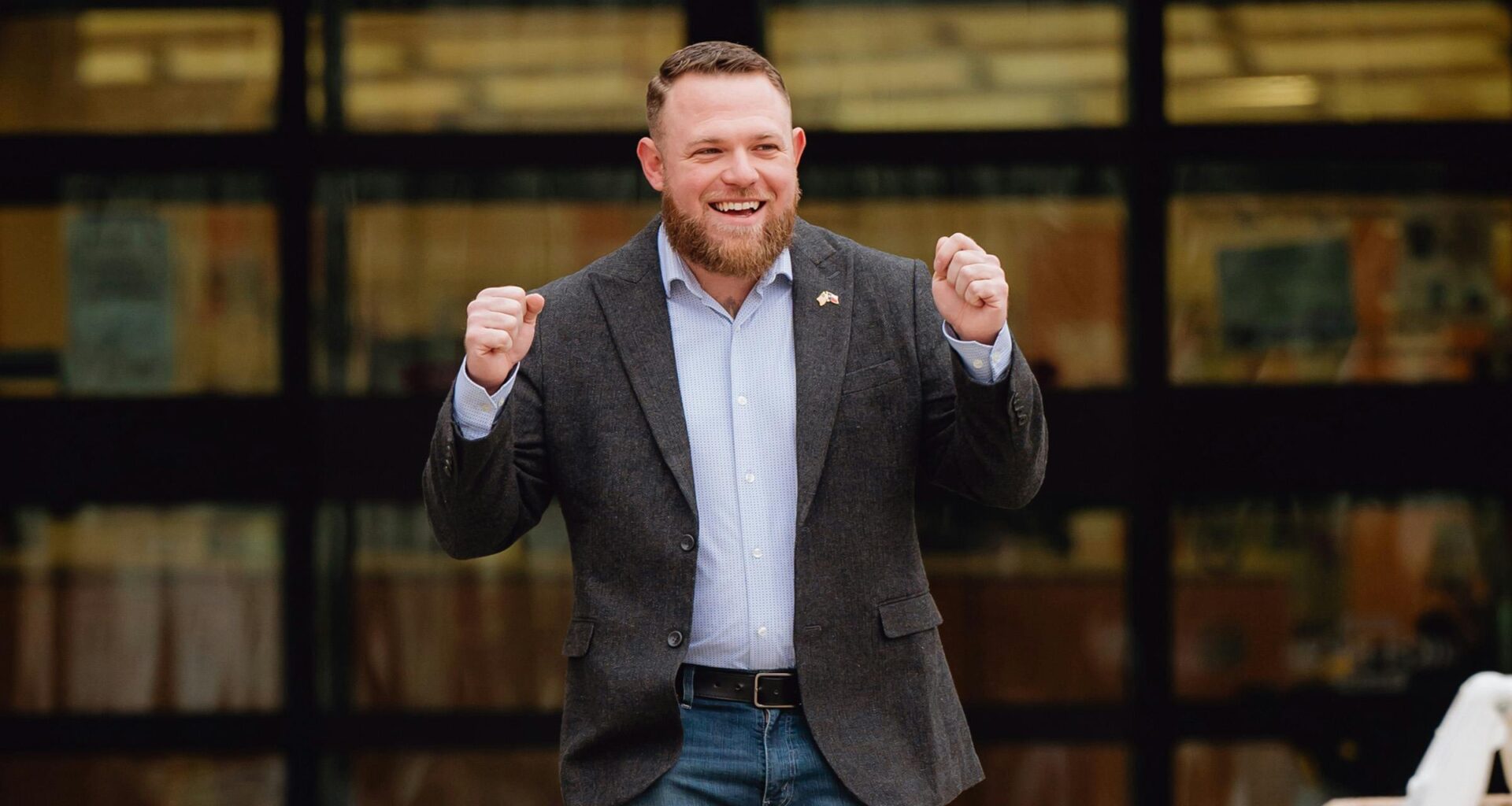
On a Sunday in mid-January, Taylor Rehmet darted around north Tarrant County, knocking on doors, stumping at a local union shop, and stopping on the streets to pitch himself to anyone who would listen. It was only a few days until the start of early voting in the special election for state Senate District 9, a ruby-red district that includes conservative Tarrant County suburbs and has not elected a Democrat since 1991. Despite being massively outraised and outspent by his billionaire-funded opponent, Leigh Wambsganss, Rehmet, a 33-year-old union-chapter president and first-time candidate, seemed remarkably confident—certain, even—that he was on the precipice of pulling off what many assumed nearly impossible.
Turns out he was right. On Saturday, Rehmet notched one of the biggest upsets of the Trump era, winning more than 57 percent of the vote in a district that, just last year, voted for Trump by 17 percentage points. He cruised to victory in the low-turnout contest by converting many Republican voters and courting independents.
Legislatively, the victory is essentially meaningless: Rehmet will serve out the remaining eleven months of the term of Kelly Hancock, who resigned last year after he was appointed acting Texas comptroller by Governor Greg Abbott, but the Legislature will not convene again before Rehmet will have to run for the seat again, against Wambsganss in the November general election.
But symbolically, it is stunning—the political equivalent, even some conservatives have acknowledged, of a 9.5 Richter scale earthquake. For most of this century, the northern Tarrant County suburbs have been a crucial hub of the state’s far right. They’re home to many of the state’s most hyperpolitical fundamentalist churches and in many ways are the birthplace of the tea party movement in Texas. And in the fifteen years since, the Tarrant County government has been transformed by a far-right political movement that has openly worked to stamp out Democratic opposition—even as the county itself gets increasingly purple. The goal, recently retired Tarrant County GOP chair Bo French (who is now running for the Railroad Commission) has said, is to make the region “inhospitable” to Democrats.
Wambsganss has been a central part of that political project. She is the chief communications officer of Patriot Mobile, a cellphone-service company with a political action committee (which Wambsganss leads) that funds Christian nationalist candidates in Texas. In the early 2020s, she was on the front lines of right-wing efforts to take over school boards in the region—creating a playbook that was used for similar movements in suburbs across the country. Her campaign for Senate District 9 was aided by roughly $2.3 million in donations—more than half of it coming from three billionaire-funded political action committees, including far-right oil tycoon Tim Dunn’s Texans United for a Conservative Majority. President Donald Trump called on his supporters to rally behind her in a Friday social media post.
Rehmet believed the core message of his campaign—working-class solidarity—could be the glue in a winning coalition of unions, progressives, blue-collar voters, and disaffected Republicans. Early analysis of the outcome indicates just how much that was true: Wambsganss had been relying on winning voters who had initially backed John Huffman, a former mayor of the conservative suburb of Southlake, in the November open election for the seat. But, according to Republican strategist Ross Hunt, many of them ended up voting for Rehmet. He even won in some of the darkest-red parts of the district—including the city of White Settlement—and his campaign’s focus on Hispanic voters also appears to have paid off. “At the end of the day, the explanation for [what] happened last night was NOT that Democrats won TX SD-9 because of increased Dem enthusiasm,” Hunt wrote Sunday on social media. “Rather, it was that Republicans LOST it because of the failure to persuade swing Republicans and right-leaning independents.”
There are some reasons to doubt that Rehmet’s 31-point swing victory perfectly encapsulates the mood of the broader electorate. Historically, low-turnout special elections have favored Democrats in Texas. Moreover, Wambsganss entered the race with years of highly divisive political activism to her name, and she spent the first round of it attacking Huffman as a shill for communist China and a “demonic” force—rhetoric that no doubt made it harder to convert some of his supporters.
Some Texas conservatives have been quick to point out these factors and downplay the result. But Rehmet’s win is also a message about growing discontent with the local far right and the Trump administration, and it shows the power of a labor-focused campaign to transcend partisan boundaries. Maybe Saturday wasn’t a 9.5 on the Richter scale. But is an 8.5 earthquake that much better?
Read Next