

With a few exceptions, Dallas police reported broad declines in reports of violent and nonviolent crime in 2025 — a picture the department has largely cast as the payoff of more focused policing.
The downward trends — which criminologists say are in line with a national downswing in killings and violence in many big cities — describe a year at times punctuated by cases that rattled the city and dominated headlines, including the fatal shooting of two migrants at a Dallas immigration office.
They also arrive as the department presses to hire more officers and bring down 911 response times, a longstanding, day-to-day challenge department leadership has said is a priority.
One of the most touted year-end figures by police Chief Daniel Comeaux is the city’s tally for murders: Department data shows police counted 141 homicides in 2025 — the lowest since 2015, when it counted 136. The same data shows reports of violent crime fell for the fifth year in a row.
Breaking News
“We are one of the most proactive police departments in the United States,” Comeaux said at City Hall in mid-January after City Council members were presented with the year-end totals, “and we’re being very proactively going after bad people.”
Nationally, Dallas’ drop in killings tracked with a broader decline across large cities. In its year-end report, the Council on Criminal Justice analyzed monthly public data from 40 cities and found that in the 35 cities with usable homicide figures, the number of homicides fell 21% from 2024 to 2025.
“It’s an ‘everywhere’ story. It’s not just three cities that are driving this trend,” said Alex Piquero, a criminology professor at the University of Miami and former director of the Bureau of Justice Statistics. “The trend is a national one, it’s a big city one, it’s a medium city one, it’s a red city, it’s a blue city — we’re in a really good spot.”
The decline cannot be attributed to any single agency or initiative, Piquero said, arguing that cities like Dallas will need to continue investing in evidence-based approaches if they want the progress to last.
He said that public perceptions of crime often don’t align with the statistics.
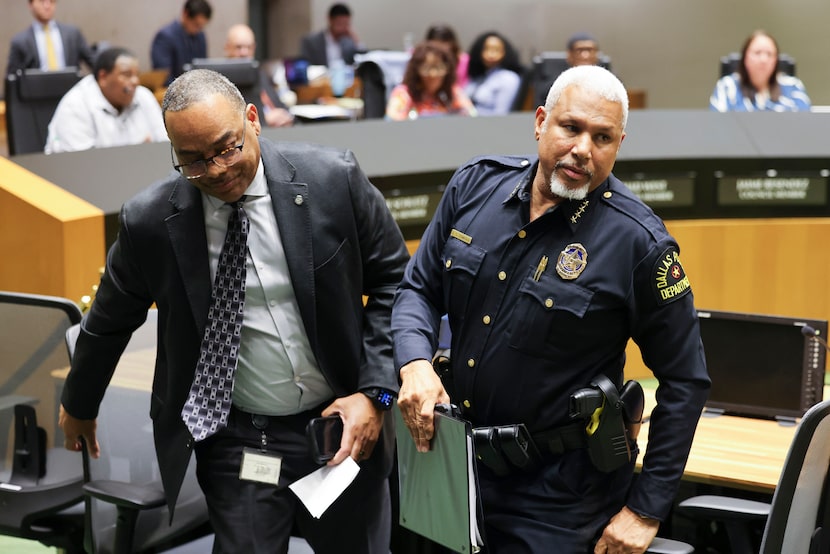
Dallas chief of public safety Dominique Artis (left) and police Chief Daniel Comeaux exit the dais after appearing before the Community Police Oversight Board on Tuesday, June 10, 2025, at Dallas City Hall.
Shafkat Anowar / Staff Photographer
At City Hall, discussions over the numbers often turn to the gap between what the data shows and what City Council members and residents say they feel on their blocks.
Earlier this month, during a briefing to the City Council’s Public Safety Committee, a discussion around the drop in reports of violent crime steered into one about whether the data matched reality and random gunfire.
Council member Maxie Johnson, who represents south Oak Cliff, said year-end totals on violent crime did not match what his constituents are experiencing in District 4. Comeaux responded, saying he was committed to working with Johnson directly.
“We need real results,” Johnson said during the meeting. “I can’t continue to just give data and say this is happening when our experience is saying something totally different.”
Related
 Downward trend may be influenced by ‘hot spot’ policing
In its year-end report, Dallas police counted 48,862 total offenses in 2025, down from 54,524 in 2024 — a 10.38% decline, based on preliminary incident-report data that the department says can shift as cases are reclassified or reported later.
Violent crime fell 12% to 8,020 offenses from 9,117 the year before, the report shows. The department recorded 141 incidents of murder and nonnegligent manslaughter, down from 184 in 2024, a 23% decline. Aggravated assaults fell 12% to 5,218 from 5,930, and robberies fell 11% to 2,019 from 2,265.
Under former Chief Eddie García, the department partnered with criminologists at the University of Texas at San Antonio to design a data-driven strategy aimed at the small number of places that generate a disproportionate share of the city’s violent crimes.
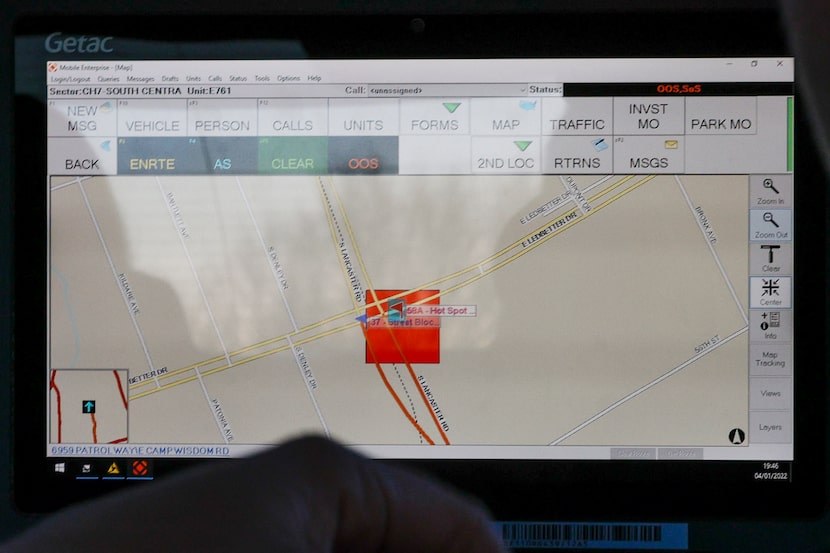
A red box pictured on the computer of a Dallas police patrol car shows a crime hot spot in South Dallas, Friday, April 1, 2022.
Elias Valverde II / Staff Photographer
Related

The approach, referred to often as “hot-spot” policing, uses department crime data to identify areas where violence is most concentrated and to focus patrols and enforcement there. It was implemented in the spring of 2021 after a period during which Dallas had been grappling with a spike in violent crimes, including murders.
“Cities do that kind of policing pretty regularly. Dallas has done it in a sustained fashion,” said Piquero, who likened the narrowed focus to a “surgical strike” on an area. “The results are very promising.”
Comeaux kept the strategy in place and promoted Maj. Andre Taylor — a former SWAT officer — to oversee the effort last fall. In April, city council members renewed a three-year, $337,305 contract with UTSA to continue the plan.
Several major property-crime categories also declined, the report shows. Auto theft fell 23% to 11,175 from 14,591, and burglary fell nearly 10% to 5,432 from 6,026.
One category saw a double-digit increase: shoplifting rose to 3,654 from 3,003, an increase of 21%. Reports of burglary of a motor vehicle totaled 13,828, which is up from 13,529 last year — an increase of 2%.
The rise in car break-ins is not unique to Dallas, said Allison Hudson, a police department spokesperson. Similar trends are playing out in cities nationwide, she said, driven in part by technological vulnerabilities and “crimes of opportunity.”
“There is no single cause, which is why DPD continues to focus on prevention, enforcement and community partnerships to address these offenses,” Hudson said.
Piquero said that nonviolent crimes like shoplifting rose during the COVID-19 pandemic and while they are unfortunate, they should not draw attention from the double-digit decline in killings big cities like Dallas are seeing in part because of more focused policing.
“That’s what the story is, and it’s a good one,” he said.