
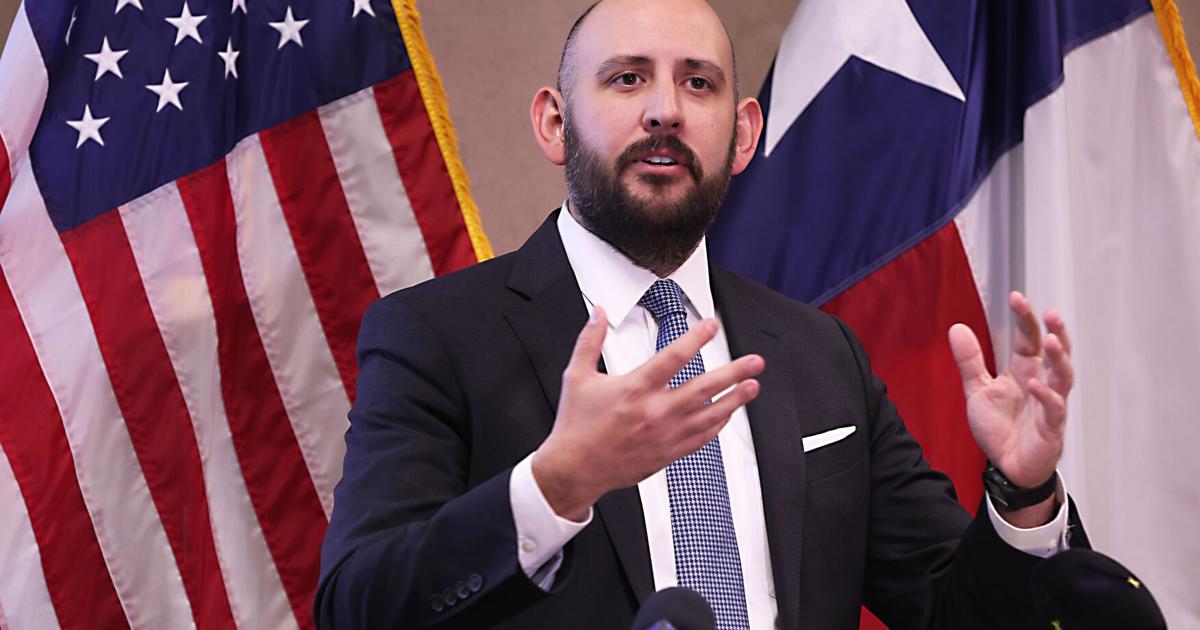
After years of turmoil that damaged public confidence in the El Paso District Attorney’s Office, newly released data shows progress under District Attorney James Montoya – though legal experts say the numbers also reveal unresolved challenges.
The report presented snapshots of misdemeanor and felony metrics beginning with the last year of Jaime Esparza’s administration in 2019 and continuing through Yvonne Rosales’ troubled tenure from 2020 to 2022, Bill Hicks efforts to rebuild the office in 2023 and 2024 and Montoya’s first complete year in 2025.
El Paso Inc. spoke with attorneys and retired judges with extensive knowledge of the DA’s office to review the data and provide insight into the current state of prosecutions in El Paso.
Nearly everyone interviewed expressed optimism that the dysfunction that plagued the office during Rosales’s administration has ended. They credited Hicks with rebuilding staffing levels and addressing thousands of backlogged cases, while also recognizing Montoya’s role in maintaining that momentum.
“Bill Hicks started that process, but these numbers clearly indicate that our criminal case filing process at the DA’s office is functioning the way it should be,” said attorney Justin Underwood, an El Paso trial lawyer who was one of a number of high-profile figures who pushed for Rosales’ resignation at the end of 2022.
“I think these numbers are strong indicators that we have a functioning district attorney’s office that actually knows how to screen, assess and properly file cases,” Underwood said. “I can say that the people of our area should be generally pleased with the work that Mr. Montoya and his team are doing.”
Montoya’s office in 2025 recorded the highest number of felony cases “disposed” – either dismissed, resolved in trial or settled through plea agreements – with 8,804 cases disposed and a conviction rate of 54%. His office also resolved more family violence felony cases than any other administration covered in the report, with 544 cases disposed and a conviction rate of 45%.
The DA’s office also received high marks for its prosecution of child sex felonies. Montoya’s office had a conviction rate of 72%, with 41 of the 57 cases ending in guilty verdicts or guilty pleas.
Hicks, whose administration from 2023 to 2024 handled 71 child sex felony cases with a conviction rate of 46%, said he was impressed with Montoya’s team in those cases.
“Those are some of the hardest cases to prosecute in the criminal justice system, and his SVU unit proved themselves well in 2025,” said Hicks, who was appointed to replace Rosales and then lost to Montoya in the 2024 election.
Hicks raised concerns, however, about the homicide data in Montoya’s report, which showed 46 resolved cases with “only 28 convictions for his homicide cases and having an unusually high number of 18 cases dismissed or not guilty,” he said.
“That low conviction to not-guilty rate is concerning, especially considering the people in the homicide unit that he failed to retain when taking over from my administration,” Hicks said.
Hicks added that it was difficult to fully assess the effectiveness of Montoya’s homicide prosecutions because it was unclear whether the data included capital murder or intoxicated manslaughter cases.
When Montoya released the report Jan. 9, he stressed one metric: a reduction in the case backlog from December 2024 to December 2025.
For December 2024, the report shows more than 4,700 pending misdemeanor cases and more than 7,000 pending felony cases – a total of nearly 12,000.
“At the end of December 2025, we had reduced the active pending caseload by almost 2,000 cases. We reduced the felony caseload by 1,000 cases and the misdemeanor caseload also by approximately 1,000,” Montoya said. “This is the overarching headline that I’m most proud of, and it is the reduction in the number of pending cases that we have here in our courthouse.”
Tackling the case backlog
At the height of the campaign to remove Rosales from office, estimates of the backlog ranged from 10,000 to 14,000 cases, though exact figures were never disclosed. Montoya’s report shows pending cases steadily increasing beginning in 2019 under Esparza, then accelerating during Rosales’ administration.
During that period – marked by the COVID-19 pandemic and turmoil in the DA’s office – cases presented by area law enforcement agencies were bottlenecked in the intake section. Although the cases were logged, many were never assigned attorneys or court dates.
According to the current DA’s office, the region’s 40 law enforcement agencies presented the Rosales administration with a total of 63,872 cases for possible prosecution – more than 25,000 in 2020, about 17,000 in 2021 and more than 21,000 in 2022.
During his recent press conference, Montoya confirmed the backlog of cases during the Rosales administration was “about 10,000 cases, 14,000 cases” and also announced that the “backlog in our intake section, … that is gone. Those cases have been filed.”
Rosales declined to comment.
Retired El Paso County Magistrate Judge Penny Hamilton reviewed the DA’s new report and disputes the claim that Montoya eliminated the backlog.
“He didn’t, based on the data that he showed,” she told El Paso Inc. “In looking at these metrics, one of the things that stood out to me is he kept saying he disposed of 10,000 cases, that he got rid of the backlog and disposed of 10,000 cases, and I do not see that in the data anywhere.”
Hamilton oversaw the jail magistrate courts and worked for more than 20 years in the DA’s office with Esparza. She was hired by Hicks to help tackle the case backlog.
Eliminating the backlog in the intake section, she said, occurred under Hicks’ administration.
“It was a heroic effort that we ended up filing almost 20,000 cases in 2023. That, to me, was clearing out the backlog,” Hamilton said. “That happened in 2023 and 2024. And when those cases got filed, then they ended up going into the courts.”
Montoya’s statistics show Hicks filed 37,204 cases in 2023 and 2024. In 2023, his office filed 19,766 cases – the most cases filed by any administration in the report, including Esparza’s final year in 2019.
Montoya’s office filed 16,840 cases in 2025.
“When his administration started, the DA’s office was already back on track for getting the cases filed,” Hamilton said.
Matthew James Kozik, an El Paso criminal defense attorney who has also been a prosecutor, reviewed the data and was surprised by the number of cases resulting in not-guilty rulings.
“What stands out, and has to be concerning to any resident of El Paso, is the fact that of the approximately 8,517 misdemeanor cases charged, 5,374 of those charged were found not guilty – a staggering 63%,” Kozik said in an email.
“That means out of 10 residents of El Paso charged, 6.3 residents were found not guilty,” he said.
Kozik noted that nearly half of the more than 8,000 felony cases filed in 2025 also resulted in not-guilty findings. The total number of misdemeanor and felony cases filed in 2025 was 16,840, and 9,404 not-guilty rulings were made that year, he said.
“Overall, in cases brought by the El Paso District Attorney’s Office, 56% are found not guilty – that is a staggering high number,” said Kozik, who added that these numbers “appear not to show progress.”
The misdemeanor conviction rate under Esparza in 2019 was 45%, while the felony rate was 69%, the highest in the report. Misdemeanor conviction rates plunged under Rosales, hitting a low of 20% in 2021, before rising to an average of 29% under Hicks and 30% in 2025 under Montoya.
Felony conviction rates dropped from Esparza’s 2019 high of 69% to 65% under Rosales in 2020. In 2021, it plunged to 43% before rising in 2022. Hicks had a felony conviction rate of 59% in both 2023 and 2024. Under Montoya, the overall felony conviction rate fell to 54%.
“Either the district attorney’s office is more concerned with metrics and increasing charged offenses, therefore bringing low-quality cases yet having the lives of these falsely accused El Pasoans upended for years, or there needs to be a significant increase in trial advocacy skills training within the DA’s office,” Kozik said.
It could also be, he said, that “the El Paso defense bar easily controls the tempo and outcome of this jurisdiction,” said Kozik, adding that “the results in the El Paso Walmart shooting case, i.e. a plea deal that accomplished nothing, would suggest the latter.”
Officials from the DA’s office cautioned that the data reflects cases at varying stages, some originating in prior years, and that year-by-year analysis may not fully capture an administration’s performance.
Still, the release of the internal data by the region’s top law enforcement agency provided a rare view for the public and the legal community.
“In looking at the statistics that DA Montoya compiled, I was moved by how hard everyone at the DA’s office had been working from 2023 through the last days of my administration, and clearly continuing through DA Montoya’s administration,” Hicks said.
Montoya described the release of the data as an “unprecedented” decision by his office, and said it’s part of keeping a promise he made to El Paso voters.
“During the campaign, I tried to make it a point that, in my opinion, being transparent is more than simply answering questions or making oneself available for questions,” he said. “It’s about being open and honest about what is actually happening in our court system, not just in one case or two cases or three cases, but systematically.”