
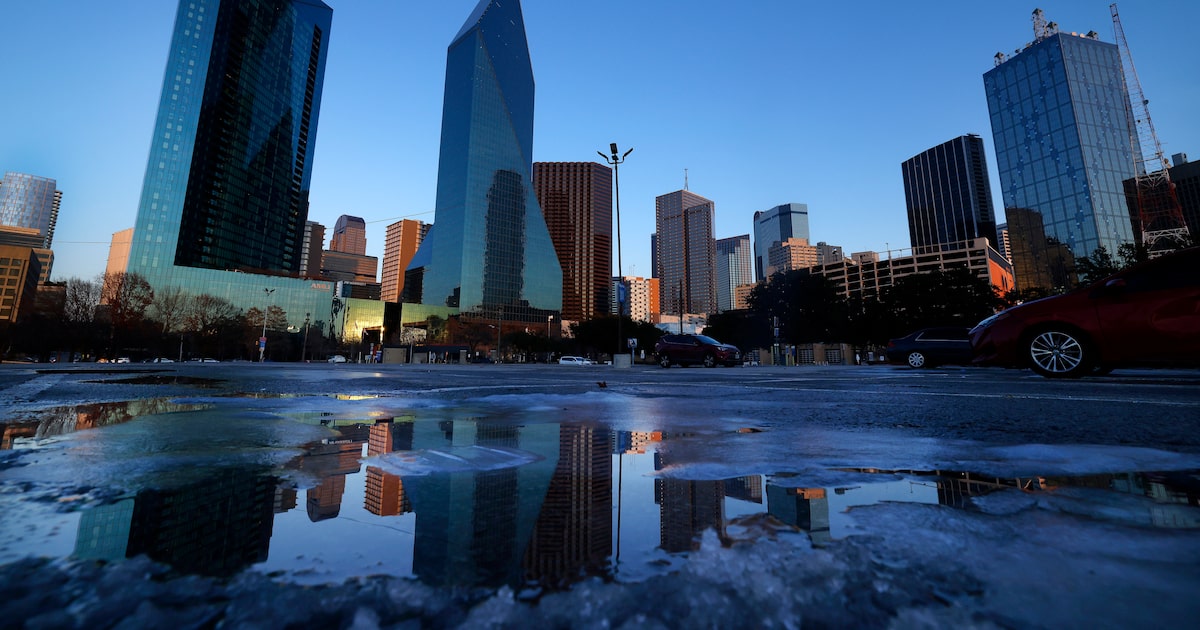
Yes, downtown Dallas has seen better days. However, I care about downtown, and I want it to have a better future. You should, too.
You should not care that I lived in downtown for seven years and loved every second of it, or that there is market demand for walkable urban living, plus the economic efficiencies of proximity and agglomeration.
This is why you should care: Downtown subsidizes city services, schools and hospitals for the entire city — and county — through its property taxes. If we admit that ours is not a healthy downtown and that it could and should be more productive, achieving that would mean less property tax burden on you.
As my friend Joe Minicozzi, a well-known urban planner focusing on the economics of cities, would say, “Let’s do the math.”
Opinion
So, I decided to do the math and downloaded all property tax data for properties within the inner highway loop, delineating what we know as the central business district area into one database. I also reviewed and cleaned over 4,000 records to ensure land owned by public entities and churches was correctly marked as tax-exempt. In sum, all land and improvements (buildings) are assessed by the Dallas Central Appraisal District to be worth over $11.5 billion, $9.45 billion of which is taxable, by my calculation.
Breaking down the combined property tax rate, that value equates to a total of $210 million to schools and hospitals, and $66 million per year to city services, which is roughly 5% of the city’s total annual property tax revenue of $1.42 billion in 2024, its primary source of funding.
Downtown is roughly 1 square mile out of a city of 340 square miles. Meaning 0.2% of the city’s land produces roughly 25 times the citywide average. Downtown and other high-density areas subsidize city and county services for everyone. That is with what we might all agree is an unhealthy downtown.
What if downtown were healthy or, god forbid, we pursued policies that actually make a difference and design interventions to make it vibrant once again instead of exsanguinating it, slowly draining its lifeblood, as we have for 70 years?
Taking one recent development, the AMLI Fountainplace tower generates $4.2 million in property tax revenue per acre. Comparatively, Mark Cuban’s property in Preston Hollow generates $67,000 per acre. If you want lower property taxes and better city services, you should probably want more downtown high-rises, fewer parking lots, fewer mansions and more high-rises. You can talk about government efficiency all you want, but public services still run on revenue.
If we were to set a benchmark of what a healthy downtown area should be producing comparatively, I took a random block in midtown Manhattan that is assessed at just over $1 billion on 4 acres. At that market rate, downtown Dallas would be worth $80 billion rather than $11 billion. (I happened to pick the block at 34th and Fifth Avenue just north of the Empire State Building with no high-rises over about 12 stories.) This hypothetical “healthy” version of downtown Dallas would generate $1.78 billion in total property tax revenue at the combined property tax rate and $560 million directly to the city of Dallas, an increase by about eight times.
More property tax revenue means either lower taxes or improved services. Perhaps we need a little bit of both, but to get to that public debate, we need more revenue, which means more growth via increased demand for downtown real estate.
What policies and interventions will it take to make downtown Dallas great again? That’s another conversation. First, we all need to care about downtown. I hope I have helped make the case. Once we agree it matters, then maybe we can do what is necessary.
Patrick Kennedy is an honorary member of the Dallas chapter of the American Institute of Architects, a member of the Congress for the New Urbanism, founder of the think tank Human Ecosystem and professor of Sustainable Urban Development at Southern Methodist University.
Part of our series Saving Downtown. This essay discusses the economic importance of downtown and why it should matter to the rest of Dallas residents.
We welcome your thoughts in a letter to the editor. See the guidelines and submit your letter here.
If you have problems with the form, you can submit via email at letters@dallasnews.com