
Under an overpass near where Interstate 30 and Central Expressway knit into a gray ceiling, Julie Hand had carved out what felt like a home.
Until last month’s icy weather, the former caregiver and housekeeper had more than most: a mattress with fresh blankets and pillows, clothes to choose from and a papasan chair where she could sit cross-legged. More than five years ago, after the COVID-19 pandemic pushed her onto the streets, the 49-year-old learned that most of what she salvaged or received in donations would be lost, sooner or later.
City crews had cleared out encampments she was living in before. She’d received more warning then — sometimes the sweep came days later, sometimes it didn’t come at all. The morning of Jan. 22, she said, was different.
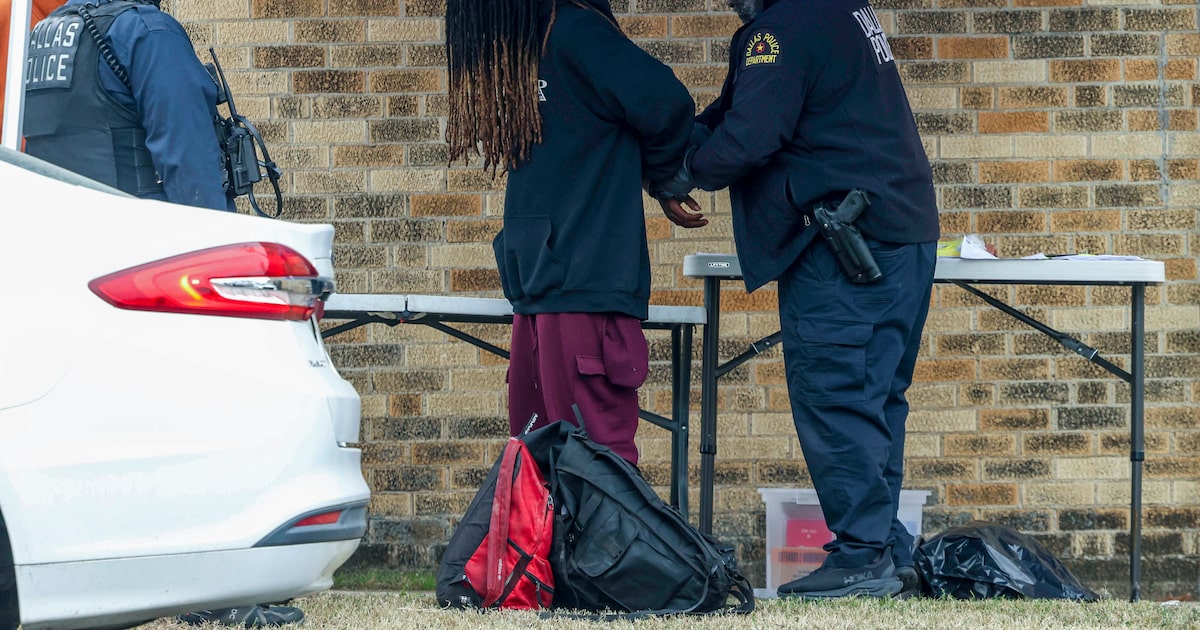
After a notice the day before, she woke to dozens of uniformed Dallas police officers moving through her corner of South Dallas with zip tie handcuffs and a choice for her and nearly 50 others in the area: jail or a shelter.
Breaking News
The operation — which a police spokesperson said was meant to ensure people were warm and safe — drew criticism from nonprofit homeless service providers, who called it poorly timed ahead of the icy weather and at odds with the more compassionate approach they say the city has tried to embrace in recent years.
Hand was ticketed for prohibited camping and chose the shelter. She stood in line with others while officers conducted warrant checks. They watched as authorities began piling up their belongings to be hauled off and thrown away.
“I’m usually downplaying whatever is going on, but I am losing my s—,” Hand recalled in an interview. “I’m like, I’m actually gonna have an anxiety attack. My hands’ve been behind my back for I don’t know how long. It’s cold. The temperatures are dropping. Nobody’s answering my questions.”
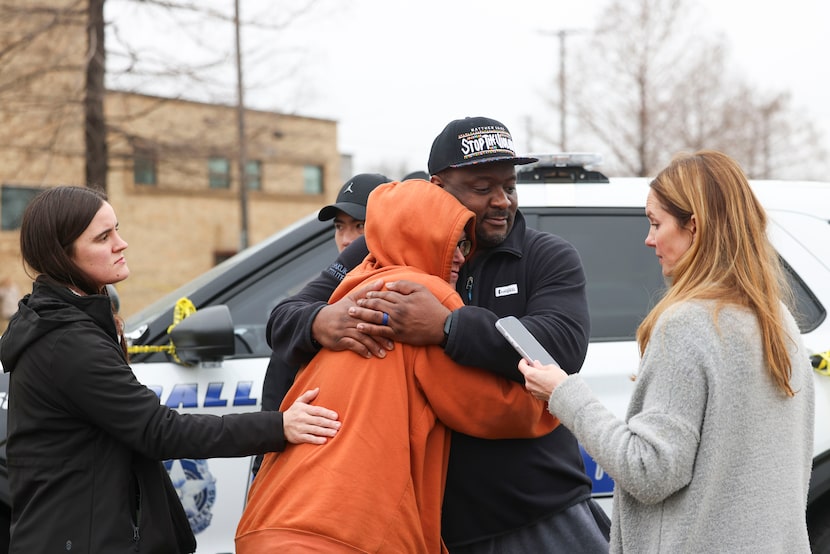
Members of The Human Impact, a nonprofit that serves people experiencing homelessness, comfort Julie Hand (center) at the scene where Dallas police officers conducted an enforcement operation, on Thursday, Jan. 22, 2026, in Dallas.
Shafkat Anowar / Staff Photographer
By the time she arrived at a shelter, she said, it was full. She ended up back outside.
Dallas police said its Homeless Outreach Team, formed in October, conducted the operation alongside the city’s Emergency Management and Crisis Response department. Officers encountered 46 people, arresting four — including two on outstanding warrants — and cited most of the rest for misdemeanor prohibited camping, according to Allison Hudson, the police spokesperson.
Hudson said police notified Housing Forward and other organizations at least six weeks in advance of the operation. The zip ties, police have said, were needed to ensure the officers’ safety during the operation.
In a joint statement afterward, the city of Dallas and Housing Forward, the region’s homelessness response agency, said they were committed to addressing “coordination gaps” they acknowledged preceded the Jan. 22 operation.
A city spokesperson, Rick Ericson, declined to comment further or answer a list of questions about what led to it. Housing Forward and the city deferred back to their initial statement.
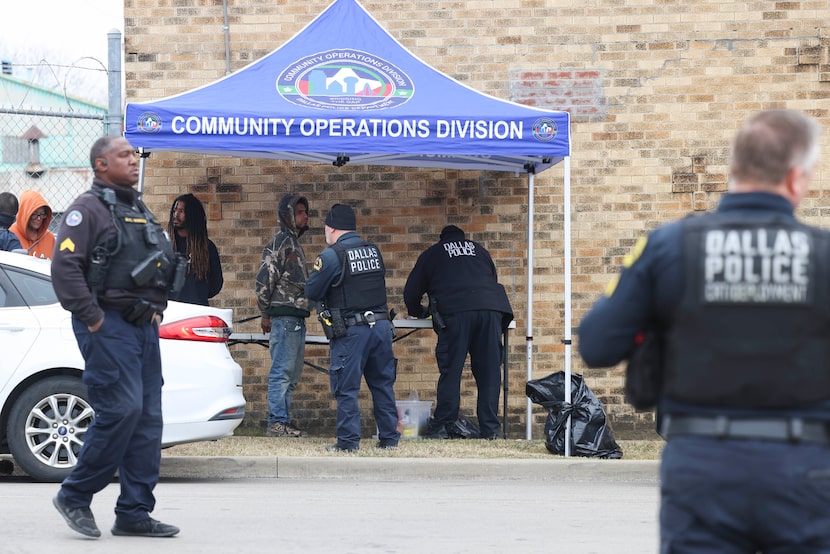
Dallas police officers conduct an enforcement operation by the premises of The Human Impact, a nonprofit that serves people experiencing homelessness, on Thursday, Jan. 22, 2026, in Dallas.
Shafkat Anowar / Staff Photographer
What was lost
The stretch of South Dallas outside downtown where the operation unfolded contains several organizations that serve people who are homeless, including The Bridge Homeless Recovery Center, The Stewpot and OurCalling.
Victor Howard, who has been homeless since a 2015 vehicle crash he said left him disabled and facing medical bills, was asleep in a tent nearby when police woke him that morning — an encounter he likened to a “sting operation.”
The 55-year-old said the zip ties were so tight the pain caused his gastritis — an inflammation of the stomach lining that can cause burning pain and nausea — to flare up. He said he needed a restroom and feared he would soil himself.
His tent was cleared away and, along with it, an electric bike he used to get around to avoid putting pressure on a leg that swells if he walks too far. He said he also lost important documents, including his Social Security card.
“When we came back, everything was in piles,” Howard said. “My tent, destroyed. Everything, destroyed. It’s like they intentionally left it there so we could see it.”
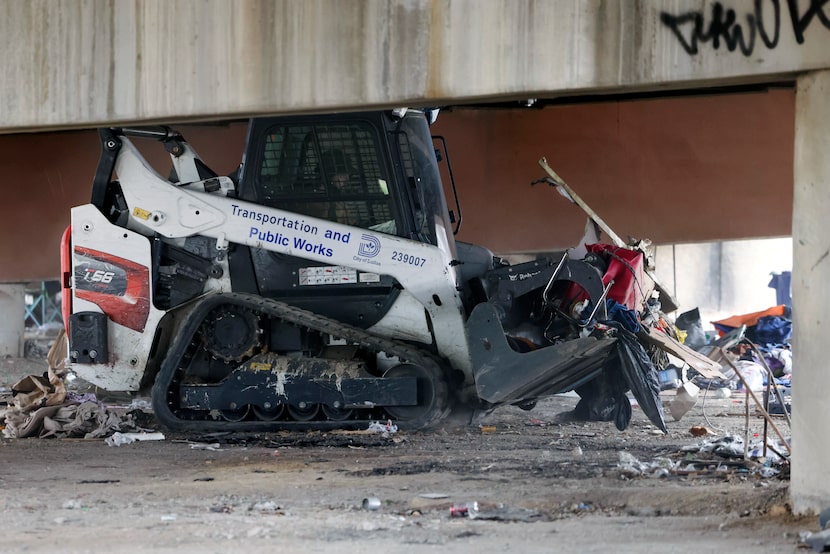
A City of Dallas skid-steer clears a homeless encampment from underneath a bridge, Thursday, Jan. 22, 2026, in South Dallas .
Shafkat Anowar / Staff Photographer
Hand said she lost everything but the clothes she was wearing and a purse she grabbed before she was zip-tied. In the rush, she left behind the one thing she can’t replace: her baptism Bible.
She was gifted it in 2024, when she decided — late in life and after years outside — that she might still be able to start anew with God. A longtime friend at The Human Impact, a homeless outreach center not far from where she was living, baptized her in a livestock trough.
She kept the Bible, its deep cobalt cover stamped in gold with curling vines and small roses, tucked inside a cheap black tote bag, afraid it would be stolen if anyone saw it. Friends at her baptism passed the book around and pressed their favorite passages on its tissue-thin pages with highlighters.
One close friend, who has since moved on, marked whole sections on how to be a warrior in faith.
“I can’t get that back,” she said. “I don’t know where to start.”
After the zip ties came off, Hand found Elisabeth Jordan, the founder of The Human Impact. In a patchy field outside the nonprofit’s office, as city officials and police worked, the two hugged.
A small group later circled around and Jordan led them in a tearful prayer.
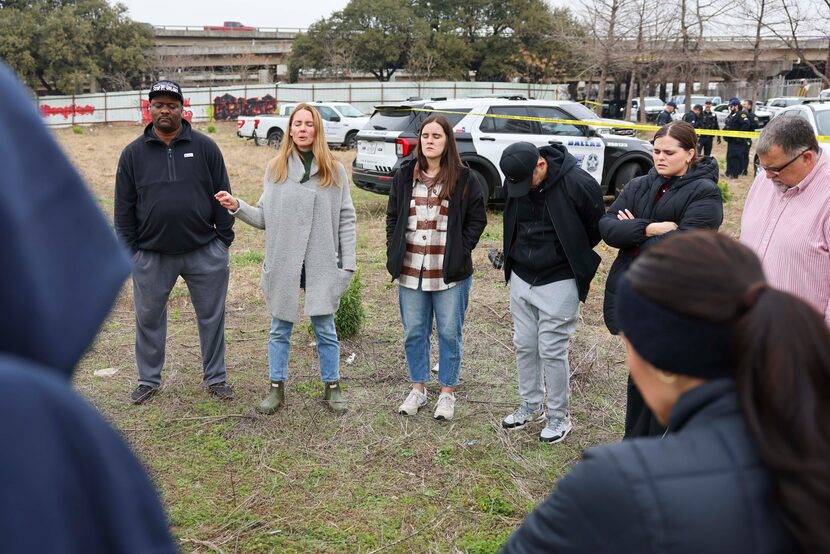
Elizabeth Jordan, (second left) founder of The Human Impact, a nonprofit that serves people experiencing homelessness, leads a prayer at a scene where Dallas police officers conduct an enforcement operation, on Thursday, Jan. 22, 2026, in Dallas.
Shafkat Anowar / Staff Photographer
Starting over
Hand questioned the validity of her citation for camping. Howard, who kept his crinkled-up ticket in his jeans’ front pocket, wondered how he could ever pay it.
Neither of them has much choice but to start over. It’s a cycle they say they have lived for years: find a spot out of the way, gather what you can, try to make it last. When it falls apart, begin again, maybe with even less.
In the meantime, they try to navigate appointments, forms and waiting lists for housing. For Hand, there are new anxieties around what she sees as a shift in the city’s posture toward residents experiencing homelessness.
“The city would usually have more compassion,” Hand said, describing the experience as “dehumanizing” and similar to how livestock are treated during transport. “This time, there was none.”
The Human Impact gifted Hand and Howard new tents last week and helped them find a place to set up.
Howard was guided to an area near The Stewpot, the icy grass crunching below his feet. All his belongings, given to him after the operation, fit into a backpack and three bags.
He settled into his new, smaller tent, resting on a hill near a droning highway.
“I like it,” he said, ducking his head inside and then scanning the area, “but I don’t like this location. Too much people-traffic through here.”
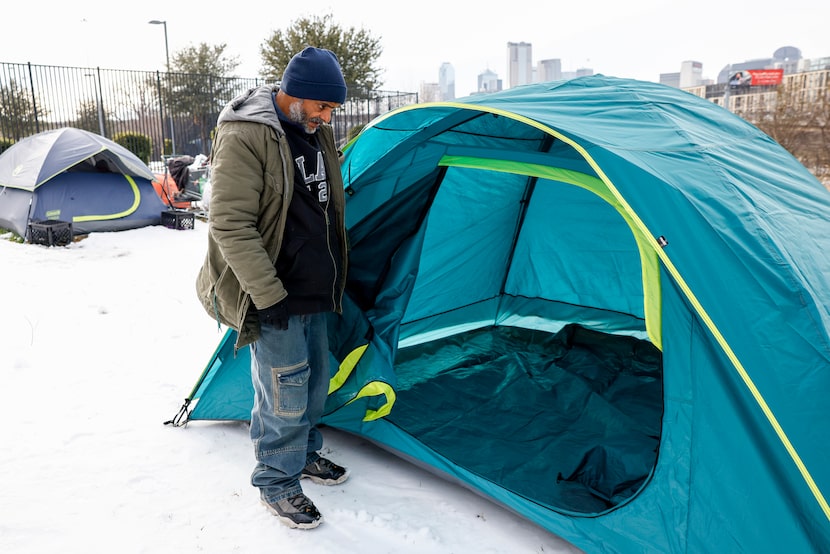
Homeless Dallas resident Victor Howard checks out his new tent given to him by nonprofit The Human Impact, Tuesday, Jan. 27, 2026, in Dallas. Howard lost all of his belongings after Dallas police’s Homeless Outreach Team conducted “enforcement efforts” and cleared out the encampment where he was staying.
Elías Valverde II / Staff Photographer