
Between chuckles and jokes, two middle schoolers hovered over a pan heating on an electric stove. An egg, dropped in a slop of melting butter, was crisping up from a cloudy white into a golden brown.
“Why is the yolk not holding? It’s a puddle,” Suraj Nambiar said, staring into the pan.
In a room on an office building’s first floor, Nambiar and Nishchay Shah stood at their makeshift kitchen, an arrangement of pans, butter and utensils on a plastic pull-out table. They were studying how proteins change when heated.
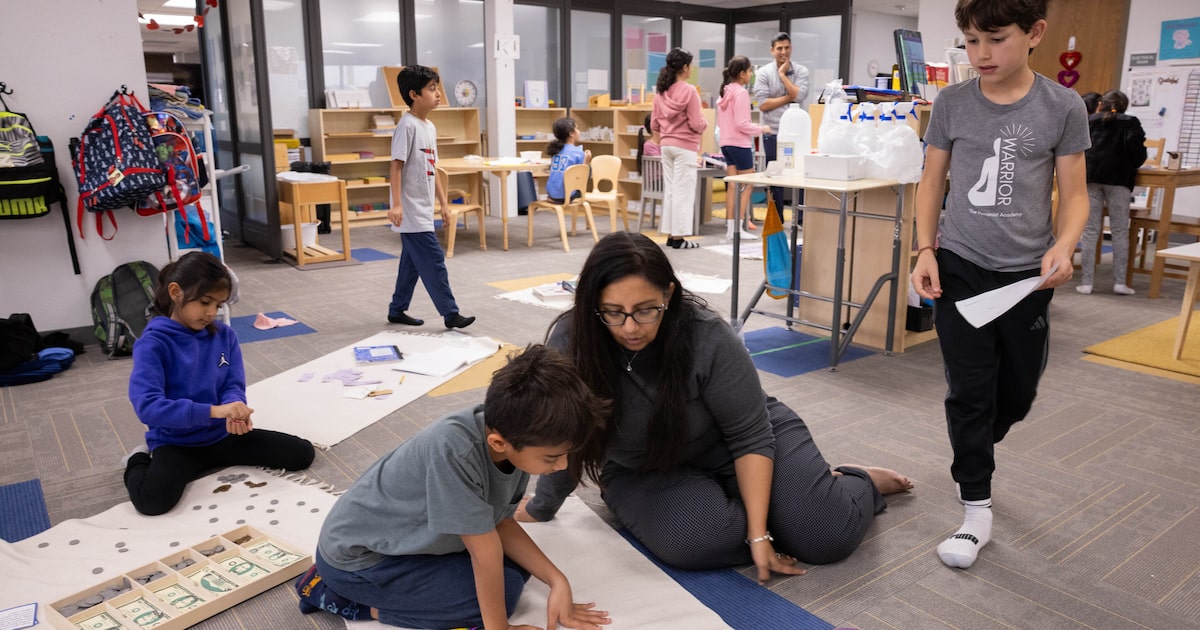
Around them, about a dozen middle school students scurried about with shoes off; their Puma and Nike socks stomping against the grey carpeted floor.
The Education Lab
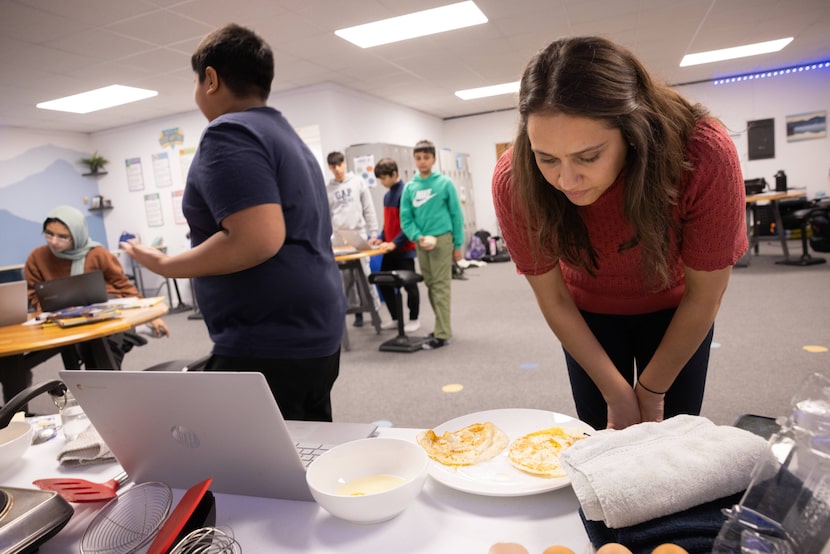
Middle school Socratic Guide Deepa Shah examines eggs fried by students as they learn chemistry through cooking at The Humanist Academy on Thursday, Jan. 8, 2026 in Irving, TX.
Juan Figueroa / Staff Photographer
The Humanist Academy in Irving does not have a traditional classroom, nor does it follow a traditional curriculum. It’s considered a “microschool,” or a modern-day one-room schoolhouse, promising small class sizes, project-based learning and a flexible curriculum. Plus, the shoes come off — because here, learning is considered sacred.
Some microschools are optimistic Texas’ voucher-style school choice program will expand their reach and help them secure more stable funding. But for others, the funding comes at a steep price — the loss of autonomy in the form of accreditation and the need to adopt standardized testing. It’s an inflection point for a movement that serves about 1.5 million students across the country and includes at least 100 microschools in Texas.
Gov. Greg Abbott signed the $1 billion education savings account program into law in May. The program is expected to draw about 80,000 participants in its first year.
Critics say ESAs will funnel money away from public school districts, which are already suffering enrollment decline. The education savings account program, titled Texas Education Freedom Accounts, will give families about $10,500 to go toward their child’s private schooling or about $2,000 to go toward homeschooling.
The microschool movement comes in response to parental demand for options beyond public schools, offering an education that is a step closer to home schooling. Parents say that they’re drawn to the autonomous education that microschools offer.
“With this model, the coolest part is that everything is flexible. It feels like a natural way of learning, like at home,” said Deepa Shah, an administrator who also oversees the middle school room.
An alternative to public schools
Microschools come in many forms. For example, the Humanist Academy is aligned with Acton Academy, a network of private microschools that provides owners resources to launch their school. Other microschools operate independently, meeting in homes, commercial spaces or churches.
While enrollment data on microschools is sparse, the National Microschooling Center estimates 95,000 microschools nationwide serve roughly 1.5 million students. The median number of students served in a private microschool is 22, the center found.
At their core, all microschools share common characteristics: small groups of students in different grades, individualized instruction, and a belief that an alternative to traditional schooling better matches certain students’ needs.
Don Soifer, who leads the National Microschooling Center, said the movement offers a diversity of models, and parents can find one to suit their child’s educational demands.
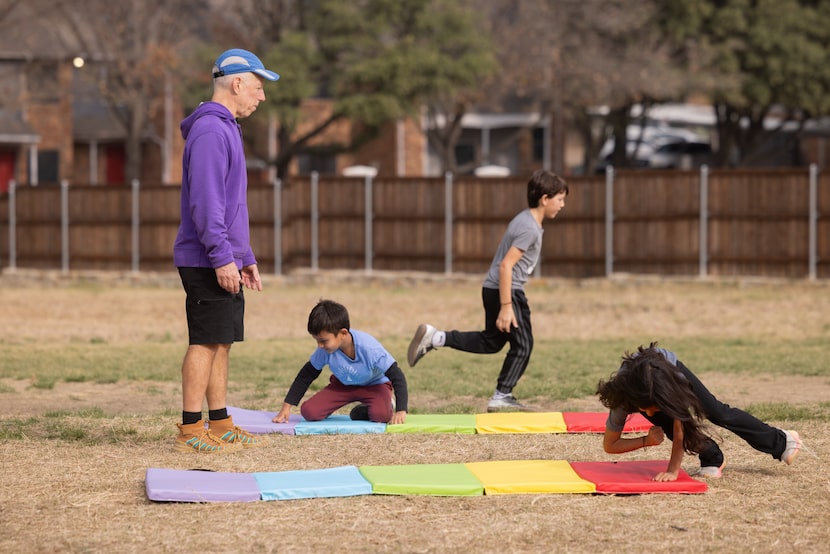
Coach John Kevin Chapman, known as Coach Kevin, watches as Curiosity Studio students complete the P.E. class activity at The Humanist Academy on Thursday, Jan. 8, 2026 in Irving, TX.
Juan Figueroa / Staff Photographer
At the Humanist Academy, there are no teachers, but “socratic guides.” There are no classrooms, but “studios.” There are no grades. Rather, the school helps students discover a “life calling” and hosts exhibitions where students present projects to families and community members.
The curriculum is mastery-based and follows a Montessori approach to instruction, which allows students to learn at their own pace, said co-founder and Director Vijay Shah. Students can lead classroom discussions, while silent hours are set aside for them to read books or complete online courses, such as Khan Academy.
“We don’t think the numbers or tests define you,” he said. “We don’t have teachers, grades and tests, like conventional schools.”
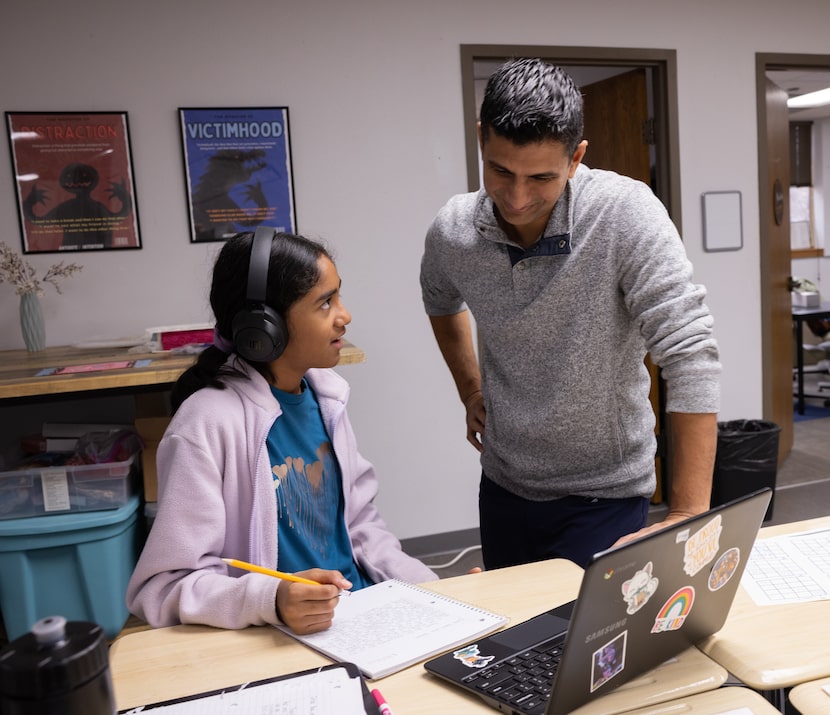
Vijay Shah, lead guide, director and co-founder of the Humanist Academy, speaks to student Divija Shah as she writes a gratitude letter to her grandparents in the Discovery Studio during the silent core skills time at The Humanist Academy on Thursday, Jan. 8, 2026 in Irving, TX.
Juan Figueroa / Staff Photographer
Before starting the microschool, Shah taught high school math and history in Chicago and served as an assistant principal with Ombudsman Educational Services, a network of educational programs for at-risk youth.
The microschool serves children pre-K through high school. The school started off with 16 students in 2016 and has since reached 95, with between 15 and 20 kids in each of its five rooms.
Its tuition operates on an honor scale. Parents decide a fixed monthly amount between $835 to $1,500 and commit to paying that amount for 12 months.
Related

Shelli Smith enrolled three children in the Humanist Academy. When her oldest son — who has learning challenges — attended the neighborhood school, he received failing grades, despite trying his hardest.
“It really destroyed his confidence, belief in himself, and his self-worth,” she said, her voice heavy with emotion. “I don’t think grades are indicative of success.”
This model may not be for everyone, she said, but it’s the one that makes the most sense for her family.
Careers, dreams and aspirations
In the high school room, students huddled around a fuzzy yellow rug. They rested their eyes for a four-minute meditation, as soothing rhythms played from Shah’s phone.
Then, Shah jumped into that morning’s “launchpad” or socratic discussion. The day earlier, they dove into the United States’ arrest of Venezuelan President Nicolás Maduro. Today’s topic? College decisions.
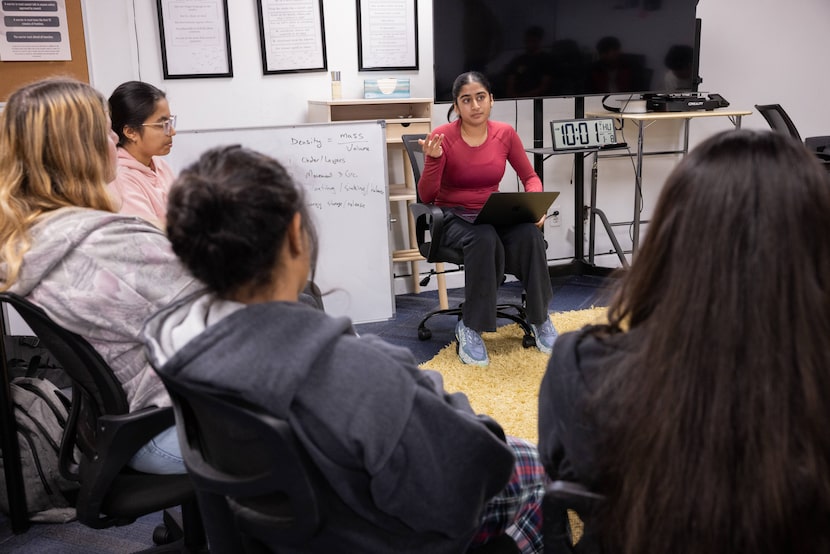
Sophomore Asatha Patel leads a Socratic discussion about Civics at The Humanist Academy on Thursday, Jan. 8, 2026 in Irving, TX.
Juan Figueroa / Staff Photographer
Shah asked students how they would settle on a college. Was it prestige? Community? How much should grades matter?
“It’s always, ‘Where are you going?’ not ‘What are you doing?’” he told the group.
During the discussion, talk of students’ career aspirations bounced around the room. The Humanist Academy will have five graduates this year. One will attend the University of Texas at Dallas, another University of Texas at Arlington.
Related

Oliver Kirk, who is set to graduate, is weighing whether to attend trade school or go directly into working for an electric company. While at the microschool, the 19-year-old apprenticed under a subcontractor in Florida, an experience that will count toward his graduation from the Humanist Academy.
“With this school, you have so much freedom,” Oliver said. “The whole point of mastery is being able to learn on your own time and understand.”
Microschool movement takes off
Microschools took off during the pandemic, when more parents sought options other than public schooling.
“When schools were shut down, families started doing this on their own,” said Christopher Lubienski, a professor of education policy at Indiana University. “Then, they started creating more structured environments, rather than just sitting around the kitchen table.”
As the microschool movement grows, some education experts are concerned about what regulations and academic oversight these schools should adhere to. Parents are not always required to report academic success if their child attends a microschool. From a sample of 800 U.S. microschools, 78% were not accredited, according to a 2025 report from the National Microschooling Center.
“There’s not a lot of regulations,” Lubienski said. “But by design, the idea is to let 1,000 flowers bloom. Let these microschools respond to what parents are asking for and create new options.”
Shah, whose school is accredited, said there is a “misconception” of microschools being “loosey-goosey.”
While students have freedom to explore their interests at the Humanist Academy, there is an “implicit” structure to their learning, he said. It’s up to school leadership to strike a balance between freedom and structure, he said.
A sign to the entrance of The Humanist Academy on Thursday, Jan. 8, 2026 in Irving, TX.
Juan Figueroa / Staff Photographer
Could school vouchers boost microschools?
Opting into Texas’ new education savings account program could come with more regulations for microschools. While some are willing to adhere to the outlined rules, others may be hesitant to trade off the autonomy that has long defined the microschool movement.
To accept state aid, microschools must be accredited by an organization recognized by the Texas Private School Accreditation Commission or an accreditor recognized by the Texas Education Agency. They must also have operated for at least two school years before applying.
Related

The schools must administer a standardized test that compares a student’s performance to a representative national sample, such as the Iowa Assessments or ACT. These tests are the type of requirement some microschools and parents feel have little value, as they believe scores aren’t an effective measure of a child’s success.
The program could incentivize more people to start microschools, while existing microschools will access more resources, Lubienski said.
“For microschools, more often than not, [school vouchers] are going to be a real shot in the arm,” he said.
But “a small minority” of microschools may not opt into the program. They may worry that its rules could strip away the flexibility that microschools pride themselves on, he said.
“That’s been a traditional pattern. Groups [may be] kind of scared that any type of government money is going to come with regulations,” he said.
For some owners and parents, a lifeline
Amber Okolo-Ebube runs Leading Little Arrows, an independent microschool in Irving that was approved to receive ESAs. The opportunity to inject funds into her microschool superseded concerns about accreditation, she said.
Instead, she advocated “very, very aggressively” for the program in front of lawmakers in Austin. A financial barrier should not prevent families from accessing an education that meets their child’s needs, she said.
Okolo-Ebube cannot accommodate the more than 75 families on the waiting list to attend her microschool. Accepting state aid would help her microschool expand to other locations and serve more students, she said.
Related
Like Leading Little Arrows, the Humanist Academy sees an opportunity in ESAs. The aid could help with its move from the first-floor of the office building, where the microschool has been housed for the past six years, to a larger site in Las Colinas. The money could give their gym a facelift.
“The vouchers would definitely help us. We can use those funds just to put back into the school,” Shah said.
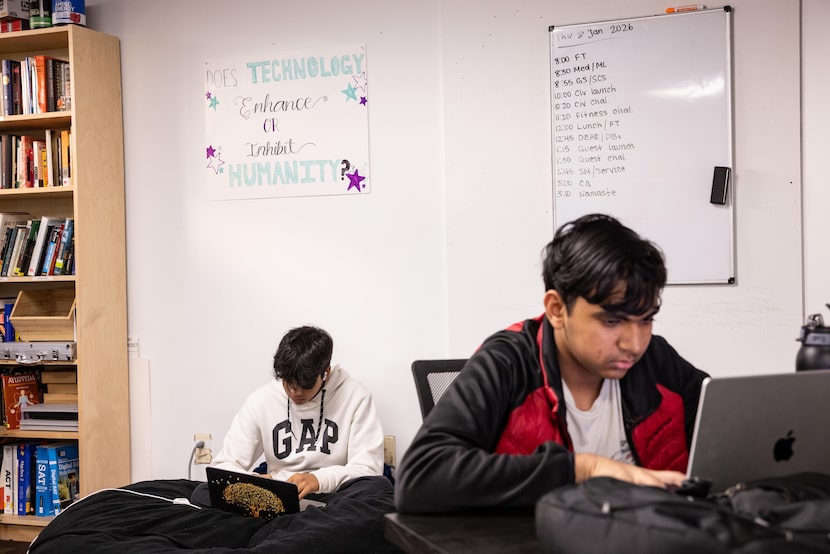
(From left) High school students Sajeed Lakhani and Rishi Santosh work on their laptops during silent core skills time at The Humanist Academy on Thursday, Jan. 8, 2026 in Irving, TX. A sign behind them reads, “Does technology enhance or inhibit humanity?”.
Juan Figueroa / Staff Photographer
For parents, like Smith, education is a financial investment — so much so that she sacrifices other things to afford tuition. ESAs would help toward her mission as a mother: setting her children down a path of becoming “lifelong learners,” she said.
“It would be foolish not to see if we would qualify for it and get that support,” she said.
The DMN Education Lab deepens the coverage and conversation about urgent education issues critical to the future of North Texas.
The DMN Education Lab is a community-funded journalism initiative, with support from Bobby and Lottye Lyle, Communities Foundation of Texas, The Dallas Foundation, Dallas Regional Chamber, Deedie Rose, Garrett and Cecilia Boone, Judy and Jim Gibbs, The Meadows Foundation, The Murrell Foundation, Ron and Phyllis Steinhart, Solutions Journalism Network, Southern Methodist University, Sydney Smith Hicks, and the University of Texas at Dallas. The Dallas Morning News retains full editorial control of the Education Lab’s journalism.