
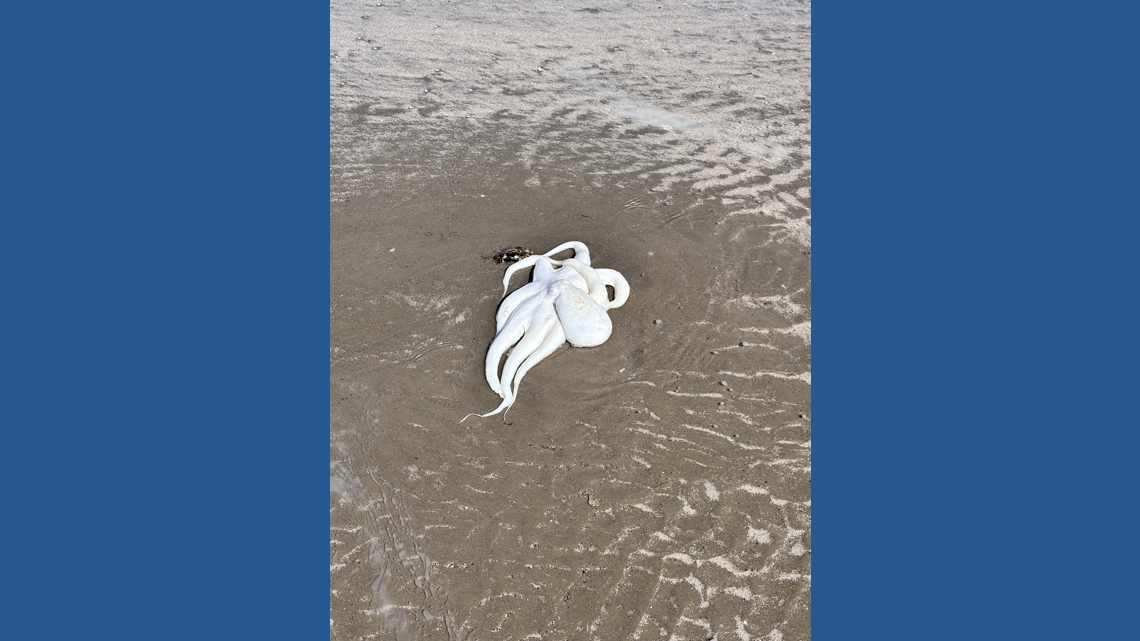
Octopus sightings on Corpus Christi shores, linked to sudden cold snaps, intrigue locals but are a natural occurrence, says marine expert Jace Tunnell.
CORPUS CHRISTI, Texas — Several octopus sightings along the Corpus Christi coastline over the weekend caught the attention of beachgoers. Still, marine experts say the unusual encounters are not entirely unexpected, especially after recent cold weather.
At least three octopuses were reported washed up along local shores following a cold snap that caused Gulf water temperatures to drop quickly.
RELATED: Octopus spotted along Padre Island beach stuns beachgoers
Jace Tunnell, the director of community engagement at the Harte Research Institute for Gulf of Mexico Studies at Texas A&M University, Corpus Christi, said these events tend to happen when sudden temperature changes slow an octopus’ body down, leaving it weak or disoriented.
“Cold water can essentially shut them down,” Tunnell said. “When that happens, waves and currents can push them into shallow water or onto shore.”
While the sightings may appear alarming, Tunnell said the common octopus is actually common along the Texas coast. What is rare is seeing them stranded on land.
Tunnell said most octopuses found on shore are already dead by the time they are discovered.
“They also have very short life spans,” he explained. “Many only live about one to two years, and females die after laying their eggs. Some of the octopuses found on shore may simply be older animals that have reached the end of their natural life.”
Tunnell recently encountered a cold-stunned octopus himself that was still alive but moving slowly. Believing it may have been affected by cold temperatures, he carefully warmed it and returned it to the water, where it swam into nearby rocks.
He says that situation was rare and does not mean the public should attempt similar rescues.
“Octopuses are really smart animals there’s movies about them, books about them,” Tunnell said. “They’re sort of this mysterious, charismatic animal. So, when you find one washed up, you feel bad for it, and people immediately want to help.”
Tunnell adds that Octopuses are mollusks that breathe through gills, unlike sea turtles and other animals that can breathe air, which makes a difference when regulating their body temperature.
As Gulf water temperatures stabilize, experts expect fewer cold-stun cases. Still, they say these sightings are a natural though uncommon result of winter cold snaps along the Texas coast.