
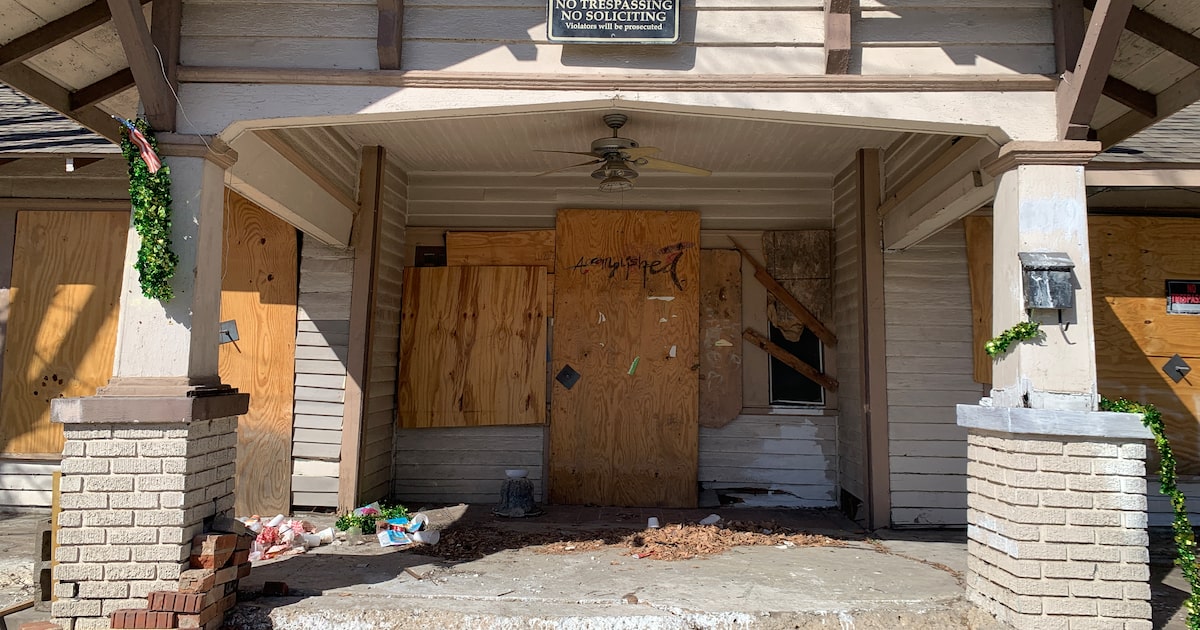

The bungalow on Gaston Avenue doesn’t look inhabited. Something, maybe, to do with the plywood affixed to the door and window frames. Or the no-tresspassing sign tacked above the front porch, Or the trash strewn across the front yard, the tattered tinsel strung along the fenceline.
“Oh, yeah, I see someone on the front porch every now and then,” said a guy who stepped out of a duplex two doors down as I was walking over early Monday afternoon. Somebody lives in that house, he said. “For sure.”
I explained that 4619 Gaston, built more than a century ago and the childhood home of a 1932 Olympic gold medalist, was on the Landmark Commission’s agenda that afternoon, its owner seeking permission to raze it. The passerby asked, “They gonna tear it down?” Doubt it, I said, seeing as how it’s a small but essential reason the Peak’s Suburban Addition Historic District is a historic district. Landmark commissioners seldom grant such requests, no matter the condition of the home.
Then again, I told the man, the city never should have let this happen in the first place. Six years ago, when the house still belonged to the estate of its longtime owners, Jose and Rosa Garcia, it looked tired, maybe, but far from dead.
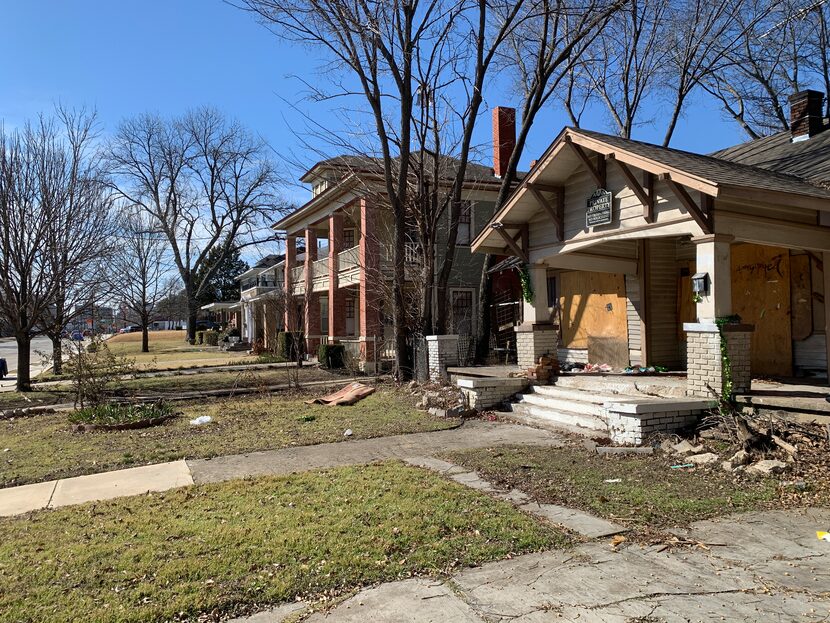
4619 Gaston Avenue really sticks out along this stretch of East Dallas just a couple of minutes east of downtown.
Robert Wilonsky
Then, in November 2021, Rahim Mawani bought it. And twice since, including just a couple of years back, he’s tried to tear it down, citing, most recently, the need to “eliminate this public nuisance” of his own making.
Opinion
A few hours later at City Hall, a couple of neighbors told me all about people living in that house for God knows how long.
“Squatters,” said Patricia Simon, an orthodontist who renovated a long-vacant manse at Moreland Avenue and Gaston about 15 years back. “And it gets worse every year.”
Joshua Kamman, who lives a couple of blocks over, actually went in the house a few weeks back with Office of Historic Preservation staff.
“There was a guy sleeping there with a fire going in the fireplace,” said Kamman, who restores old homes for a living, mostly in East Dallas. He found 4619 Gaston to be in pretty good shape, all things considered – a “manageable and straightforward rehabilitation project,” as he told Landmark commissioners in a letter sent last week.
Except, you know, “it was shocking to wake the guy up,” he told me Monday. “And all he did was pick up his stuff. He left with the fire still going. He didn’t even try to put it out.”
Which explained why Landmark commissioners on Monday kept mentioning how scared they were of the house burning down – and taking the block with it.
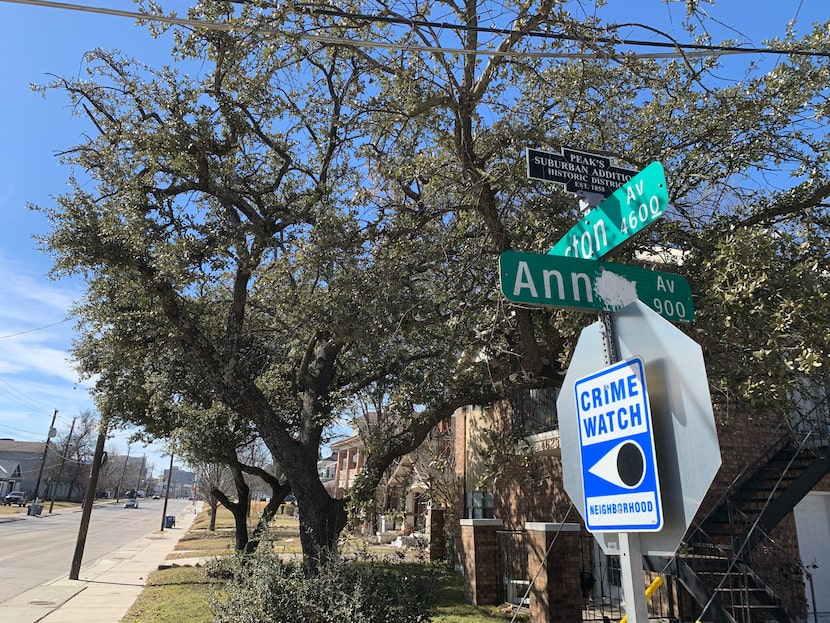
The Peak’s Suburban Addition Historic District is meant to preserve the original Mill Creek neighborhood, the first residential neighborhood developed east of downtown Dallas.
Robert Wilonsky
I should mention that Kamman and Simon are on the Landmark Commission’s Peak’s Suburban Addition neighborhood task force, which means they have connections at City Hall – better ones than you and me, anyway. And still, Simon told me Monday, “We’ve been complaining to Code Compliance about that house for years.”
About a house on Gaston Avenue. In the heart of East Dallas. In a neighborhood that’s both a local historic district and an entry on the National Register of Historic Places.
And only now has Code Compliance taken an interest. Only now has the City Attorney’s Office launched an investigation into the house’s condition. Only now has the Landmark Commission slapped the home owner with a wet rag for allowing for its demolition by neglect.
If this part of town along a busy thoroughfare can spend five years watching one of its prized jewels fall prey to plywood windows and fire-starting squatters using a bathroom without running water, what chance does Park Row or Tenth Street or Colonial Hill or some other tucked-away historic district have?
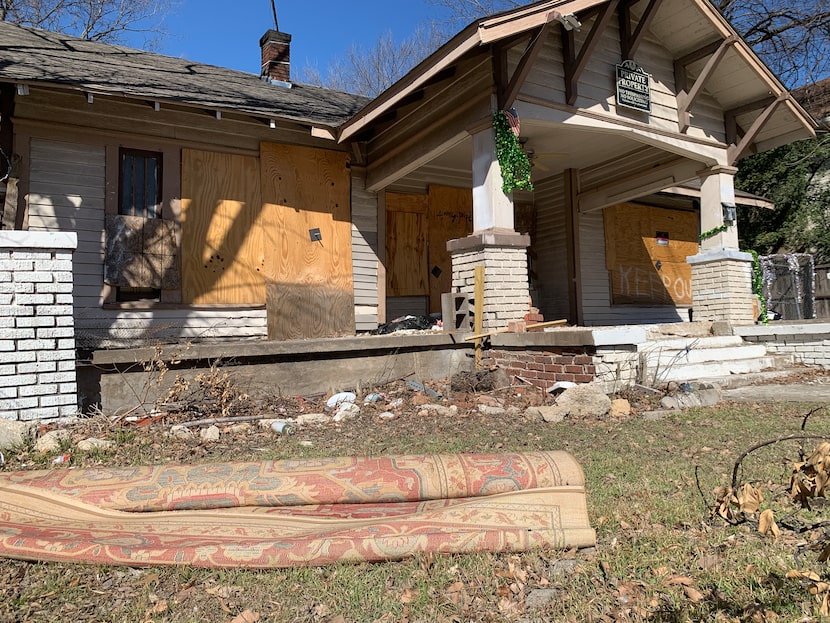
Neighbors say squatters have been living inside 4619 Gaston Avenue for years, and that their complaints to Dallas City Hall long went unanswered.
Robert Wilonsky
Peak’s Suburban was the first residential neighborhood east of downtown – “the earliest developed portion of East Dallas,” per its historic designation documents. It was stitched together in the 1800s from the enormous parcels of land owned by Mexican-American War veteran Jefferson Peak and a Confederate captain named William Gaston, who helped bring the railroads to Dallas. It consisted of Victorian mansions, brick mansions and, eventually, bungalows, of which 4619 Gaston was one, built sometime before 1915 between Moreland and Annex avenues.
For a time, the stretch one block from Swiss Avenue fell into a state of disrepair; just 15 years ago a story in this newspaper lamented the “zoning decisions that resulted in neighborhood slums” and “frightening pockets of blight” along Gaston. Then folks like Simon moved in and restored converted apartments and boarding houses to their former residential glory.
Now, this part of town is deep in the heart of Preservation Land. Woe to the out-of-towner who tries to mess with that. Or, for that matter, the city staffer who disregards the cries of the homeowners living next door to tumbledown terrace. I walked around Peak’s Suburban Addition on Monday and lost count of the “Save Dallas City Hall” signs planted in front yards. These aren’t the people you want to mess with.
The homeowner, finally, seems to have gotten the message.
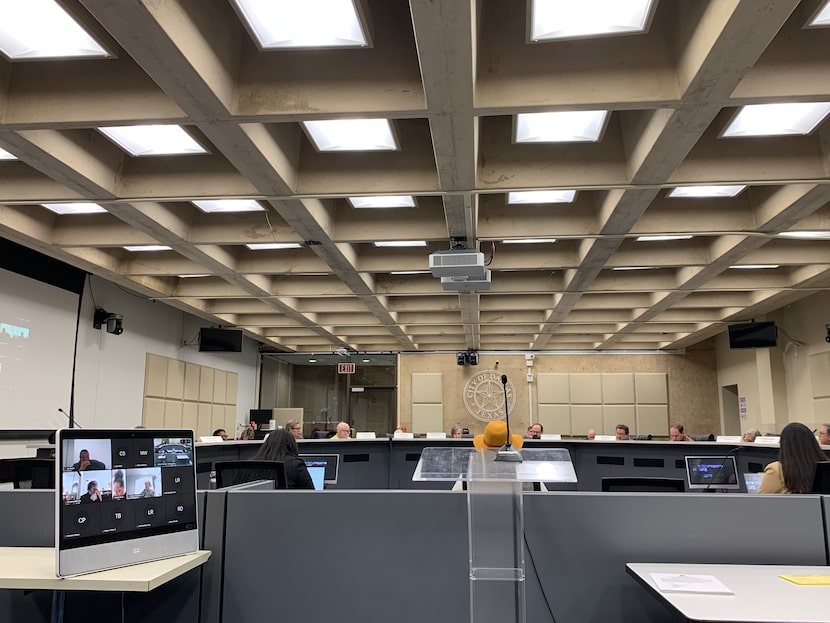
A woman named Jeanine Brunings appeared via video to explain that 4619 Gaston Avenue’s owner no longer sought a certificate of demolition for the home in the Peak’s Suburban Addition Historic District.
Robert Wilonsky
I never could reach Mawani, who didn’t show up to the Landmark Commission meeting on Monday. But a woman named Jeanine Brunings, who said she represented Mawani, appeared via video to say he was no longer seeking to demo the house. More than a few commissioners were skeptical that he was trying to save it, despite a promise to fence off the house. They demanded daily visits from preservation staff.
Jim Anderson – Dallas’ former historic preservation officer, the second vice president of the Peak’s Addition Homeowner’s Association and an alternate Landmark commissioner – kept asking Brunings why Mawani bought a habitable property and let it fall apart. She had no answer. He asked why Mawani didn’t show up to explain his need to demo the historic home. She had no answer. When I called Mawani after the meeting, there was no answer.
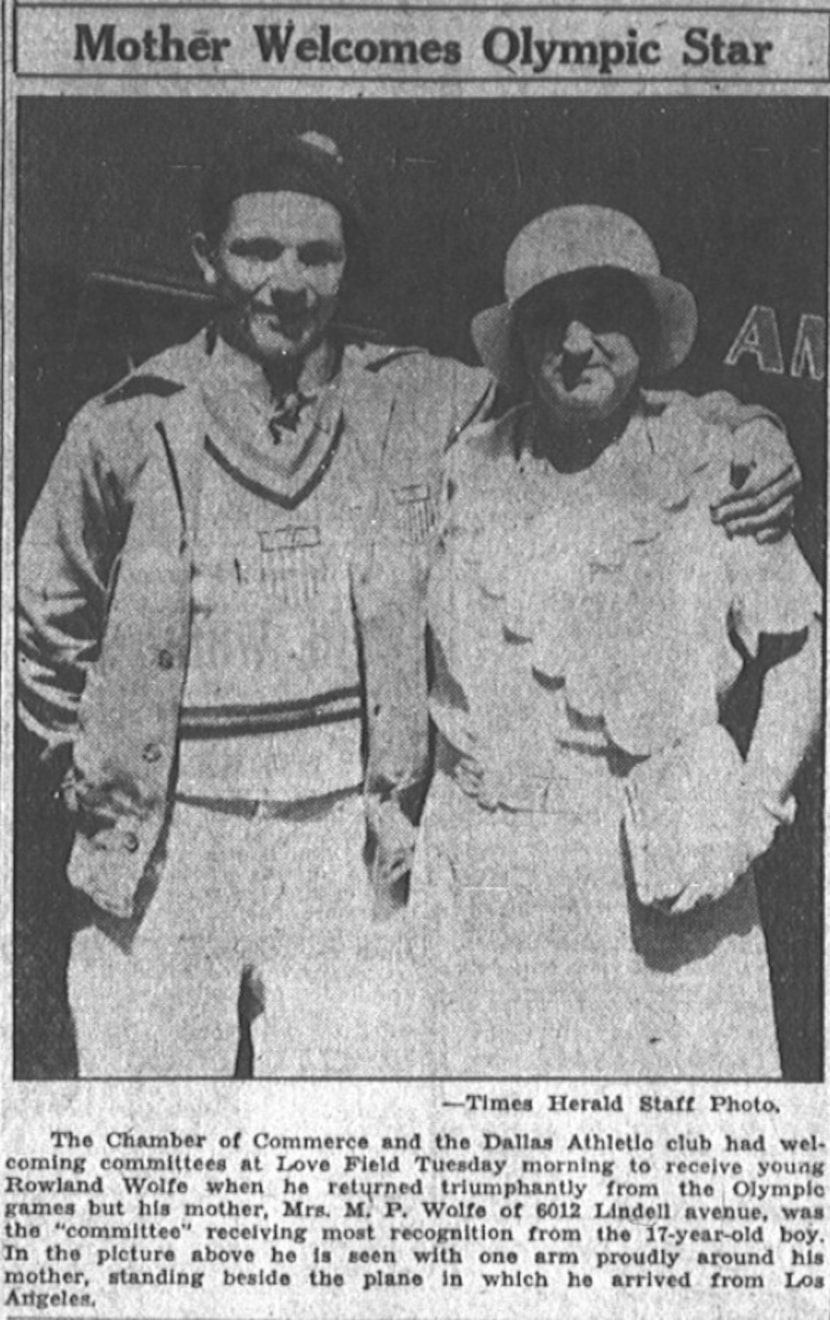
1932 Olympic gold medalist Rowland Wolfe was raised at 4619 Gaston Avenue before his family moved to nearby Lindell Avenue.
Dallas Times Herald archives
But I do have an answer to one question someone asked me over the weekend about why we should care about this house, aside from its contributing to a historic district. Patricia Simon found it when doing some research in preparation for Monday’s meeting.
The house, she told me, was built in 1914 for Merrill Pratt Wolfe, an electrical engineer, and his wife Florence Rowland Wolfe. The couple had twin sons born on Oct. 8, 1914. One died two days later. The other, Merrill Rowland Wolfe, grew up to win the tumbling gold medal at the 1932 Olympics when he was 17 – two years before he graduated from Woodrow Wilson High School on his way to helping develop the atomic bomb.
Which I never would have known if a guy from Carrollton hadn’t tried to tear down his childhood home. Twice.