
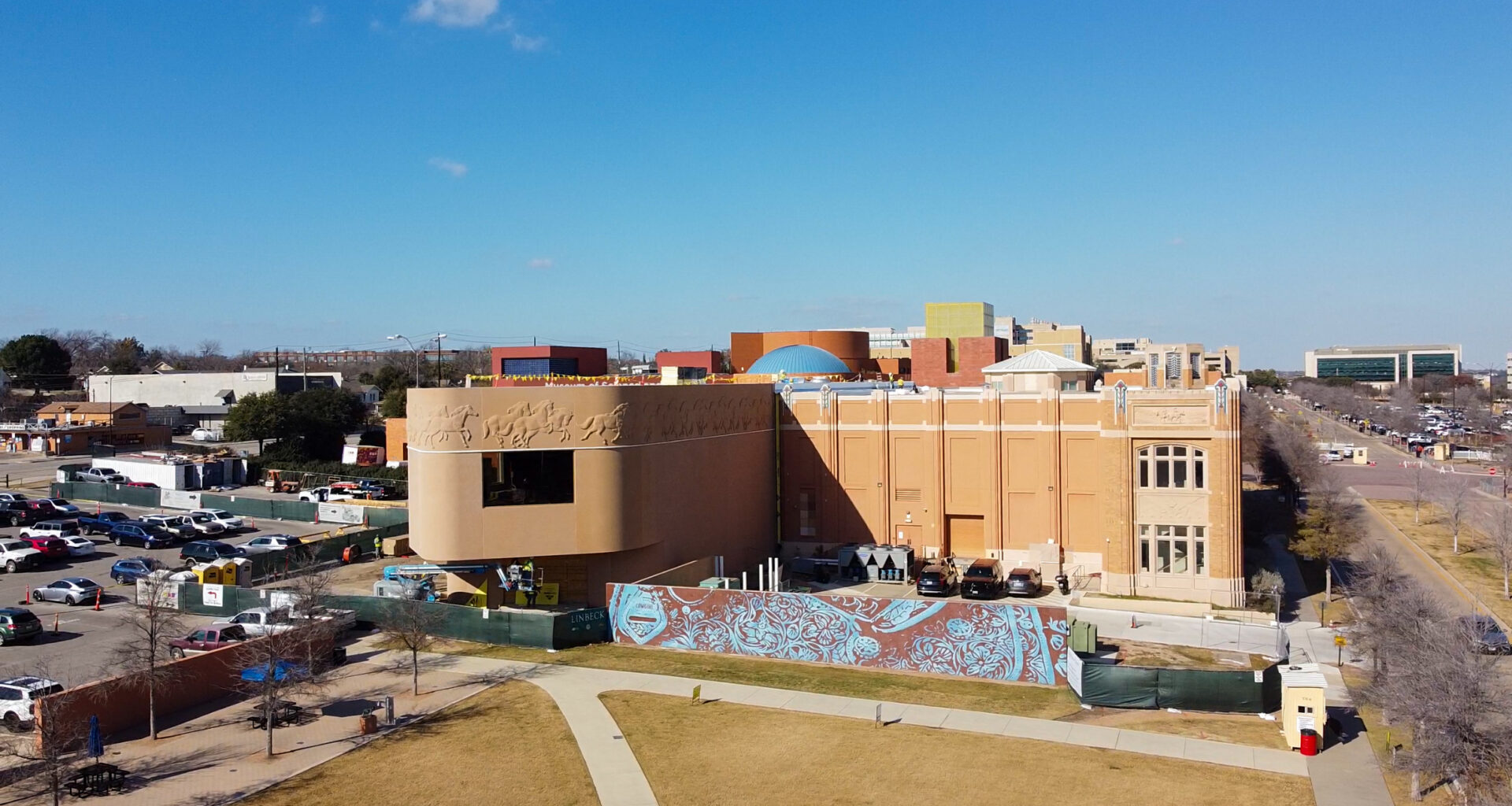
FORT WORTH, Texas — Towering above visitors at the National Cowgirl Museum & Hall of Fame (The Cowgirl) is one of Fort Worth’s most striking artistic achievements: a monumental bas relief adorning the museum’s precipice, featuring 70 powerful horses frozen in motion. More than architectural detail, the relief tells a story of innovation, strength, and the enduring ethos of the West — made possible through the generosity of Art and Catherine Nicholas, owners of Wagonhound Land & Livestock Co. of Douglas, Wyo., whose support helped bring this vision to life.
“With every stride carved into this façade, visitors get a preview of what awaits inside — bold stories, powerful women, and the unstoppable nature of the cowgirl,” said Pat Riley, Executive Director of the National Cowgirl Museum and Hall of Fame. “It’s our way of inviting the world to step into the story with us.”
The movement of the horses was inspired by The Horse in Motion, the groundbreaking 1878 photographic study by Eadweard Muybridge. His series of cabinet cards — six sequences of six to twelve “automatic electro-photographs” — captured, for the first time, the successive phases of a horse in motion. That revolutionary work changed how the world understood movement, and today its influence lives on through the Cowgirl Museum’s dramatic exterior artwork.
The vision behind the project was the expansion’s designer, Reza Azard, owner and founder of Projectiles based in Paris, France, who worked with Éric Anton of Artefactorylab to create each singular motion; a daunting task that had to be interpreted in 3D as well as across curves and angles.
“We worked together, the two of us, with Éric creating the 3D images,” said Azard. “The concept was mine (chronophotography), and initially I thought about separating the movements to have distinct horses, but it was too rigid and too static. So, we created overlays to achieve the effect of a herd using the same horse. The result is more dynamic and more satisfying.”
Each horse in the relief is modeled after the conformation of the American Quarter Horse, under the guidance of The Cowgirl’s President Kit Moncrief, owner of a breed chosen for its athleticism and historic role in Western culture. Though visually massive, each sculpted horse is only three inches thick, and from ear to hoof, is approximately 10 feet tall, equal to 30 hands in horse measurement, creating a remarkable contrast between delicacy of design and monumental scale.
The engineering behind the installation is as impressive as the artistry. The heaviest individual panel weighs an astonishing 44,700 pounds, and together all the panels total 1,180,600 pounds. Full-height panels were transported from Gate Precast in Hillsboro, Texas, and installed one by one by Linbeck Construction, while smaller sections were moved in groups of two to three at a time—an intricate logistical effort to bring the sweeping scene to life. A 300-ton crane was required to place each panel.
With 70 horses thundering across its surface, the bas relief embodies motion, heritage, and resilience, welcoming guests with a visual tribute to the cowgirl spirit before they even step inside.
As the National Cowgirl Museum continues its expansion and evolution, this iconic façade remains a powerful reminder that history isn’t just preserved here—it moves.
About the National Cowgirl Museum & Hall of Fame
The National Cowgirl Museum & Hall of Fame is where history meets horsepower, and fearless women take center stage. Located in the heart of Fort Worth’s Cultural District, it’s the only museum in the world that celebrates the grit, grace, and guts of the women who shaped the West — and those breaking boundaries today. Through immersive exhibits, interactive galleries, and powerful storytelling, The Cowgirl highlights artists, ranchers, rodeo champions, activists, and trailblazers from all walks of life. It’s not just about looking back — it’s about inspiring the next generation of unstoppable women.
Currently, the museum’s archives house more than 4,000 artifacts, with more than 260 women enshrined in its Hall of Fame.
Related
Fort Worth Report is certified by the Journalism Trust Initiative for adhering to standards for ethical journalism.