
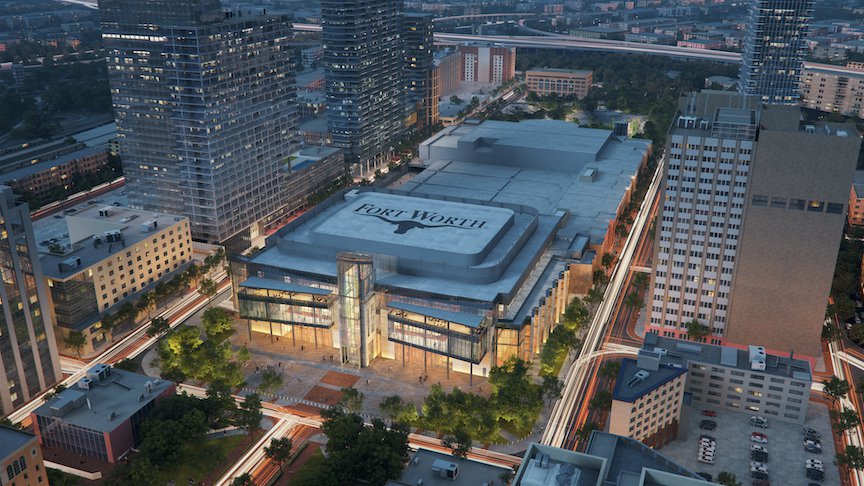
Fort Worth officials on Tuesday presented plans to the City Council for a $606 million Phase 2 expansion and modernization of the Fort Worth Convention Center, following completion of the project’s $95 million Phase 1 late last year.
Phase 2 would replace the downtown facility’s 1968 arena with a new, flexible convention building and modernize the existing convention center, which had not undergone a significant renovation since a 2003 expansion.
Plans call for a transparent, four-story structure with a central tower at Main and Ninth streets designed to reflect the Tarrant County Courthouse at the north end of Main Street. The project also includes a plaza with native prairie green space connecting to General Worth Square and terraces intended for outdoor events with views of downtown.
Once completed, the expanded and modernized facility would include more than 257,000 square feet of exhibit hall space, almost 61,000 square feet of meeting room space, 74,000 square feet of ballroom space, and 16 loading docks. City officials said the layout and Texas-inspired design would allow Fort Worth to host larger conventions or two large events at the same time.
“The Phase 2 expansion positions Fort Worth to not only attract more conventions and meetings, but also to deepen engagement with downtown businesses and residents,” said Fort Worth Mayor Mattie Parker. “As a key part of the transformation of the southeast quadrant of downtown, the new center will anchor a hub of economic growth and higher-education partnerships, and its beautiful design will showcase the Modern West brand that has helped make Fort Worth a standout destination among our peer cities.”
Studies have estimated that Fort Worth could nearly double the amount of convention business it hosts with an expanded and modernized facility. Those projections have since been updated to reflect feedback from focus groups of current and prospective clients, downtown residential development, post-pandemic tourism trends and the Texas A&M University under construction across Commerce Street.
Civic leaders cut the ribbon on the first phase of the convention center renovation project in December.
Totaling 76,794 square feet, the $95 million Phase I included a grand southeast entrance and terrace, state-of-the-art food and beverage facilities, a retail coffee bar for casual networking, 11 new loading docks (up from seven), and the realignment of Commerce Street to create a site pad for a future convention hotel and additional retail or restaurants.
With Dickies Arena now serving as Fort Worth’s premier arena, the 1968 downtown convention center arena is scheduled for demolition in early 2027. Mobilization for demolition is planned for summer 2026, with the final event in the arena scheduled for September 2026. Phase 2 completion is targeted for early 2030, and the convention center is expected to remain operational throughout construction.
“Our construction partners, exclusive service providers and our City Public Events team successfully navigated conventions and sporting events with very high [customer satisfaction] during Phase 1,” said Mike Crum, director of the city’s Public Events Department, noting high net performer scores, a widely used metric that measures client satisfaction and loyalty.
“Now that we have 13 new docks, a state-of-the-art catering kitchen, and a straightened Commerce Street, operationally we are set to continue exceeding expectations and already are booking business into 2030 and beyond.”
Design of the expansion is led by Atlanta-based architecture, interior design and planning firm TVS and Fort Worth-based Bennett Partners. The Phase 1 construction manager-at-risk joint venture of AECOMHunt, Byrne Construction and EJ Smith Construction will continue for Phase 2, with project management overseen by Broaddus & Associates and Elements of Architecture.
City officials said the expansion plans have been shaped through collaboration with Downtown Fort Worth, Inc., the Downtown Design Review Board and a city advisory committee made up of elected officials, business leaders and community representatives.