
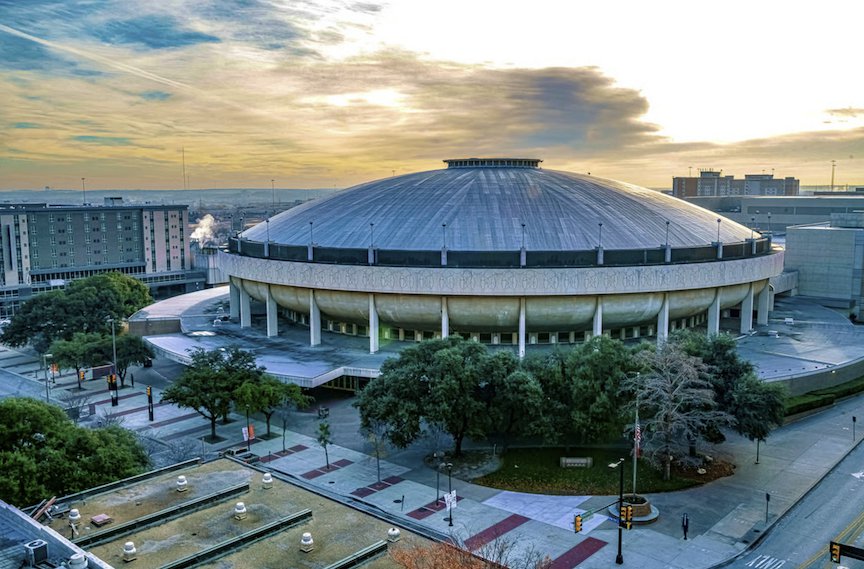
City officials rolled out plans on Tuesday for the roughly $606 million, Phase 2 of the Fort Worth Convention Center renovation.
It will include the demolition of the 1968 arena with a new, flexible convention building and modernize the existing convention center.
With Dickies Arena now serving as the city’s premier arena since 2019, the 1968 downtown convention center arena had been put on the do-not-resuscitate list.
The time is coming.
It has been scheduled for demolition in early 2027. Mobilization for demolition is planned for summer 2026, with the final event in the arena scheduled for September.
Phase 2 completion is targeted for early 2030.
Progress being what it is, the arena’s date with demolition is a necessary evil. That doesn’t mean we won’t shed a tear.
The convention center arena has served its purpose as a gathering place for the cultural arts.
Elvis tossed scarves to the salivating cult there. Mick Jagger gyrated with the Rolling Stones. Led Zeppelin rocked and rolled. U2 dazzled Gen X. Garth Brooks charmed. And Willie Nelson smoked, no doubt.
Paul McCartney’s show with Wings at the convention center arena in 1976 was his first in America in 10 years. The “Wings over America” North American tour kicked off not in New York, Chicago, Los Angeles or San Francisco, but in Fort Worth, Texas.
Take that, Yoko.
The April show was the first of 31 dates in 20 cities. A ticket could be had at the box office for as little as $7.50 or about $42 today. That’s a bargain for a Beatle.
On the eve of the Super Bowl in 2011, real and football cowboy Walt Garrison, who might have been galvanized by the spirit, if you know what I mean (it was hard to tell with him), had one of the best one-liners since the days of Hell’s Half Acre:
“The big difference between Fort Worth and our friends from the east is in Fort Worth the bullshit is on the outside of the boot.”
The sporting arts have also taken center stage here.
“We’re going to make this convention center host to as many sports events as we possibly can,” said Tarrant County Judge Howard Green, the chief political officer over the then-Tarrant County Convention Center, in 1968. The city bought the complex from Tarrant County in the late 1990s.
“We’re really excited about this facility for basketball.” Green said. “It’s conceivable we may eventually have eight teams involved in the Texas Classic.”
That first Texas Classic in 1969 involved Cotton Fitzsimmons’ Kansas State Wildcats, Henry Iba’s Oklahoma State Cowboys, and TCU and UT Arlington in a round-robin format. At the time, the 12,500 seats for basketball represented the largest facility in the state for college basketball.
TCU would return there over the years, the last time under Billy Tubbs in the 1990s.
The ABA appeared at the convention center in December 1969, the Dallas Chaparrals and Miami alternating possessions of the league’s distinctive red, white and blue basketball. (An aside: I happen to be wearing a Chaparrals T-shirt as I write. For one season in the early 1970s, the Chaparrals became the Texas Chaparrals in an attempt to make them a regional team. They played in Fort Worth at the convention center, Dallas, and Lubbock. The attempt failed. The Chaparrals eventually became the San Antonio Spurs.)
In their first 10 years or so, the NBA’s Dallas Mavericks, too, played a preseason exhibition game each year at the convention center. It was outreach to the team’s fans on the west side of the turnpike. That relationships appears to have resumed with a preseason exhibition played at Dickies Arena this season. The Harlem Globetrotters made an annual stop there to give the Washington Generals the business.
Some of the events have long been forgotten. Consider the national debut of a full-contact team karate league in 1975.
The commissioner: Chuck Norris.
“This isn’t hoked up and nothing is rigged in advance,” like pro wrestling, said the mythical hand-to-hand combatant. “These fighters are out to knock out their opponents because there is money at stake.”
To the winning team went $4,500. To the losers, $1,500.
I would say I need more to get my head kicked in, but then I write for a living.
The convention center has been home to some very significant events as well over her six decades.
“Have you ever been to Brownsville, N.Y.?” the young boxer told reporters at the 1984 U.S. Olympic Boxing Trials at the convention center. “Life in Brownsville [part of Brooklyn] is far removed than anything you can imagine. The world there is much different than yours.”
His name was Michael Tyson, an 18-year-old who would gain both fame and infamy in the years that followed as Mike Tyson.
That June, we learned the whole story and about all the affiliated characters. As Mike Tyson’s world turns was a big wild card.
It was the guiding influence of Constantine “Cus” D’Amato, Floyd Patterson’s one-time trainer, who changed the young boxer in and out of the ring. The other guy in the ring was Kevin Rooney, the brash, in-your-face New Yorker.
He was as cocksure then as he was a little more than a year later when he won his first heavyweight world title. “I have more belief in myself than anyone on the planet. I give myself reason to be confident.”
Tyson advanced to the final to meet Henry Tillman, essentially for a berth in the Los Angeles Games in 1984. Tyson did Tyson things — charging, lunging, hooking, and banging, but he was unable to knock down Tillman a second time and unable to make a convincing case for the judges.
All of Team Tyson raised hell about it. D’Amato, in particular, raged.
“Everybody is gonna hear about this,” said D’Amato, who was making sure of it as he yelled at ringside judges. “There’s more scandal in this outfit than there ever was in the pro game.”
Cus flailed a towel to add emphasis to his charge.
Those Trials in Fort Worth produced an American team in Los Angeles that many consider the greatest U.S. Olympic team ever. It included Pernell Whitaker, Mark Breland, Virgil Hill, Tyrell Biggs, and Evander Holyfield, another of Tyson’s future nemeses.
In 1992, the U.S. won a 30th Davis Cup tennis title at the convention center. The team of Andre Agassi and Jim Courier in singles matches, and Pete Sampras and John McEnroe competing in doubles defeated the peaceful Swiss, who never would’ve allowed Cus D’Amato to cross the border.
And, yes, there previously has been world-class gymnastics, which are back at Dickies Arena.
In 1979, it looked to be the United Nations as the countries of the world descended on Fort Worth for the World Gymnastics Championships. Among them was the sport’s darling, Nadia Comaneci of Romania and coach Béla Károlyi.
A hand injury limited Comaneci and, in fact, necessitated a visit to Baylor All Saints hospital.
The event turned out to be a coming out of sorts for the U.S. men, who achieved the unthinkable, a team bronze.
Kurt Thomas, the 1979 NCAA champion who finished second to Alexandre Ditiatin of the USSR in the all-around, won six medals, including gold on high bar and floor, and silver in all-around, parallel bars, and pommeled horse. Bart Conner of Oklahoma won gold in the parallel bars and added a bronze on vault.
After years of trying, the Soviets won team gold, finally edging the Japanese. The coach sounded like the general secretary’s minister of propaganda.
“The scores received by our gymnasts truly mirror the power and ability of our gymnasts,” said Leonid Arkaev, as if Stalin himself, bottle of vodka in hand, were levitating nearby. “The victory does not come as a particular surprise to us.”
We had good reasons to point missiles at those guys.
By then, we were better friends with the other of the Marx Bros., Mao’s Red Chinese, even if the town of Ripley Arnold was a mismatch in some ways culturally.
Chinese visitors, according to news reports, were spotted using plastic coffee stirrers as chopsticks to enjoy a Texican specialty — nachos.