

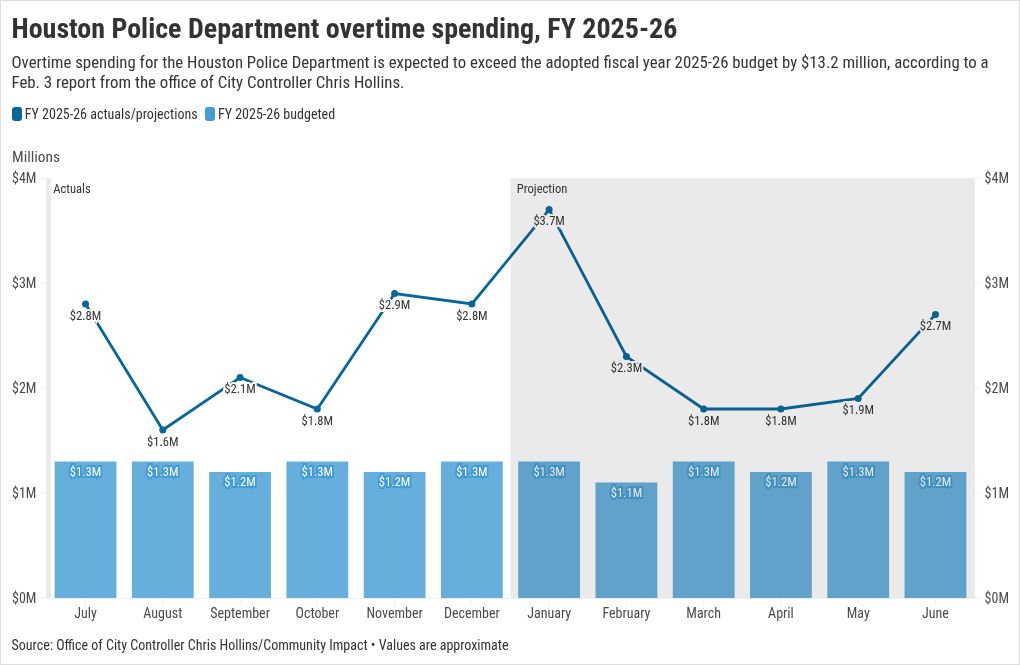
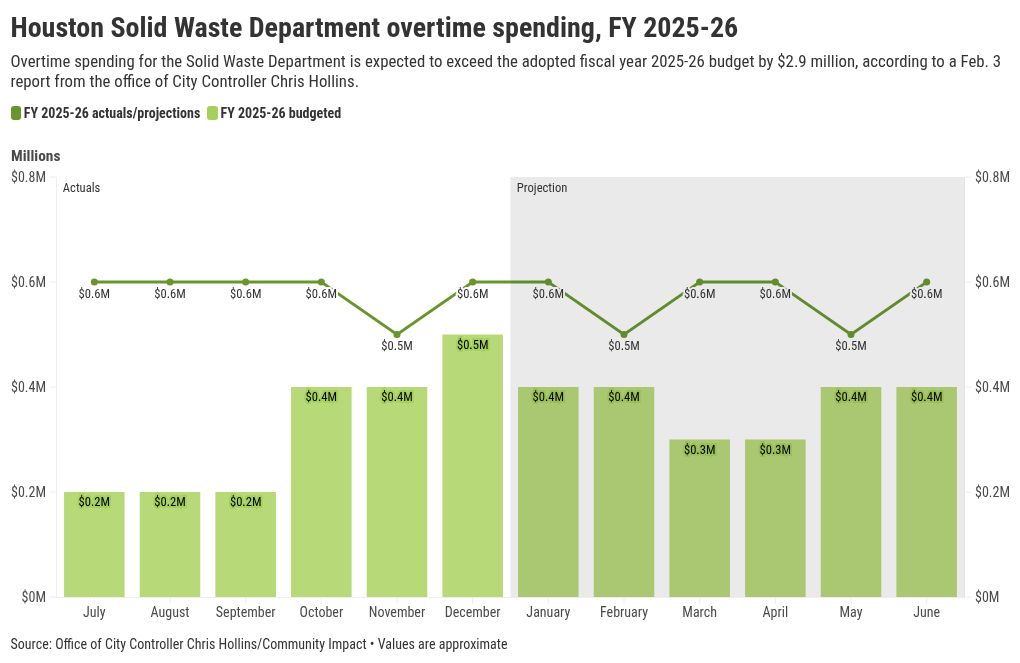
Houston is on track to exceed its budgeted overtime spending by more than $54 million by the end of the fiscal year, a Feb. 3 presentation from the city controller’s office shows.
Deputy Controller Will Jones said the spending is expected based on historical overtime trends, suggesting continued underbudgeting that does not align with department needs.
What’s happening
City departments are spending more on overtime pay each month than allocated for in the FY 2025-26 budget, adding to Houston’s growing shortfall for the fiscal year, according to a presentation to the Budget and Fiscal Affairs and Government Operations committees in a joint Feb. 3 meeting.
Houston’s fire and police departments have contributed the most to employee overtime spending so far this fiscal year, which ends June 30, Jones said during the presentation. Additionally, the Solid Waste Management Department has the highest overtime expenditures of any civilian department, the report shows.
According to general fund projections from the controller’s office:
Some of the top overtime earners across the three departments are on track to double—and in a few cases, triple—their salary by the end of FY 2025-26. Jones said the figures suggest room for improvement with the budgeting process, not an issue with the departments’ spending habits.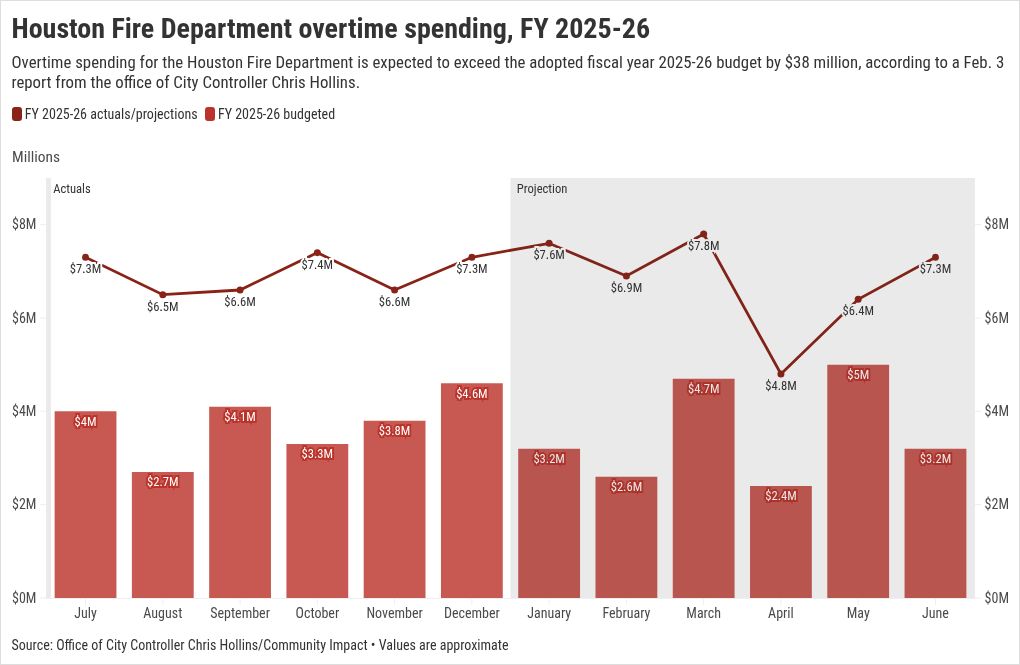
 More details
Finance Director Melissa Dubowski said overtime spending within the fire and solid waste management departments has been on pace with that of the past two fiscal years, with HPD overtime spending trending slightly lower.
She said the finance department is working on analyzing the spending and savings of all city departments, not just the three from the presentation, which will be presented to Houston City Council in April.
Common causes of overtime include staff shortages, recruitment challenges, holidays and increased demand during extreme weather events, including the winter storm that hit Houston in January.
The city has implemented several measures to address overtime demand, such as increasing salaries and cadet classes to improve recruitment, but monthly data shows employees are continuing to clock beyond a 40-hour workweek—or 46.7 hours for firefighters.
Why it matters
The city is on track to enter FY 2026-27 with a budget deficit between $227 million and $253 million, Jones said during the presentation. As of the end of December, Houston’s shortfall increased by $52 million due to less revenues and more expenditures than initially accounted for, he said.
The combined overtime projection for the current fiscal year is less than FY 2024-25, which totaled more than $71 million. However, the report indicates the city has under-budgeted for overtime in the three departments almost every year for the past 11 years.
District C council member Abbie Kamin said the next budget must better reflect the realities of the departments and account for weather-related disasters, which have historically caused spikes in overtime hours.
“We have to start projecting for the expectation of disasters,” Kamin said during the Feb. 3 meeting. “What we see is we try to keep a healthy fund balance, but we know we’re going to be taking from that because of overtime [and] if we know, we need to say so.”
Diving deeper
Leaders from each of the three departments also delivered presentations to the committee members with data reflecting staff head counts, attrition trends and the most common causes of overtime.
Head counts for the fire and police departments increased compared to last fiscal year, per the presentations, but staffing within the solid waste department dipped by approximately 60 employees. However, Larius Hassen, director of Houston Solid Waste Management, told committee members he’s confident about the number of applications received for vacancies.
Assistant Police Chief Thomas Hardin said a majority of HPD’s overtime is spent on operations and Houston’s airports, with additional costs during natural disasters and protests. Similarly, Fire Chief Thomas Muñoz said the department relies on overtime to maintain daily minimum staffing levels as well as support special events and disaster response.
As for Solid Waste Management, Hassen said garbage collection during holidays and Saturday catch-up contributes to the department’s overtime spending.
Dubowski said city staff will look for potential line-item savings within each of the departments, which she expects to be less likely for Solid Waste Management.
“It’s not a new trend for the Solid Waste Department to need additional resources to support their operations,” Dubowski said.
What’s next?
According to the presentation, the city’s Audit Division plans to complete three audits for the fire, police and civilian departments to ensure accurate and appropriate use of overtime.
Jones said the city-wide civilian audit is expected to wrap up in March and the police department audit will be completed in May, followed by a look at the fire department’s payroll.
The BFA Committee is scheduled to start workshopping the FY 2026-27 budget at the beginning of May, with budget adoption in June.