
Editor’s note: This article was updated to include a link to the parent application portal.
Texas families can soon apply to receive state funds for private education or homeschooling under the state’s new education savings account program, known as Texas Education Freedom Accounts.
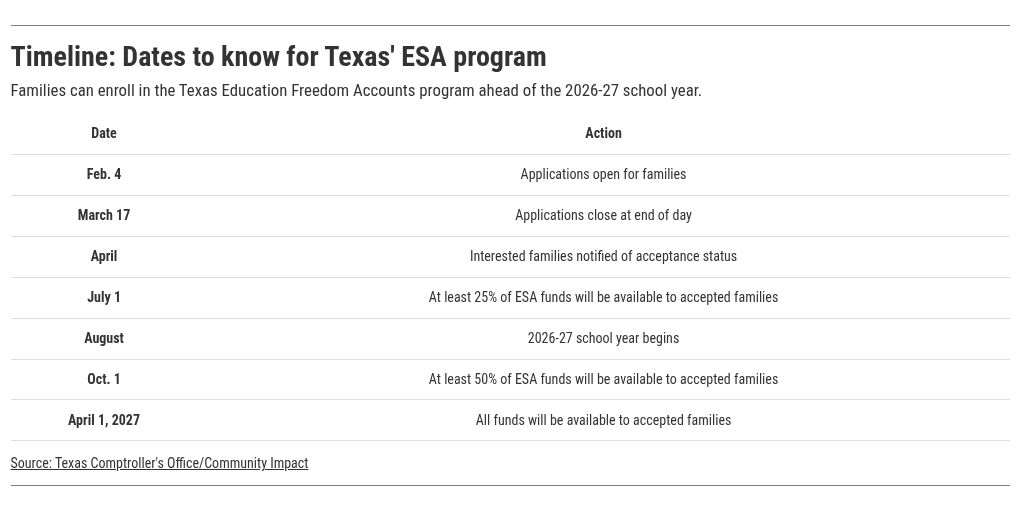
The application opens at 9 a.m. Feb. 4 and is designed to be completed in about 15 minutes, according to the state comptroller’s office. Families can apply through 11:59 p.m. March 17, at which point Odyssey, the New York-based company administering the program, will begin reviewing and approving applications.
“We’re launching the largest day-one school choice program in the nation, and we want parents to feel confident and informed about the new choices you’ll have ahead,” Acting Comptroller Kelly Hancock said in a Jan. 28 news release. “Our goal is to make this process simple and focused on helping families find the learning path that works best for each of their children.”
Under state law, applications will be prioritized using a need-based lottery system, meaning funding is not awarded based on when an application is submitted.
Accepted families will receive thousands of dollars to use during the 2026-27 school year. Keep reading for more information about the application process, available funding and how the program works.
How to apply
Odyssey will run the parent application portal. According to a video on the company’s website, each family must create an account and provide the following details:
Contact information for parents or guardiansResidency informationActive-duty military status and military orders, if applicableInformation about any children in a household who are applying for the programEach student’s educational historySpecial education information, if applicableWhether each child will attend a private school or homeschool in the 2026-27 school yearDocuments verifying household incomeDocuments verifying Texas residency, if applicableA student’s chosen private school, if applicableAn application checklist is available here and a 13-page program guide from the comptroller’s office is available here.
If multiple children in a single household are applying for the program, they must be listed on the same application, the video states.
Once an application is submitted, it can be edited and resubmitted through March 17. Accepted families will use the portal throughout their participation in the program, according to Odyssey.
Families must submit separate applications with their chosen private schools. As of press time, over 1,600 private schools and prekindergarten providers—the majority of which are located in and around Texas’ largest cities—had been approved to accept education savings accounts, per a map on the comptroller’s website.
Who can apply?
To be eligible for the program, students must:
Reside in TexasBe U.S. citizens or lawful residentsBe eligible to attend a Texas public school, open-enrollment charter school or pre-K programIf a student is currently enrolled in a public or open-enrollment charter school and receives education savings account funding, they must withdraw from that school, according to Odyssey.
How funding works
The $1 billion program, which Texas lawmakers approved in 2025, is designed to expand educational options for families who may not want to send their children to a public school, Community Impact previously reported. During last year’s legislative session, some opponents of the program expressed concerns that it would unfairly benefit students already enrolled in private schools and divert funding from public school districts facing financial challenges.
Families accepted for the 2026-27 school year will receive $10,474 per student, which can be spent on private education and related expenses, including textbooks, transportation, tutoring and therapy services. During the 2023-24 school year, the average cost of Texas private school tuition was $10,965 for kindergarten through eighth-grade students and $14,986 for high school students, according to the Texas Private Schools Association.
Students who are homeschooled will receive up to $2,000 per year.
Students with disabilities will be eligible to receive up to $30,000 annually, depending on their individual needs. To qualify, families must submit an Individualized Education Program, or IEP, that is on file with the Texas Education Agency and was completed by a public school district for the 2023-24, 2024-25 or 2025-26 school years.
Families may also submit older IEPs, IEPs from another state or other documents indicating a child’s disability, according to the comptroller’s office. This allows students to be prioritized for acceptance into the program; however, an up-to-date IEP must be submitted later for a student to receive the additional funding.
The lottery system
If applications for the program outpace available funding, state law requires that Odyssey and the comptroller’s office prioritize students in the following order:
Students with disabilities whose annual household incomes are at or below 500% of the federal poverty line, or about $160,000 for a family of fourFamilies with incomes at or below 200% of the federal poverty line, which is about $64,000 for a family of fourFamilies earning between 200%-500% of the federal poverty lineFamilies above 500% of the federal poverty line—limited to 20% of total program fundingIf a child is accepted into the program, their eligible siblings who apply during the same application period will be automatically accepted, according to the comptroller’s office.
Looking ahead
The comptroller’s office said it will begin notifying families if they are accepted into the program in April and families must select the private school they plan to send their children to, if applicable, by July 15.
Families will be able to access at least 25% of their education savings account funding in July, according to a timeline on the program website. At least 50% of the funds are scheduled to be available to families on Oct. 1 and all funding for the 2026-27 school year will be available in April 2027. If families do not spend all their allotted money, it will roll over for the next school year, per Odyssey.
Once students are accepted into the program, they will not need to reapply annually as long as they remain in good standing, per the comptroller’s office.
 Also of note
Some Texas public school advocates launched the Texas Center for Voucher Transparency, which is aimed at tracking the program’s rollout, on Feb. 2. The center will track how state funds are spent, collect confidential complaints about the program and provide policy recommendations for future legislative sessions, according to a news release.
“Regardless of whether someone thinks the government should regulate more or less, regardless of your position on vouchers, there’s nothing controversial [about] making it easier for Texans to see how $1 billion in taxpayer money is being spent and what results they deliver,” Dee Carney, a public education policy analyst and the center’s director, told Community Impact Feb. 3.
Find out more
To give families more information about the ESA program and application process, program officials are holding weekend information sessions with local schools in communities across Texas.
Texans with questions about the program can email the comptroller’s office at [email protected] or reach Odyssey at [email protected] and 737-379-2362.
Families, schools and educational vendors can sign up for email updates about the program here.