
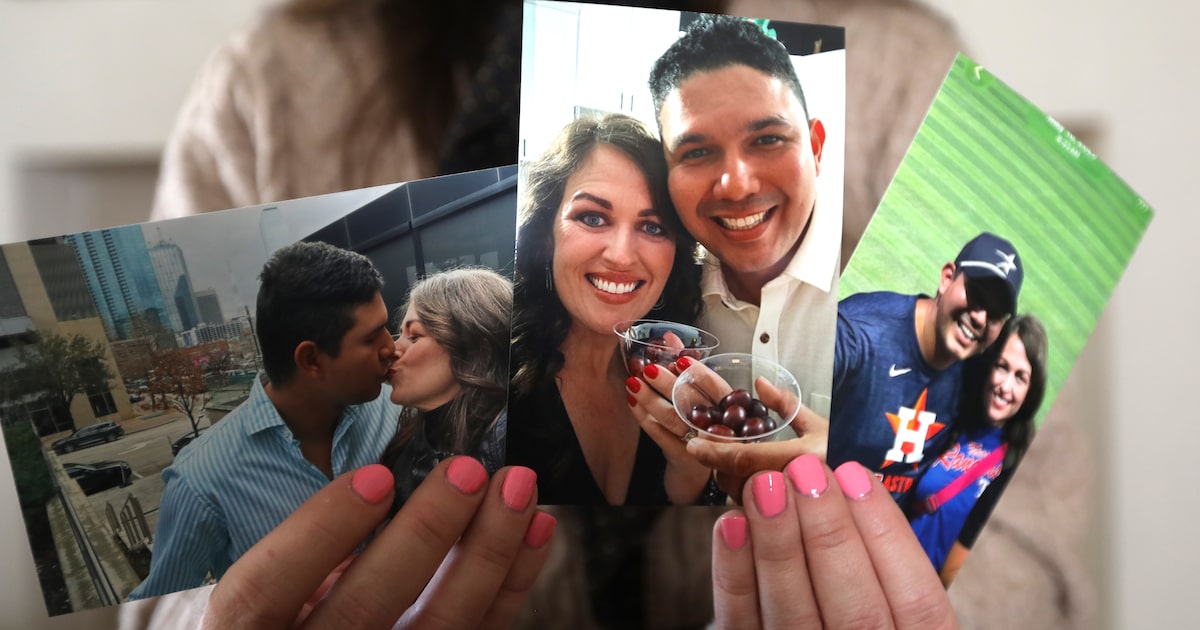
Heather Fletes first met Rafael Alambarrio salsa dancing in Klyde Warren Park.
It was March 2024, and Heather’s love of dancing and time practicing salsa on a study abroad trip to Mexico brought the bilingual McKinney elementary school teacher to the free event in downtown Dallas.
Rafael was joyful, observant and servant-hearted, Heather said. They went out for coffee, then to a baseball game, and an “earth-shattering” romance quickly began between the couple.
“It always feels like karaoke with me and Rafael, in English or Spanish,” said Heather, 41. “It defies logic … and yet we’re perfect for each other.”
Breaking News
They were married at the McKinney courthouse in June. Seven months later, Rafael and Heather Alambarrio were torn apart.
Related

Rafael, who is from Venezuela and who the federal government determined in 2023 had a credible fear of returning to his country, was detained by Immigration and Customs Enforcement on Jan. 15. He showed up at the Dallas ICE office for a mandatory and routine check-in with the agency while seeking asylum and waiting for his green card as the husband of a U.S. citizen. He never walked out.
“Very normal processes to legally immigrate have become filled with anxiety and fear for clients,” said Caitlin Twyman, the couple’s attorney who has worked in immigration law since 2013. “These are the steps that we’re supposed to do to get legal status.”
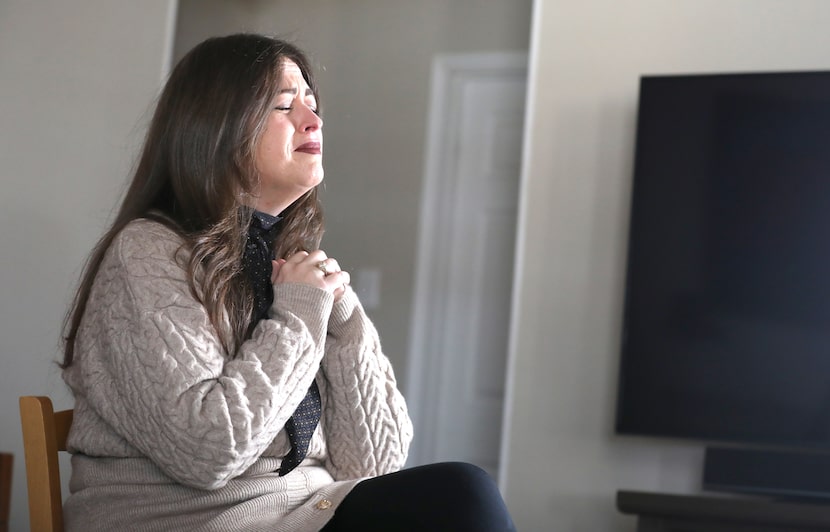
Heather Alambarrio gets emotional during an interview at her home in McKinney on Wednesday, Jan. 28, 2026.
Anja Schlein / Special Contributor
As President Donald Trump’s administration cracks down on immigration, families are confronting increasingly desperate situations of separation and uncertainty as they rethink their future. For Venezuelans who have found safety in America from the same oppressive government the U.S. has sought to remove, the stakes are high.
Seeking safety in America
Rafael protested against the government in Venezuela, Heather said, and feared for his family and for his own life. When he came to the U.S. in 2023, the government determined he had a credible fear of persecution based on his political opinion if he were to return. He then started the process of seeking asylum in America.
Related

Under U.S. law, people who flee their countries because they fear persecution based on certain criteria can apply for asylum, and, if granted, have a right to stay in the country.
“I came to the United States seeking protection,” Rafael said in a video call with his wife. “This country guaranteed you what I think is the most valuable thing for a human being, which is security, protection and social stability … something that had been lost in Venezuela.”
Rafael has multiple certifications and degrees, according to Heather, but was not yet fluent in English when he came to Texas. He worked odd jobs and did food delivery to make ends meet while taking English classes at the library and waiting for his work authorization.
Heather grew up in Collin County and teaches humanities at Walker Elementary in McKinney. She has two children from a previous marriage and also works as an education consultant, training and coaching other teachers.
After they married, Heather started the process of petitioning for Rafael to become a permanent resident and obtain a green card, which would also allow him to stay in the U.S. They paid for an attorney and collected documents: affidavits from friends who could vouch for their marriage, birth certificates, photos, ticket stubs and travel receipts to prove their relationship.
“We want to make sure that people don’t take advantage of these immigration laws that we have,” Heather said. “There are processes and for them to work and for our country to be safe, we do have to make sure that people aren’t just lying.”
After an interview in November, they were told his green card would arrive within two months. Rafael got matching sweatshirts with a smiley face that read “good things are on the way” on the front to celebrate and Heather said she was overjoyed and relieved — “cheesy, happy, can’t stop smiling, over the moon,” she said.
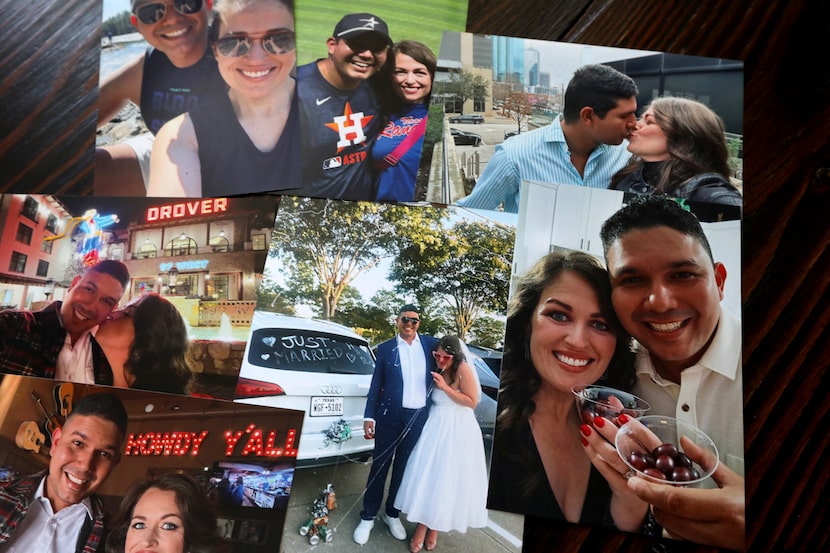
Heather Alambarrio shared a collage of photos of her and her husband, Rafael, at her home in McKinney on Wednesday, Jan. 28, 2026. Alambarrio is a McKinney school teacher whose husband was detained by ICE after the Trump administration paused processing Venezuelan green card applications.
Anja Schlein / Special Contributor
The process was going smoothly and routinely. Then in December, U.S. Citizenship and Immigration Services announced it was pausing immigration applications, including for green cards, from 19 countries — including Venezuela.
Related
“It just felt like the air coming out of a balloon,” she said. “All of that relief just dissipated.”
Routine appointment incites fear
A few weeks later, Rafael had a scheduled check-in with ICE, a routine, annual appointment. The appointment last year lasted minutes, Heather said. This time around, they feared he would be detained.
“Literally in the midst of following the law and the legal process, you’re afraid that you will be detained and punished for that,” Heather said.
The couple arrived at the Dallas ICE office anyway.
Beforehand, Heather made sure she knew how to access accounts and contact Rafael’s family; a “go-plan,” she said. She noticed Rafael fixing things around the house and putting away the Christmas decorations — things he didn’t want to leave Heather to deal with alone.
Heather wasn’t allowed in for his check-in appointment.
“It was … such a strange out-of-body feeling to wait and see if the love of your life is going to walk out or not,” Heather said.
When their attorney walked out alone, Heather knew Rafael was detained.
“We want people to show up in court and have their opportunity at due process,” Twyman said. “If people don’t feel safe coming to court, coming to their interviews, they lose the opportunity to have their cases heard, to have an opportunity to stay.”
Twyman said in the past, Rafael would likely not have been detained while he waited for his asylum case or his green card. But enforcement of immigration policy is changing rapidly and drastically.
“It used to be there were priorities for enforcement, like violent criminals or people with … removal orders,” Twyman said. “He has none of those things.”
Related
 Conditions in detention
Rafael told Heather he was in a holding cell at the Dallas ICE office with dozens of other men, most from Venezuela. The small room had a concrete floor, no beds, no chairs and an open toilet. He is now at Prairieland Detention Facility in Alvarado, awaiting a hearing scheduled for Feb. 3.
In a video call to his wife, Rafael said the conditions at the Prairieland facility are poor — bathrooms and showers aren’t clean, the lights don’t turn all the way off at night, the medical care is subpar and the meals are very low-protein. Detention has put the life the newlyweds were building together on pause.
“It takes away a bit of time and above all, calm and peace,” Rafael said from detention in a video call with his wife. “We are all here under a lot of pressure, [we’re] anxious because we don’t know what is going to happen.”
Heather said that until recently, the heat was not turned on at the facility despite freezing temperatures in January. In calls to Rafael, she has heard men crying out for warmth, heard her husband’s teeth chattering and could see him shivering. The flu is spreading and they were not given coats, she said.
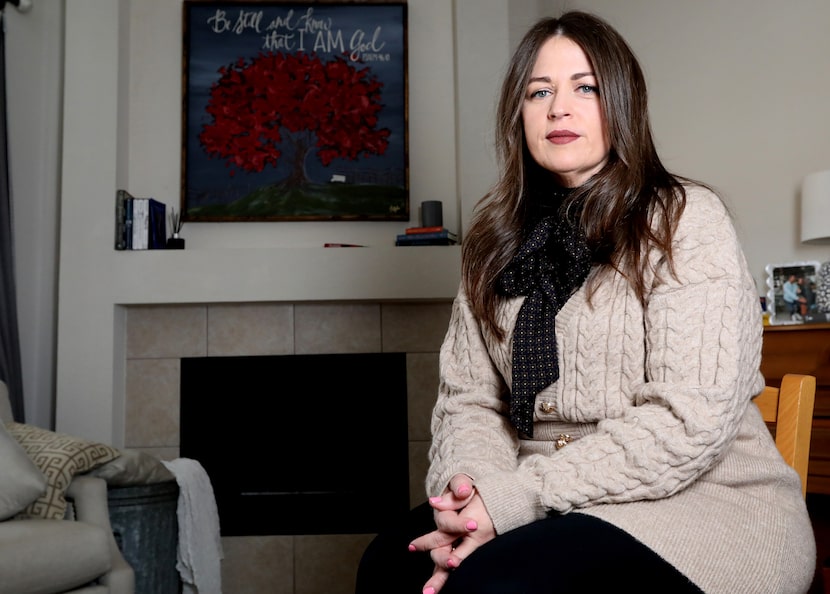
Heather Alambarrio poses at her home in McKinney on Wednesday, Jan. 28, 2026.
Anja Schlein / Special Contributor
ICE Public Affairs Officer Sarah Loicano wrote in an emailed statement that Prairieland’s heating systems are working.
“If a heating system, or any utility system that made living conditions unsafe or unhygienic, was not functioning correctly, ICE would take immediate action to address that issue,” Loicano wrote. “ICE takes its commitment to promoting safe, secure, humane environments for those in our custody seriously.”
Shifting sand
Rafael’s detention has delivered a financial blow to Heather and the family, who had hoped to send a kid to college next year with Rafael’s support. Legal fees have piled up for multiple lawyers and the family is down to one teacher’s salary. A GoFundMe has raised over $24,000 for the family as of Monday.
Heather’s been taking anxiety medication for the first time in her life and has trouble sleeping and focusing. She forgets to eat and accidentally drove home to a house she hasn’t lived in for over a year. She has memorized her husband’s “alien number,” a nine-digit code that identifies Rafael in the immigration system.
Related

“It’s not that the rules are changing, but the execution of the rules are changing constantly,” Heather said. “The sand is shifting beneath your feet. You can’t keep up.”
The United Nations found Venezuela’s Bolivarian National Guard committed serious human rights violations and crimes against humanity over more than a decade of targeting political opponents, according to The Associated Press. The U.S. launched a military strike in Venezuela and deposed its autocratic President Nicolás Maduro earlier this year.
“Rafael is so thankful for that,” Heather said. “But the rest of the regime is still in place.”
Venezuelans in North Texas reacted to the news of the U.S. strike with a mix of relief, gratitude and deep uncertainty, emotions shaped by years of political turmoil that forced many to leave.
Related

Rafael is embedded in his community — he belongs to a church and a men’s softball league. McKinney residents have rallied around the couple. Grady Ln, a local boutique, is selling shirts that read “McKinney, Unique by Nations” to raise money for the couple, a nod to McKinney’s slogan, Unique by Nature.
“I thank God I have my wife,” Rafael said in a video call from detention. “I thank everyone for everything they are doing to support me to overcome this stage. But there are many people here who don’t have that support.”
‘Wild West’ of immigration law
Twyman is grateful to see support for the family. She is seeing that although people can disagree about how to solve immigration problems in the country, some are agreeing that what’s happening is not right.
“It’s not humane,” Twyman said. “It doesn’t honor the dignity and value of the immigrant community.”
Dallas ICE officers arrested more than 12,000 people in 2025 after Trump took office. During the first nine months of his second term, 62% of those arrested by agents in the Dallas office had not been convicted of crimes.
Related

The Trump administration’s crackdown has had a particularly disproportionate impact on Venezuelans. In the Dallas area, arrests of Venezuelans have increased by more than 400% in 2025 when compared to 2024.
“I am speaking on behalf of my husband, Rafael, who I love deeply,” Heather said. “I’m also speaking on behalf of the people who don’t have anyone to speak for them, or don’t have a relative that speaks English or knows how to navigate these systems.”
Rafael is waiting to go before a judge, where he will make his case for asylum and to get his green card as the husband of a U.S. citizen.
“This is the Wild West,” Twyman said. “Things are changing so fast. I can’t say with any certainty one way or the other how this is going to end, just that we’re going to do everything we can to make sure he gets his day in court and an opportunity to stay here with his family.”
Rafael’s detention “felt like a betrayal” of her country, Heather said.
“I teach students that … this is the kind of country [where] if you work within the system, you can have such a great, hopeful life,” Heather said. “I don’t think I was naive. I just think that things are broken right now when it comes to immigration.”
Staff writers Aarón Torres and María Ramos Pacheco contributed to this report. Email tips on all things Collin County to lilly.kersh@dallasnews.com.