
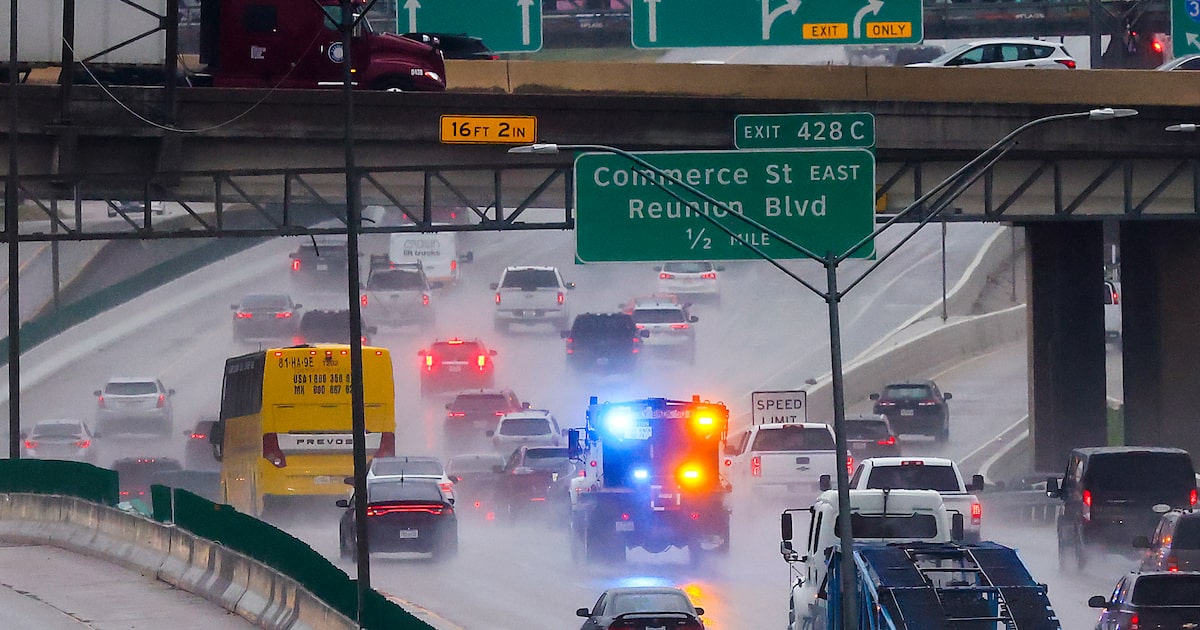

I’ve heard a lot of complaints lately regarding how highways divide neighborhoods. Indeed they do. But that’s not all they do.
The hard part about being a historian is wanting to jump in and give people the complicated backstory to provide the full picture.
It turns out the discipline of history is as tricky to practice and requires as much training as any other. I often wish I could throw a penalty flag on those practicing history without a license.
When there’s confusion, I make it a practice to see what Abraham Lincoln said on the subject. Turns out, Lincoln also wrestled with the issue of where to locate roads. He said, “One man is offended because a road passes over his land, and another is offended because it does not.”
Who says the 19th century was a long time ago?
Roads have been important even longer than that. I am sure some Roman once shouted, “Non in meo horto.” Not in my backyard.
Opinion
People are like that. When something becomes ordinary or necessary, they fail to appreciate it. I recall my grandparents being outspokenly grateful for reliable electricity and expressing their appreciation for Dallas Power and Light. They grew up when electrification of Texas was a current event. (Pun intended.)
Now, Texans complain when Oncor trims tree limbs, while also bemoaning any outage caused by downed wires.
Americans had the same virtus for roads in an earlier era, but we are good at forgetting our history, or never learning it. The start of the American Revolution occurred when the British went to quell the beginnings of a revolt and chose to move along the road to Lexington and Concord. The excursion taught them that they faced a people numerous and armed, and that movement along roads would not be safe. Roads, sometimes only paths, often impassable and crude, did allow determined patriots to travel from one colony to another, becoming committed American revolutionaries and, later, countrymen in the process.
The almost 4 million Americans of the post-Revolutionary period remained isolated and agrarian with a small merchant class. It still took four days to travel from Boston to Providence, R.I.
Despite the challenges, the country was on the move west. People of the early nineteenth century, clamored for roads. Congress authorized the National Road (also called the Cumberland Road) in 1806. Stretching from Maryland to Illinois, the road opened up the country to westward expansion, allowing Indiana to have the nation’s tenth largest population in 1840. In 1800, Indiana Territory had two thousand people.
Private roads and railroads also abounded, sparking not just a transportation revolution, but also a market revolution. The same trip from Boston to Providence in 1840 was half a day by rail. Technology was conquering the challenge of space across a huge nation, and roads remained a critical factor.
Famed historian (yes, that’s a real thing) Charles Sellers maintains that the era between the War of 1812 and the year 1846 transformed our nation. The Market Revolution “mobilized collective resources through government to fuel growth in countless ways, not least by providing the essential legal, financial, and transport infrastructures.”
Sellers said, “Establishing capitalist hegemony over economy, politics, and culture, the market revolution created ourselves and most of the world we know.” The price of this progress was that democracy was replaced by capitalism as the prevailing ethos.
By the eve of the Civil War, the country had nearly 32 million people. No longer did they labor in the fields. Roads, canals and railroads had transformed America — mostly the northern portion. Sellers reports that the country was producing nearly 3 billion different types of goods, and exporting 400 million of them.
The Union benefited from both the industrial and transportation revolution in the Civil War. Superior roads didn’t win the war, but they were an important advantage.
The country failed to make road improvements a priority in the postbellum period. In 1919, a young lieutenant colonel named Dwight Eisenhower embarked on the first effort to drive motorized vehicles across the country. The Transcontinental Motor Convoy consisted of more than 250 service members and 81 motorized vehicles. The convoy took 62 days to travel more than 3,000 miles from the nation’s capital to San Francisco.
It also had 230 travel accidents or other mishaps that resulted in only 90% of the vehicles completing the trip.
Imagine. Only 100 years ago, it took two months to cross the country by road — and it had to be done by the military because it was so difficult. Now, we just complain if the restrooms aren’t spotless at Buc-ee’s.
Ike’s experience resulted in his creation of the Interstate Highway System as president. These roads are used often but seldom appreciated by Americans. They have created economic prosperity for the country as well as enhanced public safety and convenience.
Benjamin Franklin noted, “There are many roads to success, but only one sure road to failure: and that is to try and please everyone.” I’m quite sure I didn’t please everyone in this piece, but at least you know a bit more about a time when roads united Americans.
Today, that’s the road not taken.