
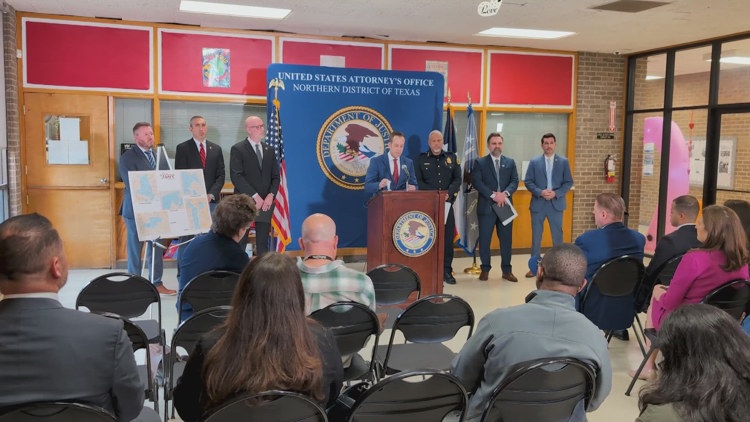
Federal and local law enforcement leaders gathered at a northwest Dallas recreation center Wednesday to announce the expansion of a long-standing anti-violence initiative into the blocks surrounding Harry Hines Boulevard.
The program, known as Project Safe Neighborhoods (PSN), will now focus its resources on the city’s northwest sector. Ryan Raybould, U.S. Attorney for the Northern District of Texas, characterized the move as a vital step in maintaining public safety.
“This is an area that’s been suffering,” Raybould said. “Violent offenses, firearms trafficking, narcotics trafficking, human trafficking, money laundering — it’s all on the table.”
The initiative relies on a combination of community-provided tips and data-driven research to target specific high-crime corridors. While the program has operated in northeast Dallas for years, officials say its track record justifies the westward expansion.
Dallas Police Chief Daniel Comeaux noted that the collaborative approach has contributed to a recent downturn in citywide crime.
According to year-end data provided by the U.S. Attorney’s Office for the Northern District of Texas, through Dec. 31, 2025, established PSN zones of northwest and northeast Dallas combined saw a 52.4% reduction in homicides compared to the previous year. Property owners in those sectors also saw relief, with auto thefts plummeting by 30.6% and business burglaries dropping by more than 19%.
However, the data also reveals while violent street crime is down, law enforcement continues to struggle with domestic issues and specific property crimes. In the combined PSN zones, aggravated assaults involving family violence rose by 17% over the last year. Additionally, shoplifting reports jumped by 20.6%.
“We are a full 100% partner in it,” Comeaux said. “If you’re committing crimes and you’re doing criminal activity in Dallas, we’re going to come after you.”
At the press conference, there were multiple federal agencies, including the FBI, IRS, DEA, and Homeland Security Investigations (HSI). However, the inclusion of HSI — a branch of U.S. Immigration and Customs Enforcement (ICE) — has raised questions regarding the mission’s scope amid national tensions over immigration enforcement.
Officials were quick to draw a line between criminal investigations and civil immigration matters.
“This is a violent crime reduction. This is not an immigration enforcement activity,” said Jeremy Wright, Assistant Special Agent in Charge of HSI Dallas.
Wright emphasized that the task force plans to prioritize community outreach to ease local anxieties and build rapport with residents. He noted that the U.S. Attorney’s Office will lead public meetings where residents can engage directly with the agencies involved.
While leaders acknowledge that curbing systemic crime and building trust will take time, chief Comeaux offered a blunt assessment of the task force’s intent for northwest Dallas.
“I’m looking you in the eye,” Comeaux said. “It’s going to get crushed.”