
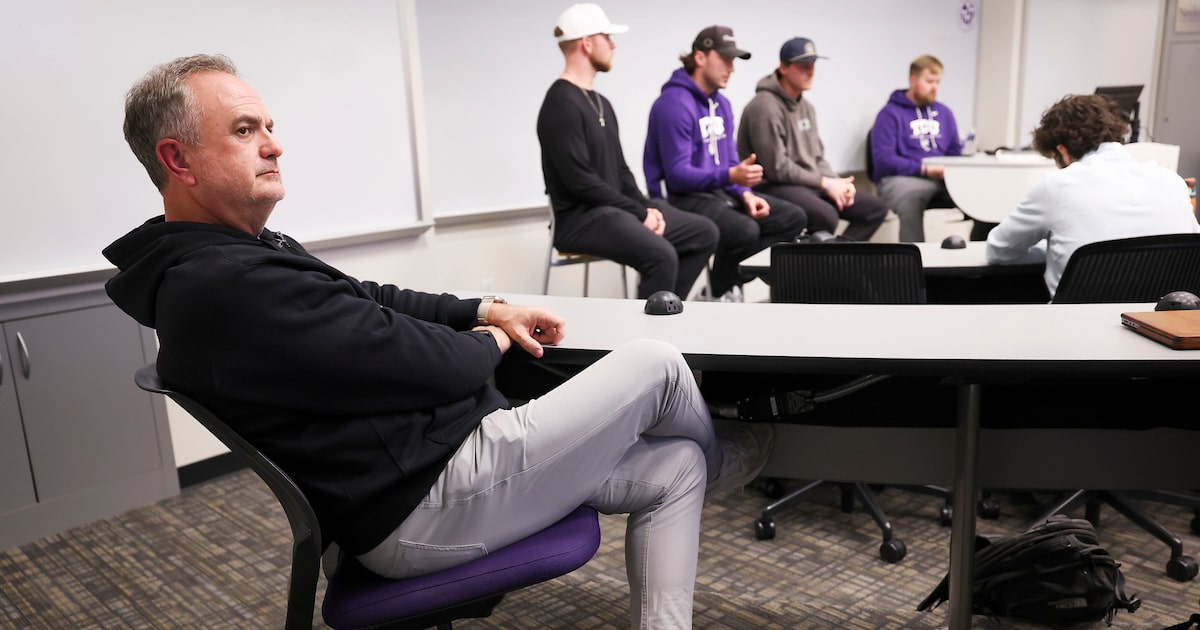
FORT WORTH – The last class Sonny Dykes taught was creative writing at Navarro College in the mid-’90s, when he needed the stipend. As coach of the running backs, he was making $288 a month. His car payment was $250. Gave him reason to question his calling.
Here he was a 27-year-old college graduate, coaching, teaching, mowing lawns and bagging groceries, and he still couldn’t make ends meet.
Sonny told those stories and others to the two dozen students in his class on “Leadership in Action: Lessons from the Gridiron to the Boardroom” Monday night at TCU, which pays him $7 million to coach football, not play professor.
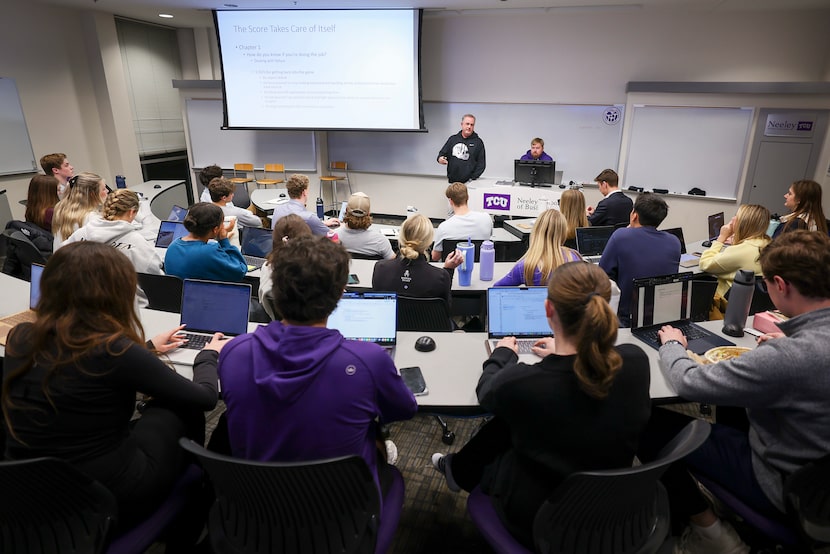
TCU football coach Sonny Dykes teaches a leadership class at the Neeley School of Business on Monday, Feb. 2, 2026, in Fort Worth.
Smiley N. Pool / Staff Photographer
Sports Roundup
But this is what you do when you’re afflicted with a naturally curious mind, and, more to the point, your boss asks.
For the record, there’s precedent for this sort of thing. Houston’s Willie Fritz, Minnesota’s P.J. Fleck and Colorado’s Deion Sanders are teaching classes this spring. Bill Snyder, one of the best ever, did it at Kansas State.
Mike Leach, among Sonny’s eclectic cast of mentors, once taught a spring course at Washington State on Geronimo, the legendary Apache leader.
“Insurgent Warfare and Football Strategies,” Leach called it.
The Pirate loved Geronimo, Sonny said. Even wrote a book about him. Compared Geronimo’s military plans to Air Raid tactics, if you can believe that. When he learned of Leach’s class, Sonny figured it’d be “a pretty fun thing to do sometime.”
The time came last fall when TCU’s chancellor, Victor Boschini, asked if he’d be interested in teaching a class on leadership, and he readily agreed.
“Of course, I didn’t think anyone would follow up,” Sonny said.
“Course, they did.”
The class meets Monday nights for nearly three hours, which is a lot, even if your teacher is a high-profile coach who brings good guest speakers to class. This week’s panel was a trio of quarterbacks: Shane Buechele, who played for him at SMU and is now Josh Allen’s backup in Buffalo; Max Duggan, who took his first TCU team to the national title game; and Ken Seals, who came off the bench after Josh Hoover left for Indiana to orchestrate an upset of USC in the Alamo Bowl.
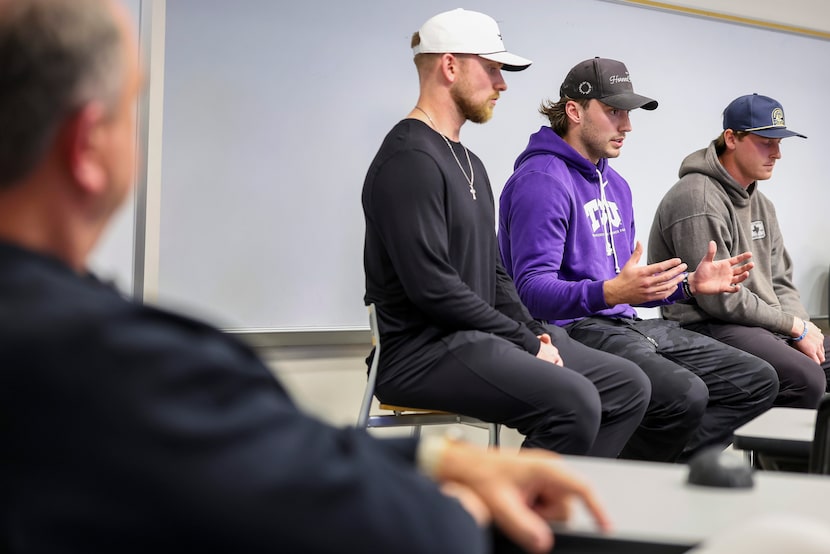
TCU football coach Sonny Dykes (far left) listens as quarterbacks (from left) Shane Buechele, Ken Seals and Max Duggan speak to students during a leadership class at the Neeley School of Business on Monday, Feb. 2, 2026, in Fort Worth.
Smiley N. Pool / Staff Photographer
Sonny warmed up the class, meeting for the second time this semester, with his own story, then led a discussion of the three quarterbacks’ own. He couldn’t resist noting his Cal team, with Jared Goff at quarterback, beat Texas at Royal-Memorial in Buechele’s freshman season.
Before his transfer to SMU, Buechele said the culture under Charlie Strong and Tom Herman at Texas “wasn’t very consistent,” which is putting it nicely. He also told the class the difference between the two quarterbacks he’s played second fiddle to in the NFL. Patrick Mahomes’ level of preparation, Buechele said, is “crazy,” and it shows in his performance. Allen is more laidback, he said, but inspires loyalty because “he’s the most genuine person in the building.”
All three of Sonny’s quarterbacks spoke extensively on what it takes to be a leader and how they reacted to highs as well as lows.
A half hour in, Sonny opened it up to the floor. Hands shot up. The questions were universally thoughtful, occasionally complex and executed in a manner which Sonny is probably unaccustomed to in his other job.
Just the same, I couldn’t help thinking: What if someone asks about the national title game in 2023?
One student asked about the quarterbacks’ “mantras” – a topic rarely broached in my circles – and got surprisingly good answers.
After the mantra interlude, Sonny jumped in to note that, unlike most CEOs, leaders in sports become public figures. One moment they’re worshiped on social media; the next, they’re scorched. They must learn to ignore extremes and cultivate an inner circle, albeit one that includes constructive criticism.
Basically, in an office or a locker room or a Dairy Queen, everyone needs someone to tell them when they’re going the wrong direction.
“I’m 56 years old,” Sonny said, “and I got thrown out of a football game two years ago at SMU. It was not a good day. And I had to check myself.”
Pause.
“It was kind of a BS deal, because I didn’t say anything. I did the first time, but not the second.”
Sonny called his ejection from TCU’s 66-42 loss to his former school in 2024 an “incredibly humbling” experience, but a good one, nonetheless. He’d lost focus after getting sucked into social media that week. Lesson learned. Watching his Horned Frogs go on without him, he gave up Twitter on the spot.
Seals had known a little of his coach’s story before class, but he learned a lot he didn’t know.
Did he sound the same as he does in the locker room?
“I think he turns on the same talking mode whenever he gets in front of a crowd,” Seals said after class.
“He’s good at it.”
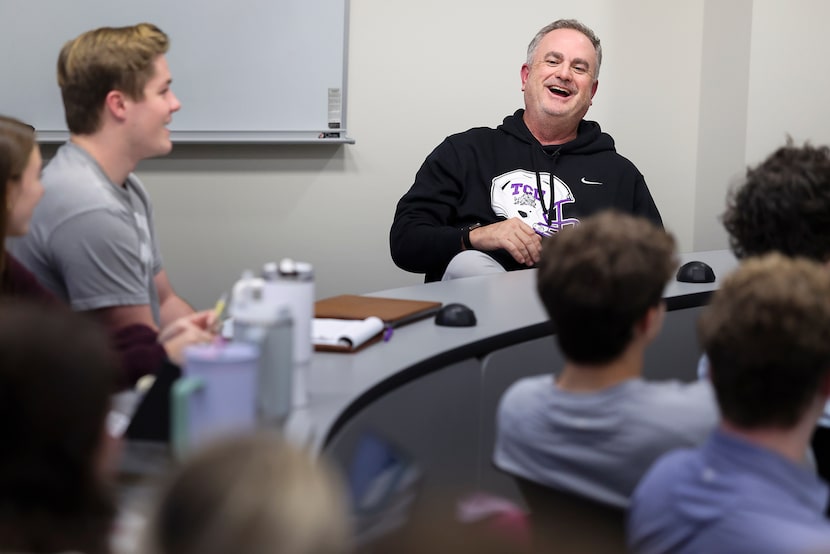
TCU football coach Sonny Dykes laughs with students as he teaches a leadership class at the Neeley School of Business on Monday, Feb. 2, 2026, in Fort Worth.
Smiley N. Pool / Staff Photographer
No state secrets were revealed Monday, though Sonny said he had no idea the ‘22 team was on its way to SoFi Stadium after barely beating a “terrible” Colorado team in their opener. He also noted he doesn’t read the newspaper, or at least the TCU stuff in the sports section.
Called it “destructive.”
Ouch.
Otherwise, Seals said he was “shocked” to see students taking notes and showing enthusiasm for the subject. Class participation is, indeed, part of the grade. A presentation is forthcoming. One of the books on the syllabus was authored by Bill Walsh, the genius behind the 49ers and the West Coast offense.
Sonny says he enjoys the class because it allows him to “double-check” his philosophies. None of his players are enrolled, but, if any were, he swears he’d flunk them if they didn’t do the work. As it is, everyone in this class has turned in homework on time and remained engaged.
Brooke Sidler, a 21-year-old senior from Plano with a double major in marketing and management, took the class on a recommendation from another professor. A couple of her friends are in the class, too.
Sidler likes college football. Attends most TCU games. In fact, she was at Ford Stadium when Sonny got tossed. Judging by that experience, she was expecting her new professor to be a little, well, wired up.
“He’s a great person to learn from, but different in energy,” she said. “But maybe that’s just a difference between a classroom versus a football field.”
No referees in here, anyway.
I asked Sidler, who was a freshman when TCU lost to Georgia, 65-7, at SoFi Stadium, if she was afraid someone might ask Duggan about it.
“Within the student population,” she said, earnestly, “we don’t speak about the national championship, so I don’t think anyone was willing to go there.”
No one?
“Honestly,” she said, “it was definitely a thought in my mind. But I know I would not want to be asked about probably one of my lowest moments, and I can imagine that would definitely be a tough one.”
No decent person would have asked Duggan that question, anyway. Only a sportswriter.
Twitter/X: @KSherringtonDMN