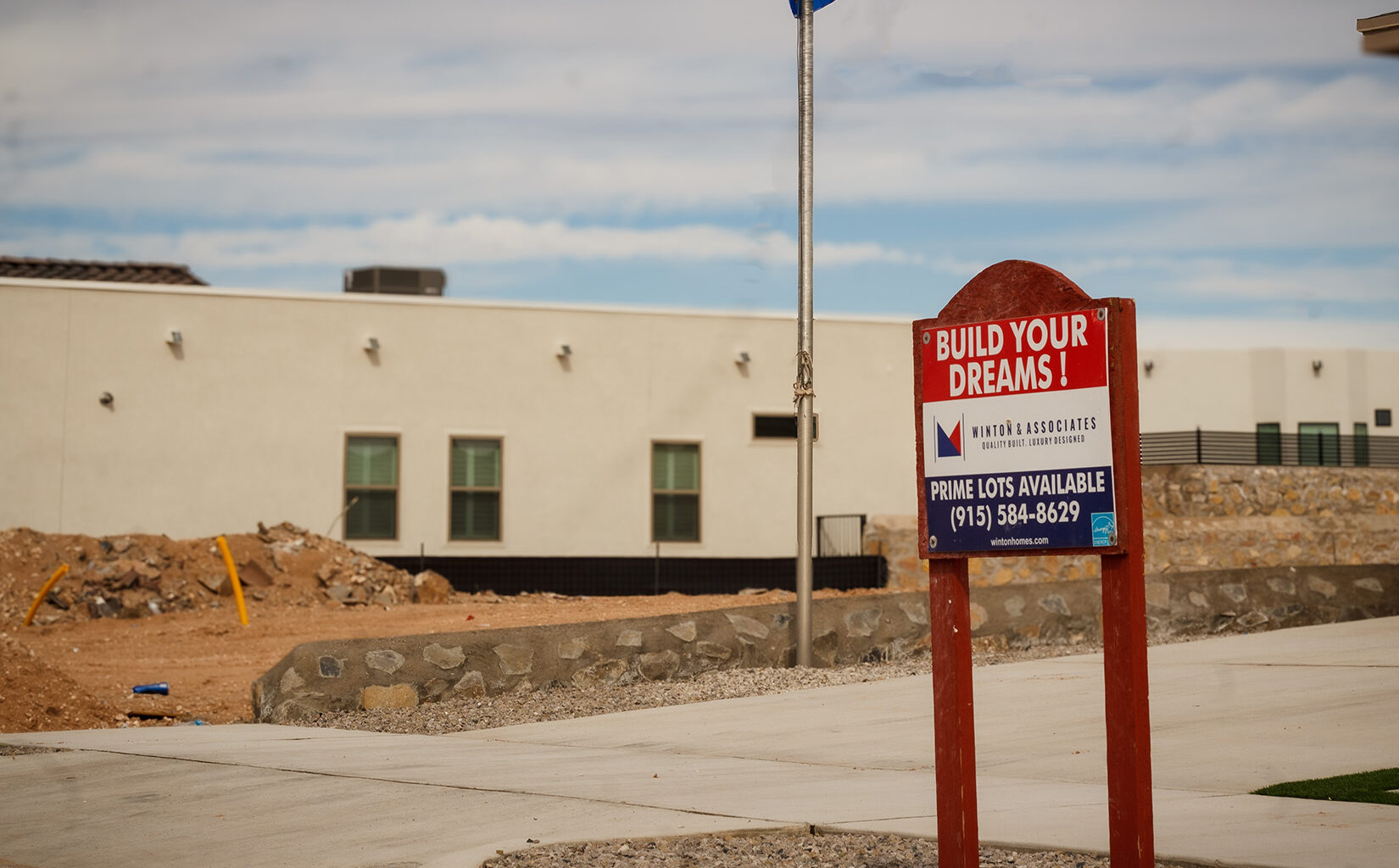
Recent U.S. Immigration and Customs Enforcement (ICE) operations at construction sites across El Paso have intensified public concern and renewed debate over immigration enforcement in a city where immigrant labor is seen as central to the local economy.
Multiple sightings of ICE agents at housing developments have been reported throughout January 2026, with videos circulating widely on social media.
On Jan. 22, KTSM reported that federal agents had conducted operations at construction sites where homes were being built and appeared to be searching for specific individuals.
This follows an operation on Jan. 14 in the Paseo del Este neighborhood of Horizon City. Witnesses reported dozens of ICE vehicles, supported by the Texas Department of Public Safety (DPS), arriving at a development where several detentions occurred.
On Jan. 16, footage shared by the social media account, FitFam El Paso, showed agents approaching sites near Montana Avenue and Mager Drive.
The El Paso Times reported that while formal arrests were not seen at every location, the visibility of federal agents has turned some neighborhoods into “ghost towns.”
The activity coincides with the implementation of Texas Senate Bill 8, which went into effect Jan. 1. The law requires Texas sheriffs in counties with more than 100,000 residents to enter into 287(g) agreements, effectively deputizing local law enforcement to assist in federal immigration checks.
Workers describe a climate of high pressure and constant surveillance. Erick Cano, a construction worker and U.S. citizen, said agents arrived while his crew was working in a garage in Northeast El Paso.
“Well, they were all over the place,” Cano said. “They just arrived… asking for documents, and we just showed them to them.”
Cano expressed his frustration with the focus on laborers.
“They’re just bothering the people who want to work… we’re not here doing anything bad. We’re just working,” Cano said.
Another worker, also a U.S. citizen who asked to stay anonymous, described a 40-minute encounter where agents took people away.
“There aren‘t many people here because they‘ve been taken away,” he said. “We’re not doing anything wrong… I don’t see [why]they want to take us out of this country.”
A third colleague who asked to stay anonymous described a more confrontational exchange, noting he refused to show documentation.
“I spoke to them in English, and I asked them, ‘Do I have to show you something?’… I told him‚ ‘I’m not going to show you anything.’”
He described the agents as “overpowering” and “angry” when workers asserted their rights.
At the University of Texas at El Paso (UTEP), where the student body is approximately 84% Hispanic, these raids have begun to raise debate across the political spectrum.
A senior criminal justice major who asked to stay anonymous witnessed a raid firsthand in the Upper Valley region.
“I saw several immigration cars surrounding a construction site… preventing people from accessing their homes and blocking off [the] streets,” they said.
For this student, the choice of targets felt intentional.
“I think construction zones [are targeted] because these people are easy targets in the eyes of immigration enforcement, they are seen as a way for the administration and ICE to meet their daily quotas,” they said.
A sophomore student who asked to stay anonymous echoed these concerns, noting that the “militarization of immigration enforcement definitely hits hard” at a school with so many first-generation students. They argued that the raids are “performative.”
“ICE is an organization that is state-sponsored terrorism,” they said. “They have been added to our communities to invoke fear.”
A mechanical engineering student who asked to stay anonymous admitted that even those at the university are unsure of their legal standing during these encounters.
“I personally, myself don’t understand [my rights], I know I can ask for a lawyer but specific details of what I can and cannot do when directed or confronted by an ICE officer, I do not know.”
An economics student who wished to stay anonymous called for ICE to transition into a “case worker” role rather than a detaining force.
“It should be easier to get a [U.S.] citizenship,” they noted, citing family members who have waited decades for legal status.
A junior political science major who asked to stay anonymous and identifies as conservative offered a different point of view. They pointed out that enforcement is not a new phenomenon, referencing Tom Homan, who received a Presidential Rank Award for Distinguished Service in 2015 under the Obama administration for his work in immigration enforcement.
“People look at Trump and they think [he’s doing this] because of his hatred for Hispanics… that’s not the case. It’s a rule of law,” the student said. “This rule of law has been enforced by many presidents before Trump and will be enforced by many presidents after… Are they taking issue with the fact that the U.S. is enforcing its border laws, or who’s at the head of that?”
The operations come as the El Paso construction industry faces high demand. Mario M. Guerrero, CEO of the South Texas Builders Association, warned that these raids are causing widespread economic disruption. Guerrero stated that fear among workers has led to labor shortages so severe that some projects are facing delays or bankruptcy, with regional construction activity dropping 30% to 40%.
As ICE continues its operations, the El Paso community remains a focal point for the national debate on immigration policy, balancing federal law against the social and economic realities of a border city.
Adrian Gonzalez Jr. is a staff reporter for The Prospector. He may be reached at [email protected]