
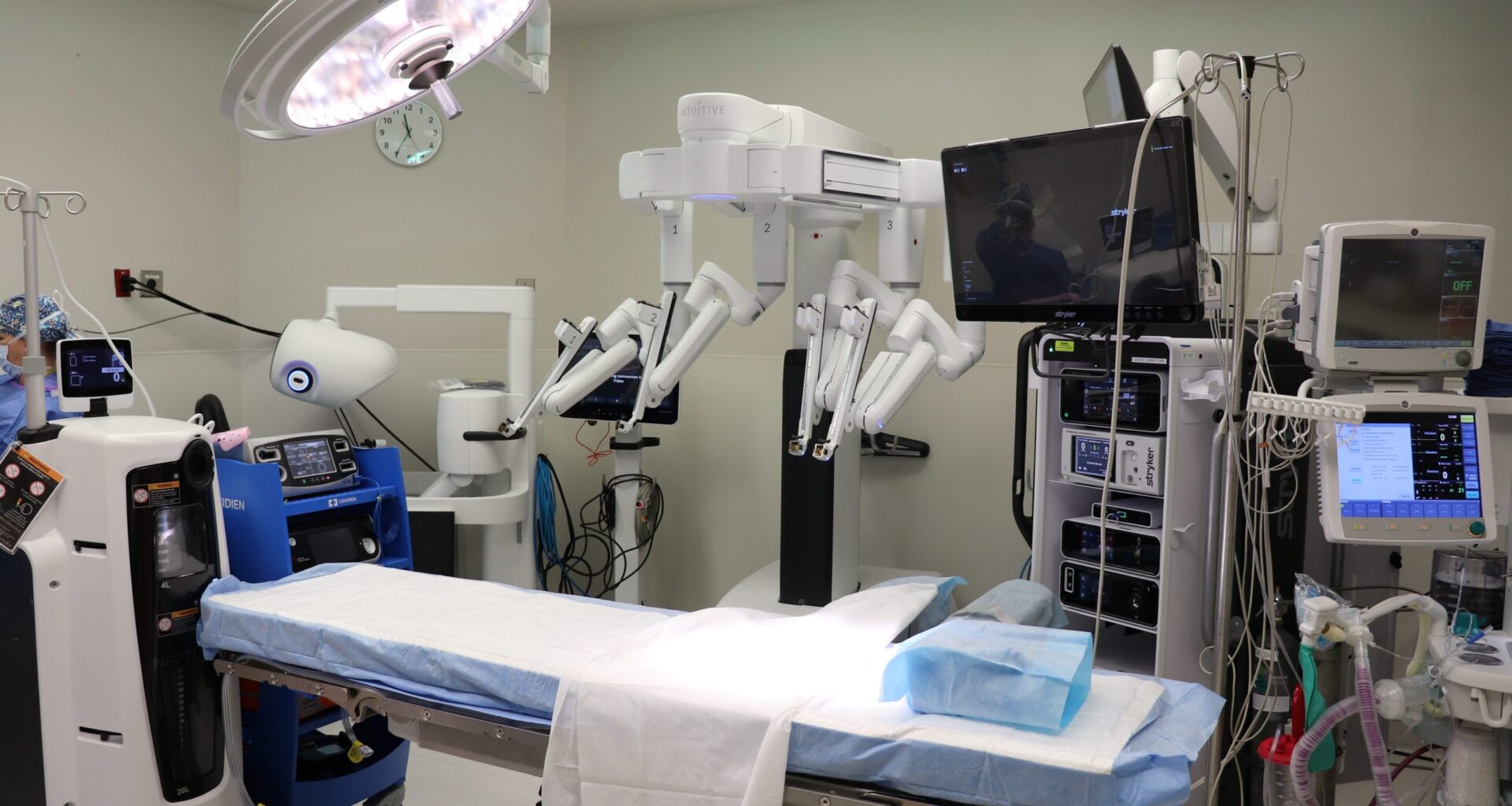
New advanced robots are allowing surgeons to operate faster and more accurately at Medical City hospitals in Alliance and Arlington, health care system officials said.
Using these high-tech tools does not mean replacing a surgeon, nurses or others, said Dr. Ashley Mekala, general surgeon for Medical City Alliance. It’s about efficiency, he stressed.
“A surgery that may take an hour and a half now just takes 45 minutes,” Mekala said. “Patients are in and out of the OR (operating room) faster. They’re back with their families faster, and it’s a safe and efficient way to do it.”
The incorporation of advanced technologies for surgeries is not a new concept. The most successful robotic surgical system, da Vinci, was launched stateside in 2000, according to the National Center for Biotechnology Information.
The value of these systems has grown, alongside the emergence of artificial intelligence-assisted robots.
A 2025 study from the National Center for Biotechnology Information found that AI-assisted robotic surgeries created a 25% reduction in operative time, a 40% improvement in precision and a 15% decrease in patient recovery times.
Mekala has conducted the most robot-assisted surgeries at Medical City Alliance with 500 operations. The da Vinci 5 was deployed at his hospital over the summer, which he uses specifically with laparoscopic surgeries, a minimally invasive procedure to look for problems in the stomach area.
Mekala is capable of doing the surgery without support but compared it to using regular headlights while driving at night instead of turning on high beams.
Surgical staff use different robots depending on specializations.
Dr. Brandon Levy, an orthopaedic surgeon at Texas Bone & Joint, which is affiliated with Medical City Arlington, uses the Mako robot to assist in knee and hip replacement surgeries.
Levy will use it for shoulder replacements later this year. Tapping the machine for help is a no-brainer because of how precise it is with specific cuts and angles needed for these operations, he said.
“Using the robot helps a lot with some of the variables we were dealing with before we had the robot,” Levy said.
Nationwide, about 22% of all surgeries implement robots, according to UCSF Health, University of California San Francisco’s academic medical system.
Usage continues to increase as the newest surgeons entering the field are generally trained in robotic assistance for operations, Mekala said.
The da Vinci and the Mako are only a handful of the advanced robotic systems available at seven Medical City hospitals in the area, officials said. Additionally, the majority of the health system’s hospitals use minimally invasive robotic surgical options, according to a Medical City Healthcare’s press release.
“I’m not going to say it’s the gold standard yet, but I do feel like it is going to be sooner than later,” Mekala said.
Nevertheless, the machine is only as good as the operator. And although the technology continues to advance, a medical professional’s guiding hand is still a requirement, Levy said.
“Some people hear ‘robot’ and they think, ‘Oh God, the surgeon’s not even doing it. They’re just plugging in something and letting the robot control it,’ which is not true,” he said. “We’re just using it as another tool to guide us in the surgery.”
Ismael M. Belkoura is the health reporter for the Fort Worth Report. Contact him at ismael.belkoura@fortworthreport.org.
At the Fort Worth Report, news decisions are made independently of our board members and financial supporters. Read more about our editorial independence policy here.
This <a target=”_blank” href=”https://fortworthreport.org/2026/02/04/how-robots-help-in-surgery-at-medical-city-hospitals-in-tarrant/”>article</a> first appeared on <a target=”_blank” href=”https://fortworthreport.org”>Fort Worth Report</a> and is republished here under a <a target=”_blank” href=”https://creativecommons.org/licenses/by-nd/4.0/”>Creative Commons Attribution-NoDerivatives 4.0 International License</a>.<img src=”https://i0.wp.com/fortworthreport.org/wp-content/uploads/2021/04/cropped-favicon.png?resize=150%2C150&quality=80&ssl=1″ style=”width:1em;height:1em;margin-left:10px;”>
<img id=”republication-tracker-tool-source” src=”https://fortworthreport.org/?republication-pixel=true&post=395462&ga4=2820184429″ style=”width:1px;height:1px;”><script> PARSELY = { autotrack: false, onload: function() { PARSELY.beacon.trackPageView({ url: “https://fortworthreport.org/2026/02/04/how-robots-help-in-surgery-at-medical-city-hospitals-in-tarrant/”, urlref: window.location.href }); } } </script> <script id=”parsely-cfg” src=”//cdn.parsely.com/keys/fortworthreport.org/p.js”></script>