
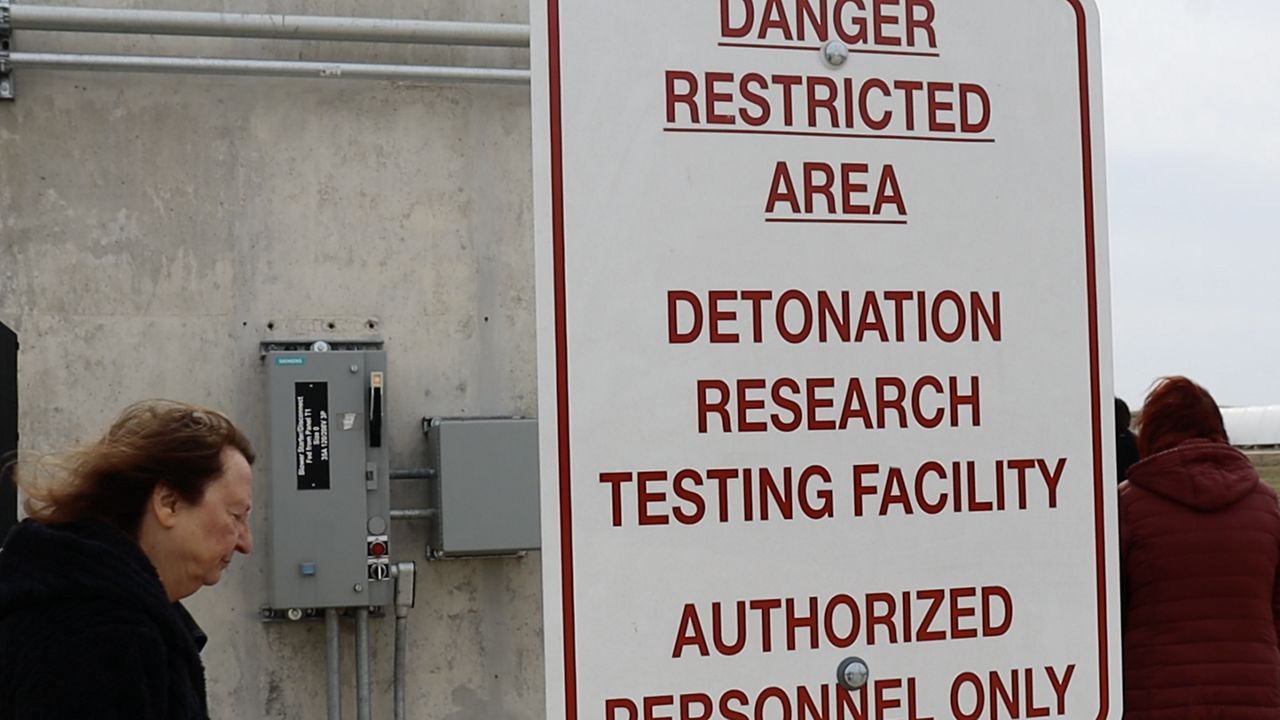
TEXAS — Tucked in the back corner of Texas A&M University’s (TAMU) Rellis Campus is a long, rusty tube. Connected to pipes supplying methane gas, at the turn of a key, the tube lets out a puff of smoke, dirt and a powerful roar.
The site is used to create and study detonations.
“It’s probably the largest research explosion and detonation tube like this in the world,” said Elaine Oran.
Oran is a professor of aerospace engineering at TAMU, helping oversee the tests and research done at the detonation facility for just over a year.
“I think you have to begin with this first question by asking what an explosion is and what a detonation is,” she said. “An explosion is just a big boom; it generates a large shockwave. But a detonation is a very particular kind of explosion. It’s driven by energy release behind it.”
She added that “detonations are explosions that are driven by chemical energy release, nuclear energy release or even lasers putting energy behind the shockwave, making it go faster and faster.”
TAMU published videos online showing the strength and intensity of the detonations. From the outside, people can see the large puff of dust coming off of the tube. But from the inside, people can observe the shockwave and the energy it behind it as it vibrates from one end of the tube to the next.
The force showed in the videos applies to research in multiple fields.
“Detonations occur at just about every scale,” Oran said. “Stars through to tiny, little things here on Earth.”
The formation of new materials is another observation the team has made.
“One of the things that are created in these waves are called nano-diamonds, so they’re very small diamonds,” said Scott Jackson, an associate professor of aerospace engineering.
Jackson added: “If you have a larger facility, you can keep the pressures and temperatures high enough for longer that you can make these at larger scales or different variants of them.”
One of the fields where the test findings are applied is in industrial explosion safety — Oran cited the Buncefield Fire in 2005 — and the Sago Mine explosion in 2006.
“The kind of information that we’ll be getting out of this, as far as practical safety concerns, is very important for designing large systems,” Oran said. “It affects regulations; in some problems, it will affect whether a material is safe to put on your body – it goes that deeply.”
The tests conducted at the detonation site aren’t done by Oran and Jackson alone. They are joined by four students across the entire TAMU system: Emma Stewart, Tugba Karachau, Zach Widman and Clay Hicks.
There’s a collective joy when they’re able to conduct a test and feel the strength of the detonation tube firsthand.
“You could feel it in your stomach,” said Widman, a first year PhD student. “It’s just like a deep rumbling in your stomach when it detonates, and you know that [that] was different.”
The group of students enjoy more than just the nature of their exclusive field of study. The hands-on experience is another asset to their program, like manipulating detonations with steel baffles.
“We can remove these baffles, we can change the spacing, and we can see how that all affects our detonation properties,” Widman said. “Speed, the length of DET, and those factors.”
The facility also proves to be a learning process when it comes to day-to-day operations.
The facility is expected to open operations to private companies later this spring.