
Keke Wyatt performs during a taping of Black Divas, a performance and film project created by Austin artist Ghislaine Jean that centers Black womanhood and motherhood, airing on Austin PBS.
Provided by Ghislaine Jean
A little over a week before her new special “Black Divas” was scheduled to premiere on PBS Austin, as the city was murmuring about an approaching winter storm, Ghislaine Jean was talking about singing. Not the kind meant for applause, not spectacle, but the kind that happens when women gather in rooms that look ordinary until they aren’t — when bodies loosen, grief surfaces and something unnameable begins to hum beneath the noise.

It is the kind of singing that has always existed alongside danger, especially for Black women in Texas, where joy and vigilance coexist by necessity.
Article continues below this ad
Jean — known publicly as Qi Dada, a musician, spiritual facilitator and “priestess of the party” — has built a career around those rooms. To outsiders, her work can look like celebration, like more Austin events promising release. But for years, those who have come to Body Rock, the recurring happening she co-hosts with husband Jonathan “Chaka” Mahone, have understood something else is happening: people cry in her arms; stories of loss, depression and survival emerge; the party reveals itself as a container.
Austin hip-hop duo Qi Dada and Chaka use art and music to celebrate the city-designated “Riders Against the Storm Day” as a community day of healing.
NAAS
Founded in 2010, Body Rock ATX began as a dance party shaped by the call-and-response rhythms of hip-hop’s block-party origins. Over time, it became something else. As the party moved from room to room across the city, it gathered Black and brown Austinites, and the act of dancing began to feel less like entertainment than communion. This month, Body Rock marks its 16th anniversary with a Feb. 13 celebration at the 29th Street Ballroom — a milestone that quietly attests to how long the party has functioned as both refuge and ritual.
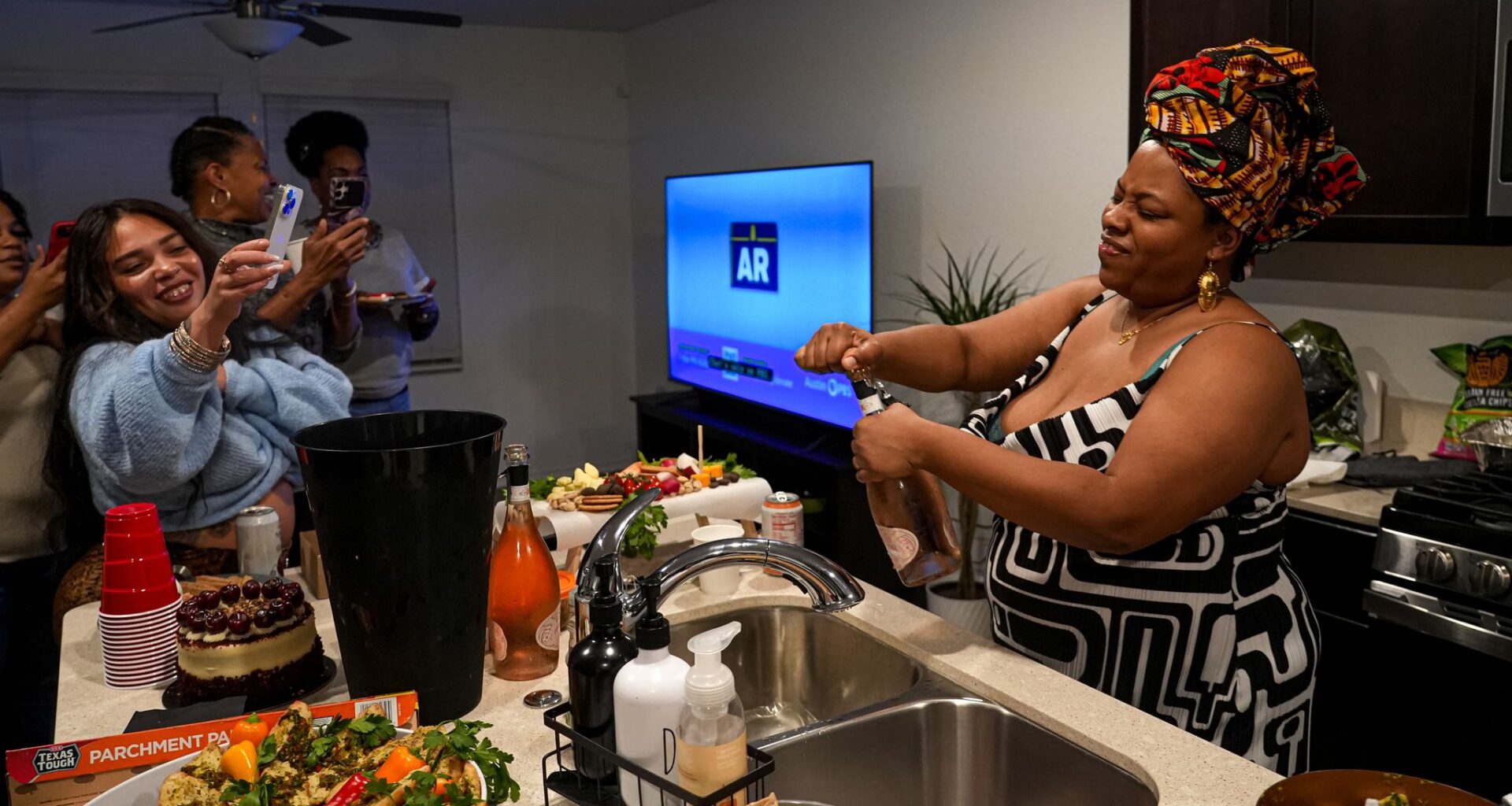
Ghislaine Jean, producer and creator of Black Divas, opens a bottle of champagne at a watch party at a vacation rental in Southeast Austin on Monday, Feb. 2, 2026. The second aired installment of Jean’s program “Black Divas” aired on PBS on Monday night.
Aaron E. Martinez/Austin American-Statesman
Ghislaine Jean, producer and creator of Black Divas, left, serves champagne for Imani Aanu, a guest experience specialist for Black Divas, right, during a watch party at a vacation rental in Southeast Austin on Monday, Feb. 2, 2026. The second aired installment of Jean’s program “Black Divas” aired on PBS on Monday night.
Aaron E. Martinez/Austin American-Statesman
That same philosophy now anchors “Black Divas,” a performance and film project that has become a PBS special airing on Austin PBS. The newest installment premiered on Monday and airs again on Feb. 10. It is also available to stream on pbs.org. It is framed as a celebration of Black womanhood, voice and artistry — but its center of gravity is motherhood, specifically Black motherhood in Texas, where the risks surrounding pregnancy and birth remain stark and unequal.
Article continues below this ad
According to the CDC’s 2023 report, Black women die at a rate of 50.3 per 100,000 live births — just over four times higher than the national average of 12.5 for other women.
The project arrives at a moment when conversations about Black maternal health often flatten into statistics, stripped of interiority. “Black Divas” insists on something else entirely: feeling as a form of knowledge, art as survival, glamour as care.
Jean says the first performance of Black Divas functioned as a benefit, raising funds for Delivering Unto You, a local doula and parent-support education program founded by Black doula Janice Goodwin (formerly Denise Washington). That initial iteration was a live event, recorded and later submitted to PBS as proof of concept.
Article continues below this ad
After birth, the work begins
Jonathan “Chaka” Mahone and Ghislaine “Qi Dada” Jean, the married couple behind Austin hip-hop duo Riders Against the Storm, pose for a portrait at Austin City Limits Music Festival.
Dave Creaney for American-Statesman
Jean traces the origins of the project to her own transformation into motherhood. She gave birth in 2022 to her son, Embele, after what she describes as an exquisite pregnancy followed by a long, difficult labor. She was prepared — two doulas, a midwife, a student midwife, a husband and a community trained not only to witness but to protect. Still, the aftermath carried its own weight: exhaustion, shame, the quiet panic of not producing milk quickly enough, the pressure of keeping a new life alive while your own sense of self rearranges molecularly.
“There’s this instant difficulty that can come,” Jean says. “And with it, this feeling of failure. Like you did everything right — and it still didn’t go the way you imagined.”
Article continues below this ad
What struck her most was the absence of art that spoke to that reality. Not representation in the broad sense — faces on screens, bodies included — but something more elusive. “I didn’t feel respected in how I felt,” she says. “You can meet a quota and still erase the interior.”
This, too, belongs
Keke Wyatt performs during a taping of Black Divas, a performance and film project created by Austin artist Ghislaine Jean that centers Black womanhood and motherhood, airing on Austin PBS.
Provided by Ghislaine Jean
“Black Divas” became her response to that void. Drawing on the same mechanics she has long used to convene community — music, ceremony, shared vulnerability — Jean centered the work on birth, postpartum experience and maternal health disparities affecting Black women in Texas. She collaborated with Black doulas and mothers, listening to stories that rarely make it to public stages.
Article continues below this ad
One moment in the PBS special lingers: a segment built around lullabies, where mothers were asked what song they first sang to their babies. One woman answered that she never sang at all — she was too deep in postpartum depression, too focused on survival. Rather than framing that as absence or failure, “Black Divas” transforms it into choreography, into collective motion, into something held and witnessed.
“To put that story on national television,” Jean says, “and to make it beautiful — not to sanitize it, but to honor it — that matters. It says you’re not alone. It says this, too, belongs.”
The musical structure of Black Divas is equally intentional. The project moves through opera, gospel, R&B and classical traditions — genres often siloed, particularly within Austin’s music ecosystem. Jean describes the choice as both personal and political. Within classical and other traditionally European musical traditions, Black women are even less visible. “The women that I know in those sectors are phenomenal,” Jean says. “They’ve committed themselves tremendously. And if they weren’t going to be centralized and boosted and highlighted, then I was going to do that.”
The aesthetic choices reinforce that conviction. The show looks glamorous — custom design, lush staging, a format that nods to late-night talk shows rather than solemn panels. Jean insists this is reclamation. “Motherhood doesn’t mean you disappear,” she says. “Birth workers are glamorous. Care is glamorous. Repair is glamorous.”
Article continues below this ad
In Texas that reframing feels quietly radical. For Black women, the danger is real, Jean acknowledges. It is why preparation matters, why community matters, why singing has always mattered. Historically, when Black families faced separation, surveillance and loss, they gathered. They rocked. They hummed. They turned unbearable weight into something shareable.
Not for export, but for return
Audience members watch a taping of Black Divas, a performance and film project created by Austin artist Ghislaine Jean that centers Black womanhood and motherhood, airing on Austin PBS.
Provided by Ghislaine Jean
“Black Divas” operates as what Jean calls an echo chamber — not for export, but for return. Black women, she argues, have long been expected to give endlessly: culture, sound, leadership, resilience. This work insists on reverberation, on creativity circling back to replenish its source.
Article continues below this ad
The word “diva,” in this context, sheds its caricatures. Jean returns to its original meaning: divine. Opera singers were called divas because their voices opened something celestial. Birth, she notes, does the same. “Six people in a room,” she says, “and then suddenly there are seven. If that’s not magic, what is?”
Jean situates herself within that lineage deliberately. “I see myself fully as a Renaissance woman here in Austin,” she says. She speaks about the importance of record-keeping, of being specific about what has happened here. “As I matriculate in my work, and outside of Austin, it’s good that the archive of what I’ve done here historically is clear — my particular stance, and my well wishes for the community.”
As public media contracts and women’s health remains politically fraught, “Black Divas” persists — quietly subversive, deceptively joyful. It looks like a show. It feels like a party. Underneath, something else is happening: a gathering, a remembering, a refusal to let interior lives go unseen.
Article continues below this ad
In Austin, on the eve of storms both literal and structural, Jean’s work suggests another way forward. Not louder. Not harder. But deeper — into song, into care, into the divinity of staying alive together.