
Richardson could see a budget shortfall in the next few years due to the statewide cap on property tax increases, City Manager Don Magner warned City Council at the Dec. 15 meeting.
“This is a regionwide, statewide issue that is impacting municipalities, and we’re finally seeing the trending of what that looks like,” council member Jennifer Justice said.
Some context
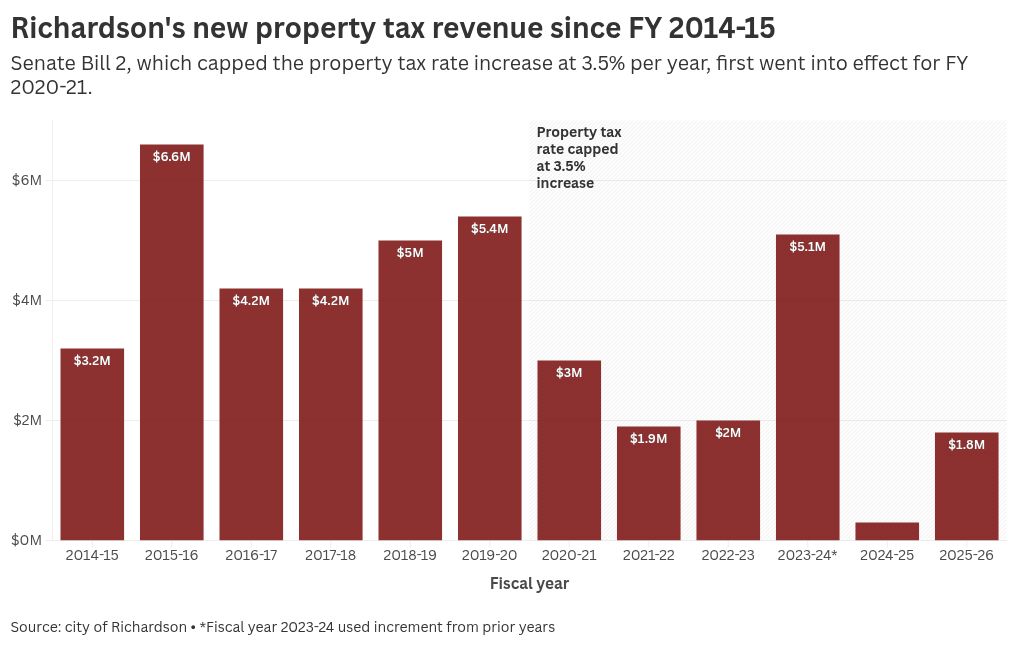
The Texas Property Tax Reform and Transparency Act of 2019, also known as Senate Bill 2, required voter approval for local governments to increase property tax revenue by more than 3.5% a year, effectively capping their property tax revenue.
Under prior law, the cap was set at 8% increase per year.
After six years of the cap in place, Magner, who co-chairs the North Texas Commission’s local government policy task force, said Richardson and cities across the state are experiencing a “compounding effect” of limited revenue growth.
“[It] has fundamentally changed municipal finances across Texas and here locally has fundamentally altered our long-term budget outlook,” Magner said.
The budget could get even tighter if state legislators lower the property tax increase cap again during the 2027 legislative session. Earlier this month, Lt. Gov. Dan Patrick announced his plans to oversee legislation in 2027 that further cuts back the property taxes charged by local governments. Both the Senate and the House attempted to pass legislation in the 2025 session to lower the tax increase cap to 2.5% and 1% respectively.
“It’s time to drive a stake through the heart of local property tax hikes for good,” Gov. Greg Abbott said at a Nov. 9 campaign event.
Zooming in
Magner estimated that Richardson has experienced a cumulative loss of $21 million in new revenue as a result of SB 2.
In the six years prior to SB 2, Richardson averaged $4.76 million in new property tax revenue each year, he said. Since fiscal year 2020-21, the first under the new legislation, the average new property tax revenue has dropped to $2.35 million a year.
“I believe that Richardson is at a crossroads,” Magner said.
Magner presented a model to City Council of the tax cap’s future impact. Even under the most favorable circumstances—assuming strong revenue growth, minimal expenditure growth and no new city programs—Richardson’s net new revenue will remain under $1 million every year through fiscal year 2031-32.
In November, council approved a new Fire Department Strategic Master Plan to guide expansion over the next eight years for the Richardson Fire Department. If that is the only program the city pays for in the next six years, Magner said, then Richardson will already be working at a shortfall.
“Between now and the end of FY 2032, we will have almost a $3 million deficit that we will be trying to work with,” Magner said. “And that’s with adding no new programs or services. Not one new dollar for a new program or service.”
What they’re saying
Mayor Amir Omar said that Magner’s models crystallized what an “incredibly awful policy” SB 2 has been, and pointed out that there are very few cities in Texas that are not impacted.
“This is a result of lazy governance,” council member Justice said. “Our state legislators wanted to be able to check a box and tell you all that they gave you property tax relief, and that’s not what really happened here. What they’ve done is they’ve gutted the cities that you choose to live in.”
Council member Joe Corcoran said that one issue—like Richardson’s water system upgrades this year after a 2024 malfunction—could wipe out almost all of the new revenue in one year.
“Some of the programs that you love could be impacted or we may have to make hard decisions to do away with them because of what your state legislators are doing,” Justice said. “We’re just not going to be able to be the Richardson that you’ve all come to love.”
What’s next
Magner suggested a comprehensive review of current programs and services to ensure that they are aligned with City Council priorities. He said the city needs to prepare for “very probable” limits on revenue or expenditures, as well as new unfunded mandates, from the next legislative session in 2027.
Magner presented another model that showed the city’s revenue if the Legislature reduced the cap on property tax increases to 2.5%, which was pushed in the last session. With robust revenue and modest expenditure assumptions, Magner said the city will run a shortfall in fiscal year 2027-28, which will only increase with the addition of any new programs.
He said this issue will be at the forefront for city staff as they start work on the fiscal year 2026-27 budget.
“To introduce a new program or service in the future, with the modeling we just described, we will need to either identify new revenue sources or we’re going to have to reduce funding for existing programs and services,” Magner said. “This is just simple math.”
Magner, echoed by several council members, said it will be crucial to demonstrate the local impact of the property tax cap, and the danger of further limits, to legislators in 2027.
“This modeling, replicated across dozens if not hundreds of cities, will hopefully paint a picture for the state legislators that cannot be ignored,” Magner said.