
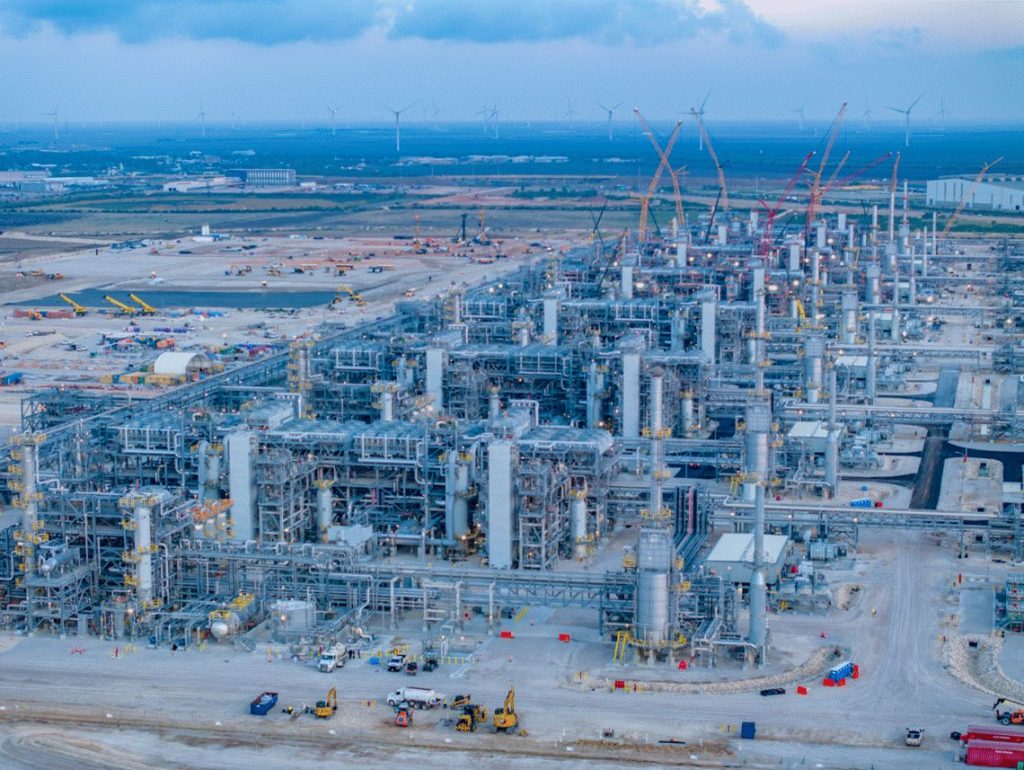
In June 2025, Cheniere announced plans for the CCL Stage IV expansion project to further boost capacity at the Corpus Christi facility.
After that, Cheniere also sought approval from FERC to initiate the environmental pre-filing review.
Corpus Christi Liquefaction (CCL), Corpus Christi Liquefaction Stage IV, and Cheniere Corpus Christi Pipeline have formally submitted an application with FERC to site, construct, and operate the new project expansion this week.
Cheniere’s Corpus Christi liquefaction terminal consists of three trains, each with a capacity of about five mtpa, while Cheniere is also building the Corpus Christi Stage 3 expansion project, which includes seven midscale trains, each with an expected liquefaction capacity of about 1.49 mtpa.
This expansion is expected to be completed this year as Cheniere already launched commercial operations at four trains and is nearing completion of the fifth.
In addition, Cheniere made a positive final investment decision last year to build two more midscale trains under the Midscale Trains 8 & 9 project.
Upon completion of these expansion projects, which are under construction, and together with expected debottlenecking, the Corpus Christi LNG terminal is expected to reach over 30 mtpa in total liquefaction capacity later this decade.
24 mtpa
Cheniere and its units noted in the application that the proposed Stage IV expansion consists of four liquefaction trains with an estimated liquefaction capacity of approximately 1,200 billion cubic feet per year (“Bcf/y”), and two 220,000-cbm LNG storage tanks.
“While the actual per train production is likely to vary over time due to a multitude of factors, including ambient temperatures, feed gas composition, and operational efficiencies, the anticipated production capacity for the CCL Stage 4 project is projected to be approximately 6 million tonnes per annum (mtpa) per train, for a maximum aggregate of approximately 24 mtpa,” Cheniere said.
Moreover, the project includes three ground flares, a marine terminal that will accommodate LNG carriers with cargo capacities up to approximately 200,000 cbm, a terminal supply line, and other associated infrastructure.
The project is anticipated to increase maximum vessel traffic by approximately 390 LNG carriers per year.
Chenieere said the project will be located largely within areas previously authorized by the
Commission for the construction and operation of the CCL terminal and an area adjacent to the terminal, which was previously used for an industrial facility.
 Image: Cheniere
Pipeline
In addition, Cheniere Corpus Christi Pipeline is seeking approval to construct, own, operate,
and maintain new interstate natural gas pipeline, compression, and related facilities in San Patricio County, Texas.
This project will include a 25.8-mile (41.5km) long, 42-inch diameter pipeline loop, as well as
compression, metering, and interconnect facilities.
The CCPL expansion project will be partially collocated with CCPL’s existing 48-inch-diameter pipeline, and will extend from CCPL’s new proposed compressor station.
It will be capable of transporting an average of approximately 2.75 Bcf/d of natural gas to the CCL terminal and the CCL Stage 4 project.
CPL estimates that the total cost of constructing the CCPL expansion project will be approximately $676,380,295.
Also, CCPL has determined that it no longer intends to construct the previously approved 21-mile long, 42-inch-diameter pipeline loop (Stage 3 Loop).
This facility change reduces the previously certificated capacity of the Stage 3 pipeline project from 1.5 billion cubic feet per day (Bcf/d) to 1.35 Bcf/d, all of which remains subscribed, on a long-term basis by CCL, Cheniere said.
Cheniere requests that the Commission grants the “instant application by May 2027, and that the Commission allow ten years from the date of the authorization order for applicants to complete construction and place the projects’ facilities in service to account for any construction schedule delays.”