
Funding for Austin’s social service programs is in line for further cuts, and the city is now evaluating how to both save and reduce portions of its tens of millions of dollars in annual spending.
“I know we’re just at a very challenging time as an organization, and I know these are going to be difficult decisions. But I do feel like that if we all come together, all of the community, all of one voice and all of the partners, and we all work on this together, we can get to a very good place,” Assistant City Manager Stephanie Hayden-Howard said Feb. 4.
The setup
Last year, City Council originally passed a fiscal year 2025-26 budget with significant investments in social services like homelessness response, public health programming, violence interruption and resident assistance.
That added spending was backed by a tax increase presented for voter approval through Proposition Q. However, most of the funding anticipated by council was stripped away in a budget rewrite after voters rejected the tax measure.
“That was heartbreaking for me personally, to know that subsequent to failure of Prop Q that we essentially balanced our budget on the backs of our social safety net,” council member Vanessa Fuentes said.
After the election, City Manager T.C. Broadnax outlined how those millions of dollars would be removed. Further cuts are on the horizon as Austin works toward what several officials have called a social services “reset.”
The approach
City budget officials are now evaluating dozens of social service contracts totaling tens of millions of dollars. Daniel Culotta, assistant director of Austin’s budget office, said the city is filtering contracts through a three-tiered review process designed to:
First, identify “non-negotiable” contracts that must be funded under legal or structural obligations.Then, focus on streamlining programs through an efficiency process to find services that can be adjusted with consolidation, realignment or transfers.Finally, grade contracts based on their financial, strategic equity and other values.“We want to move through these tiers. And essentially what we’re trying to do with this framework … is trying to create the least amount of disruption in the service ecosystem that residents experience across the metro area that we can,” Culotta said.
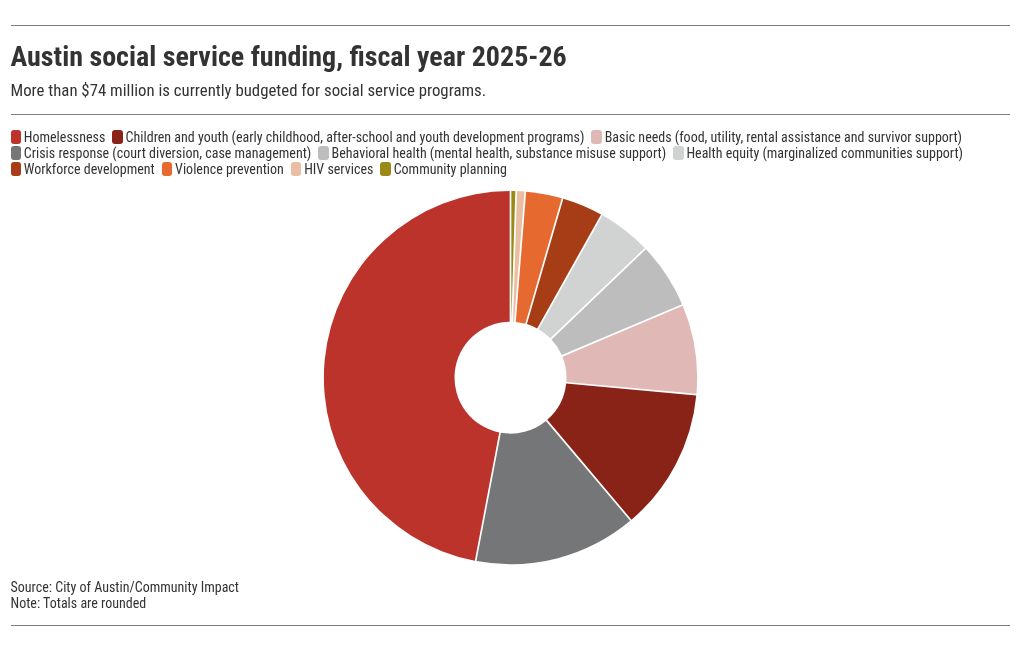
Overall, the city’s ongoing multipart assessment has already inventoried nearly 170 past contracts worth more than $200 million for consideration. More than $74 million is reserved for social services in FY 2025-26 alone, and that total is expected to be further impacted in FY 2026-27, which begins in October.
 So far, the budget team found some funding that’s relatively out of line with other major Texas cities as well as peer cities in other states. For example, a far higher share of Austin’s general fund—the roughly 25% of the budget that includes public-facing services—goes to social services, while other cities receive more support from grants or taxes for those purposes.
 Austin uses more of its general fund budget for social service programs than comparable cities. (Courtesy city of Austin)Austin also spends more on homelessness services and behavioral health in relation to entities like county government or local health districts elsewhere, while lacking more established relationships across jurisdictions.
“Although we’ve done that in some spaces, the other peer cities that you look at have formalized, structured agreements on who’s going to do what. And that’s just not something that we’ve developed in our community so far,” budget Director Kerri Lang said.
 More social service spending in places comparable to Austin is generally split between local governments and other entities. (Courtesy city of Austin)Next steps
Staff recommendations for next steps will be released in early spring, with public updates to council following in May or June. Final budgeting decisions will be taken up in the summer ahead of the spending plan’s adoption in mid-August.
The continuing review is one of several efficiency measures that moved forward in the wake of the Proposition Q outcome, from an internal technology update and optimization project to new City Council spending policies and citywide auditing. As evaluations moves forward, Fuentes said she also wants council members to help guide the changes.
She laid out a proposal, unanimously advanced by council’s Public Health Committee on Feb. 4, adding further standards to the process. That policy would have contracts graded based on several directives and plans like the Austin/Travis County Community Health Assessment, see staff pursue further cost-saving measures, and give residents more chances to share their perspectives on any changes or priorities.
Fuentes said it’ll also be important for any cuts to be clearly linked with potential outcomes in the community, as losses to one program could increase need for others.
“If the city doesn’t fund that service, where else might we be shifting the cost? Either to our emergency services, to our legal system, to our jails,” she said. “Somehow, somewhere our everyday taxpayer is going to absorb the costs, and so we have to have a way to capture that information as well.”