
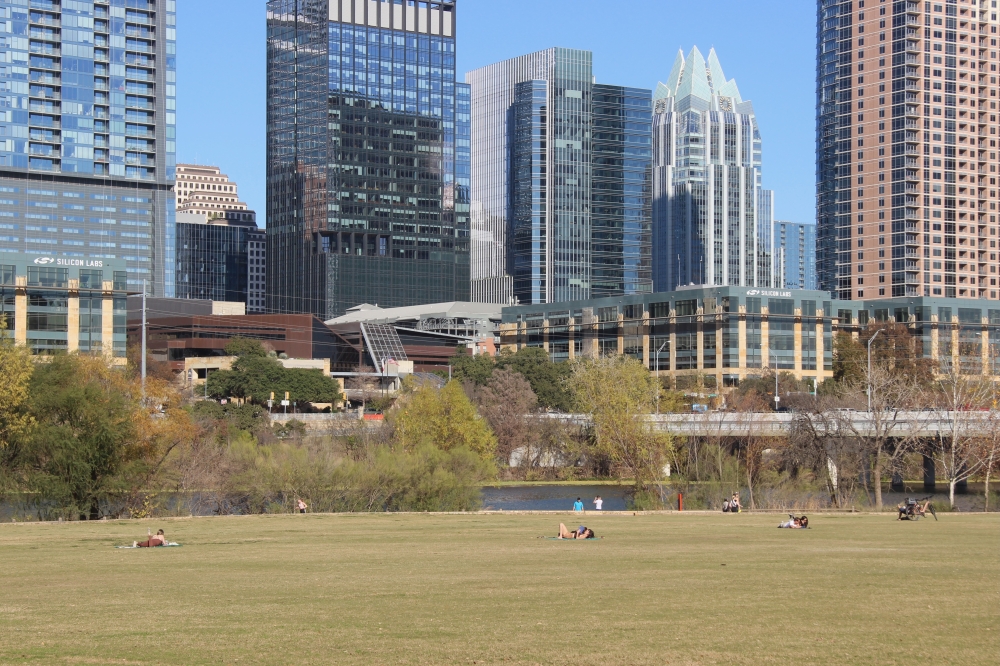
Austin’s supply of parks and open spaces is often referenced as one of its most cherished amenities. But after years of population growth, it’s become more challenging to meet rising recreational needs.
The city prioritizes all residents living within 10-minute walks from a park and offering at least 24 acres of parkland per 1,000 people. Portions of city bond packages have been used to expand parkland, and Austin’s also relied on a parkland dedication system requiring developers to either pay fees or contribute land. But future acquisition funding is uncertain, especially under a new state law that slashed dedication requirements.
“Parks create community; parks are spaces for recreation, for physical health for mental health, for relief from urban life,” said Scott Grantham, Austin Parks & Recreation principal planner. “It’s going to be vital that we find a way to continue to bring parks to the people.”
How we got here
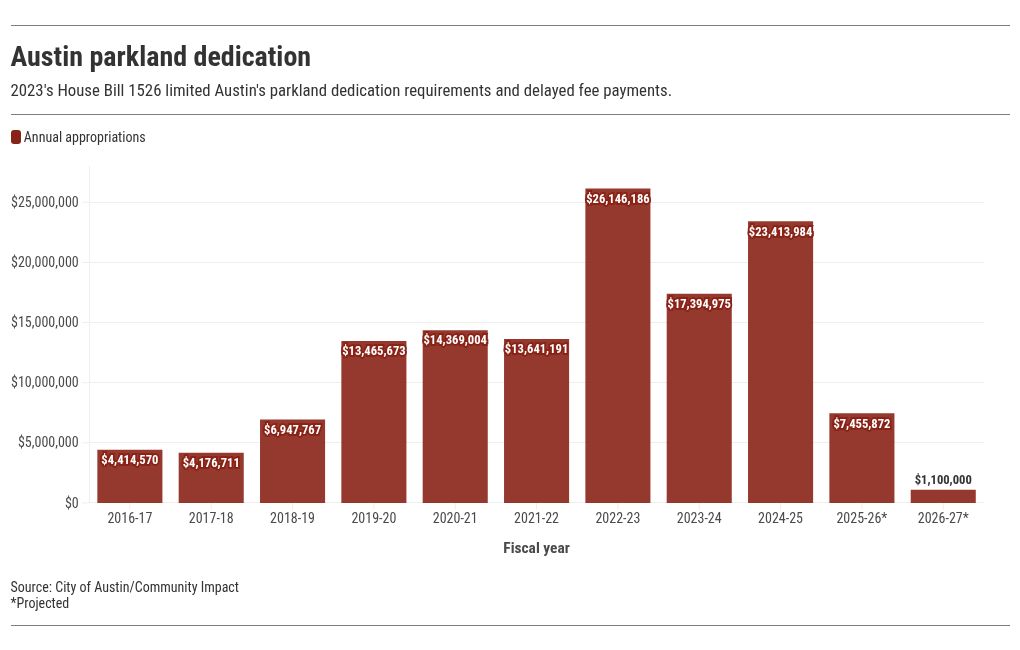
City requirements on developers rose through the 2010s and early 2020s, when developers had to donate land or pay fees equivalent to 9.4 park acres per 1,000 residents.
Limitations under House Bill 1526 went into effect in 2023. The bill targeted cities of 800,000 people or more, and lawmakers referenced Austin in their statement of intent, citing rising dedication fees and housing costs as a threat to economic growth.
This forced local officials to approve new rules at a fraction of pre-2023 levels based on location—most significantly downtown, where dedication values are more than 100 times smaller than under past policy. At the time, former council member Alison Alter said HB 1526 “gutted” the city’s system.
“Its been huge. We were originally appropriating in the neighborhood of $20 million in fees through parkland dedication [annually], and now it has been reduced to about $2 million,” Grantham said.
 The context
Much of Austin lacks the parks access that’s a stated desire of residents and city planners.
Less than 18.5 acres of parkland were available per 1,000 residents as of late 2025, 77% of the city’s per-resident goal. That gap equates to a need of roughly 5,700 acres, or almost 9 square miles.
The parks department estimated about 70% of residents remain out of walking distance from public green spaces. However, city mapping shows many neighborhoods remain “parks deficient” based on that metric, most notably in North Central and East Austin, and around the city’s fringes.
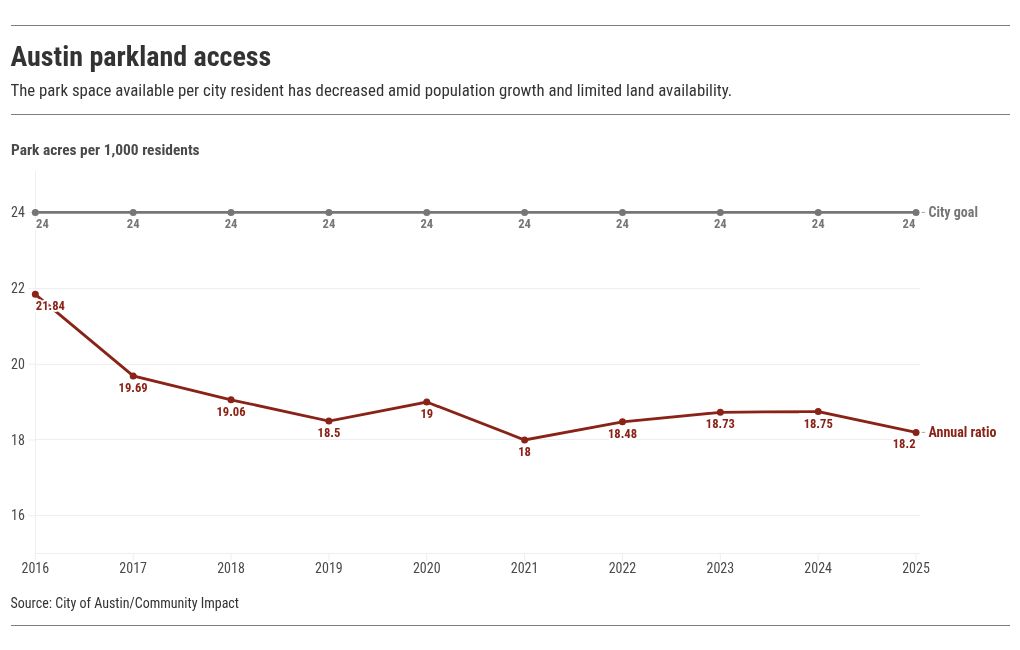 Recent strides have still been made, Grantham said. More than 1,100 park acres have been acquired since 2020, with a focus on deficient areas, resulting in almost 200,000 people citywide seeing their parkland access increase.
“We make our best effort, and we try to hit every council district,” he said. “We are actively trying to acquire land in areas that are not well-served by parks—areas where people currently, today, cannot walk to a park.”
The approach
The parks department is using available dollars to build out Austin’s network of open spaces.
Most recently, that included $45 million of the nearly $150 million 2018 parks bond. The community is now looking ahead to another bond, potentially for voter consideration this year, that could include a fresh round of green space funding.
An initial $3.9 billion project list for a bond was released last year with $100 million for park acquisitions. On Jan. 21, a reduced proposal was released for a $700 million bond, with $40 million for acquisitions out of $140 million in total for parks.
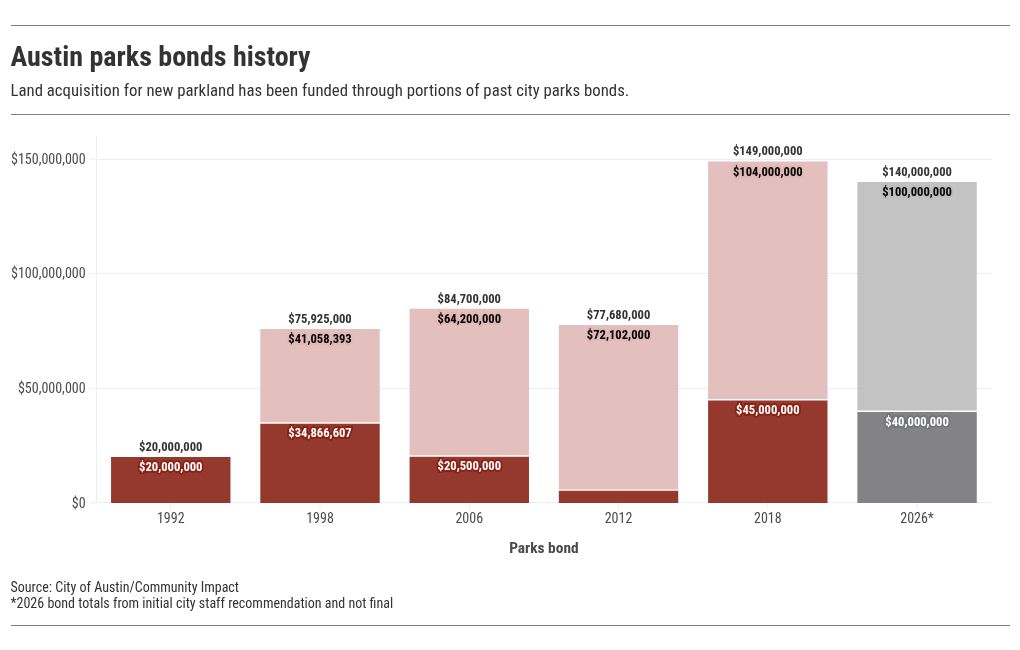 Approving more land acquisition dollars today is critical and cost-effective for growing Austin’s parkland, according to the parks department. It estimates $100 million of current investments would save $150 million over the coming decade due to property appreciation. That money can be stretched with dedication fees, Grantham said, but payments now come at lower levels.
Gong forward
City staff and a resident commission are still working to develop a final list of funding priorities for a 2026 bond. However, Austin’s tight finances also led some officials to recently question whether the time is right for the city to take on more debt, or if a comprehensive bond package should be delayed.
For now, Grantham said he’d like to be optimistic about more support in the future.
“We are still acquiring parkland, we are still building new parks, and we are still making connections. We are doing so with fewer tools, and we’re doing so with less funding,” he said. “I’m hopeful that we can get more tools and explore creative options and, let’s be honest, receive more funding.”
More information about the city’s dedication system is available online.