
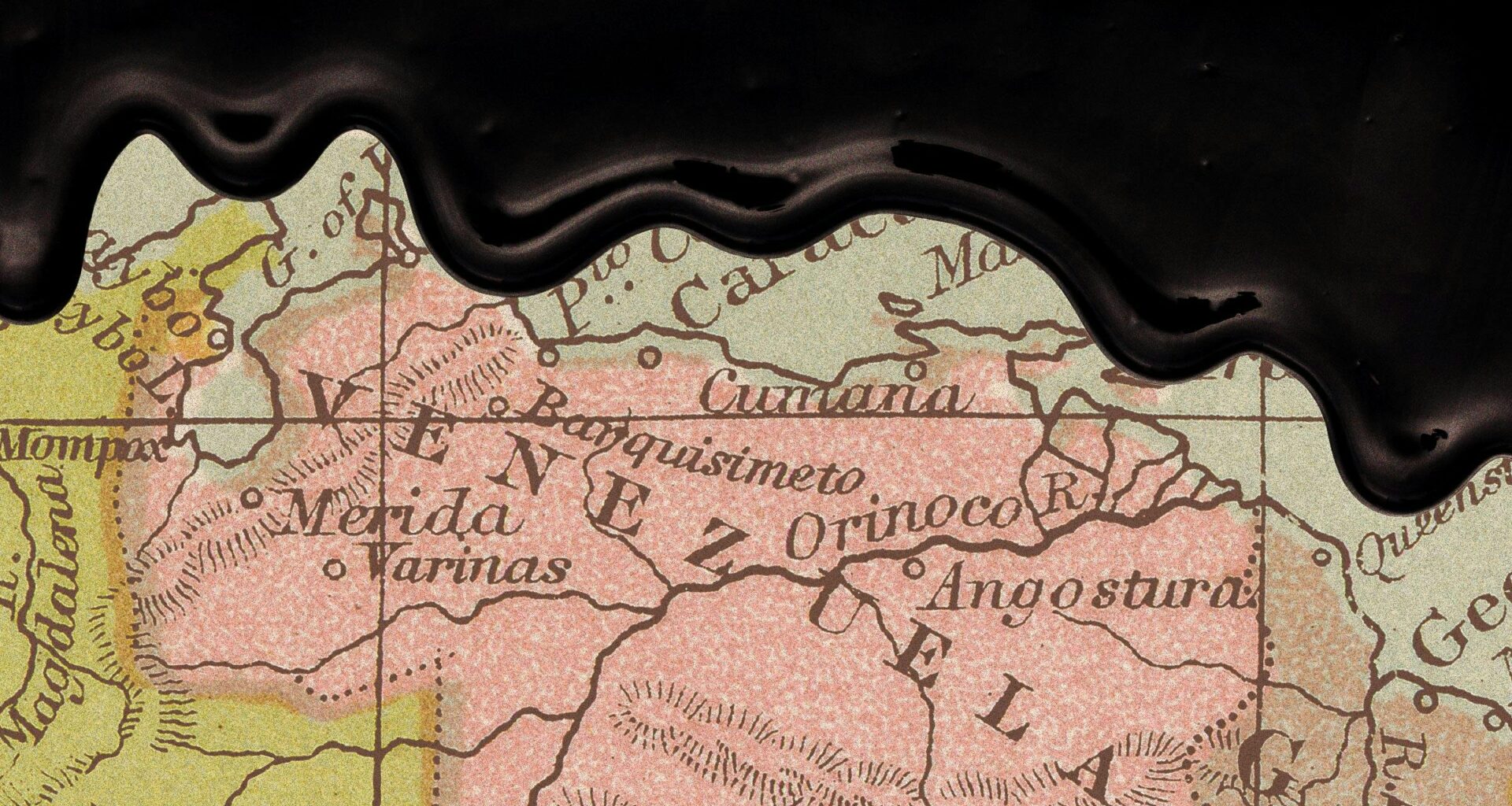
When I moved from Venezuela to Texas in my mid-twenties, so much felt unfamiliar. I missed the tropical green hues of Caracas, the relief of afternoon showers during the rainy season, the hordes of frogs and insects that provided the soundtrack to my evenings. In Austin, every yard was brown, every afternoon hot; nights were eerily quiet.
During my first tour of the University of Texas campus, on a scorching September day in 2006, we stopped to visit Santa Rita No. 1. The oil rig had been partially relocated to the campus from West Texas, to commemorate the first well drilled on public lands that the Legislature had set aside to benefit the state’s universities. Standing there, I saw something I could recognize from back home: the reverence for oil.
On a work trip a few years later, I felt strangely comfortable in the Coastal Bend. Spying the refinery towers of Corpus Christi, I was reminded of my childhood trips from Caracas to Puerto La Cruz, where my uncle Hector worked as a manager for PDVSA, the national Venezuelan oil company.
I don’t remember the first time I learned about the importance of petróleo to my homeland. In Venezuela, oil occupies such a place of honor that its significance seeps into developing brains and lodges there. As a schoolkid in the eighties and nineties, I was taught that each Venezuelan was a steward of the vast wealth secreted beneath our dirt. The path to joining the first world, we were taught, would be paved by crude. Oil was sold to me, and to every other Venezuelan child, as my birthright.
For my grandparents’ generation, and my parents’, and mine, oil is the defining characteristic of our nation—almost Cartesian: We have oil, therefore we are.
I share a birthday—April 15—with Zumaque I, the first significant Venezuelan well, drilled in 1914 in what would later be known as the Mene Grande oil field, in the Maracaibo Basin. The success of that well sparked a frenzy of international investment that funneled most oil revenue out of the country. This foreign plundering by American and European interests didn’t abate until the forties, when the Venezuelan Congress enacted legislation that forced companies to split profits fifty-fifty with the government. Even then, Venezuelan crude became essential for the American war effort during World War II, and it later kept American cars gassed up and on the road as the automotive industry boomed.
By the time the government fully nationalized oil, in 1976, the industry had ushered Venezuela onto the world stage; our country’s fortunes had become entangled with those of our largest consumer, the United States; and petróleo had forged our national identity.
My oil-soaked inheritance has been much on my mind since my mother called me in the wee hours of January 3. I’ve been in Austin twenty years now, have built a life and a career, with an American wife and daughter. My parents joined me here in 2019. “They are bombing Caracas,” my mother said. My first reaction was concern for loved ones who still live in Venezuela, horror that the dogs of war had been let slip. But after digging into the news and viewing footage of the incursion, there came, surprisingly, a small twinge of hope.
I felt conflicted, part of me rooting for the imperial designs of a wannabe tyrant like Donald Trump. I worked for a decade in liberal politics. I wrote dozens of ads for the Hillary for America campaign, warning voters of what the U.S. could become under a Trump regime. More recently, I have been telling whoever might listen about my fears that America is veering toward authoritarianism, in ways that mimic what Venezuela went through, only from the other side of the political spectrum. But when a text came through in a WhatsApp friend group at 3:26 a.m., with a photo of Trump’s Truth Social post announcing the capture of dictator Nicolás Maduro and his wife, Cilia Flores—a Machiavellian political operator in her own right—I was happy. For a moment, I celebrated.
That is what 25 years of oppression will do to you. My reaction was born of a deep resentment for a regime that has destroyed the economy, stolen elections, and imprisoned, tortured, killed, and humiliated its own citizens. More than one quarter of the population has fled, in one of the fastest-growing diasporas on the planet. I haven’t been back in ten years, and I dream of taking my baby daughter to see the Venezuelan coastline, of escaping Austin summers for the vibrant green of the Caracas Valley. Seeing Maduro in well-deserved chains offered me hope that it could happen.
I didn’t sleep that night, and the next day felt like a bad hangover as I waited for Trump’s press conference. Opposition leader María Corina Machado had just received her Nobel Peace Prize, and after the 2024 election that Maduro had so obviously stolen—which Machado won through her proxy, Edmundo González—she had been telling anyone who would listen that she was ready to enact a changeover of power. It seemed possible that the American government could enforce some sort of transition that either recognized González’s victory and placed him in charge or established a swift timeline for fair elections, allowing Machado to run. (Polls indicate she would comfortably win.)
Of course, that didn’t happen. Trump instead unleashed a mostly incoherent rant, a deranged victory lap to celebrate defeating an inept and ill-prepared target. How inept? Millions of dollars’ worth of antiaircraft weapons Venezuela had purchased from Russia had not been installed or had fallen in disrepair—not surprising, given how the regime has neglected the country’s infrastructure. Trump’s speech made clear that there would be no transition to democracy anytime soon, and that his administration’s priority was extracting as much oil as it could. When asked who would lead the country, he said, “We will run it.” I felt humiliation for my fellow Venezuelans, at how debasing it is to be under the heel of another flavor of oppression.
Trump and his administration seem content, for now, to leave the dictatorship in place, only with Delcy Rodríguez at the top. She was Maduro’s cunning vice president and the engineer of a recent softening of Venezuela’s stance toward U.S. oil interests. She’s been working with Houston-based Chevron for a while, and last July she negotiated a license renewal with the Trump administration that allowed Chevron to resume producing and selling Venezuelan oil.
Rodríguez and others in the former Maduro regime are experts at buying time. Their game now is proving to Trump that the only way to retain order in Venezuela, the only way to start oil flowing again, is to keep them in charge. The regime controls the military; it controls the informal, weaponized gangs, called colectivos, that have served as the government’s intimidation arm; and it also controls the Mafias that have infiltrated all of Venezuela’s resource industries and run the black market resource economy.
For my other home, Texas, this situation is all upside. Because of our proximity to Venezuela through the Gulf and the Caribbean, our state has always been a natural trading partner. For decades before the Maduro regime came to power, Gulf oil refineries invested billions of dollars in technology to process the type of heavy crude that’s abundant in Venezuela. When that trade trickled down to almost nothing—because of the regime’s ineptitude and corruption, and then the sanctions Trump’s first administration began imposing in 2017—those refineries had to pivot to much more expensive and less plentiful supplies, mostly from Canada. From Port Arthur to Corpus to Galveston Bay, Texas refineries are licking their chops at the prospect of a Venezuelan oil bounce back.
Texas wildcatters are also ready to pounce. The nimble, risk-prone investors see Venezuela as the new frontier. Hundreds of abandoned oil fields throughout the country still have crude to extract or are operating at a tiny fraction of their capacity. These opportunities are perfect for the wildcatter grab-and-go MO. Drilling in the Orinoco Belt, where the largest oil reserves in the world lie, will require massive investments that only the major oil companies have the resources to make. Some Big Oil executives have expressed reluctance to risk such outlays, at least until the long-term political situation in Venezuela stabilizes.
There have been some welcome signs of progress. Caving under Trump’s pressure, Rodríguez announced an amnesty bill that would pardon all political prisoners going back to 1999 (there are an estimated seven hundred still incarcerated). She also says she will close El Helicoide, a horrific torture center. In a congressional hearing last week, Secretary of State Marco Rubio reiterated that one of the goals was a “democratic Venezuela,” and a few days later, The Wall Street Journal reported that Energy Secretary Chris Wright had told oil executives that elections could be held within 18 to 24 months.
There is also hope that the oil resurgence and the relaxation of sanctions will at least bring some economic relief to the country. I asked a childhood friend if he had seen improvements in the last few weeks, and he said prices were swinging erratically day to day. Another friend told me that the lines to get gasoline had disappeared and that water service had been unusually dependable. (Before January, he had access to city water only two or three days a week.)
When American forces started to gather in the Caribbean, and after the January 3 incursion, all I heard from my fellow liberals was “It’s not about democracy; it’s all about the oil.” To which I responded (mostly on the inside): “Well, duh.” For decades, oil bought the Venezuelan regime absolute control of the country’s institutions. It also made the leaders obscenely wealthy, while the people starved.
Venezuelans tried to escape this oppression by any means possible: peaceful and violent protests, coup attempts, negotiation. We’ve even overwhelmingly won elections. None of it has worked. Now, for better or worse, Trump may be giving my people a chance to sell our oil for something we desperately need. Were we not taught that oil was our birthright? If we can’t use it to buy back our own freedom, then what is it good for?
It’s a Faustian bargain, and many of us know it. There is a further price to pay, and we haven’t received the bill yet. Oil has linked Venezuelans and Texans for decades, and my new home could play a big role in my homeland for years to come. Will it be as an ally or as another oppressor?
I’m not sure what will happen in the next month, let alone a year from now, or longer. Yet even in the oil- and bloodstained quicksand of Venezuela, stubborn dreams of a better future persist. I can’t help imagining what it would feel like to hold my daughter in one arm, grasp my wife’s hand with the other, and walk on the soft sands of La Sabana, a troop of pelicans flying low, skimming the waves of the Caribbean. Will it happen? I can only hope.
Alejandro Puyana’s writing about Venezuela has also appeared in Time and the Best American series. His novel, Freedom Is a Feast, about a Venezuelan family swept up in fifty years of the nation’s history, won the Westport Prize for Literature, among other accolades.
When you buy a book using a link on this page, a portion of your purchase goes to independent bookstores and Texas Monthly receives a commission. Thank you for supporting our journalism.
Read Next